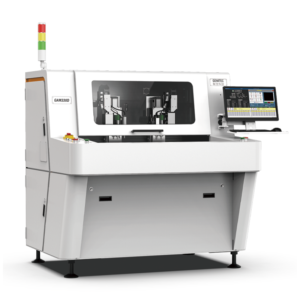

When a contract manufacturer delivered 2,400 units of a life-critical monitoring PCBA, the depaneling records showed only that a 60,000-RPM spindle was used to separate boards from a 915mm × 610mm panel. No record existed of which runout measurement was active, when the routing bit was last replaced, or what the measured-X force was on each individual board at the depaneling stage. Three months later, field failure analysis traced the root cause to microcracks that propagated from routing stress into a signal trace. A complete traceability chain from incoming panel to individual unit serial number would have identified the affected population within hours. Without it, the recall extended to every board processed in the same four-week production window.
This scenario illustrates why medical device depaneling is fundamentally a quality-critical process, not merely a manufacturing step.
Regulatory Framework and Applicable Standards
Medical device PCBA depaneling falls under strict regulatory oversight. For FDA 21 CFR Part 820 compliance, every process step in a medical device PCBA production workflow must have documented evidence of execution, and depaneling is specifically identified as requiring in-process controls with defined acceptance criteria.
The IPC-A-610 standard defines minimum acceptable criteria for electronic assemblies, and for Class III medical devices, manufacturers typically apply IPC-A-610 Rev H Chapter 10 requirements with supplementary criteria. IPC-7711/7721 addresses rework and repair of electronic assemblies, with Section 5 of IPC-7711 specifically covering depaneling procedures, requiring documented technique, tool qualification, and workmanship verification as mandatory prerequisites.
EU MDR 2017/745 introduces analogous requirements under EN ISO 13485:2016, where Clause 7.5.1 mandates that production and service provision be planned and controlled, including the validation of processes where their output cannot be fully verified by subsequent monitoring or measurement.
Mechanical Routing Parameters and Their Measurement
Routing depaneling of medical-grade PCBAs demands tighter control of mechanical parameters than general electronics manufacturing. Spindle speed for routing depaneling equipment typically ranges from 40,000 to 80,000 RPM depending on board thickness and material composition. For standard FR-4 boards up to 1.6mm thickness, spindle speeds of 40,000 to 55,000 RPM are standard; high-Tg materials or thicker boards require 60,000 to 80,000 RPM.
Feed rate directly influences the stress applied to the board at the depaneling edge. Controlled feed rates of 25–50 mm/s for routing and 15–30 mm/s for punching operations are standard; deviations exceeding 15% in feed rate directly affect the stress zone width and can induce microcracks in multi-layer boards. Thermal stress at the cut zone must be monitored, with peak temperatures limited to 80°C above ambient on the component-side surface to prevent pop-corning of moisture-sensitive packages.
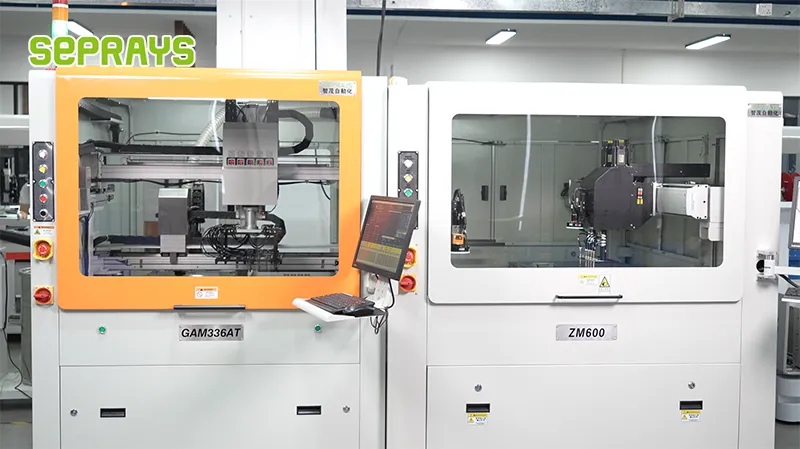
Positional Accuracy and Stress Management
Tool runout is a critical parameter that must be measured and recorded. On medical-grade depaneling equipment, runout must not exceed 0.02mm at the cutting point. A 0.03mm runout at the spindle tip generates approximately 180 micrometers of lateral displacement at the cutting edge, sufficient to exceed the ±0.05mm positional tolerance requirement for components positioned within 3mm of the depaneling edge.
For high-density medical assemblies with components positioned closer than 1.5mm from the depaneling line, laser depaneling has become the industry standard approach. CO2 laser systems operating at 9.3μm wavelength can achieve kerf widths of 30–50μm with heat-affected zones below 20μm, compared to 200–400μm for mechanical routing. This directly reduces stress transfer to adjacent components.
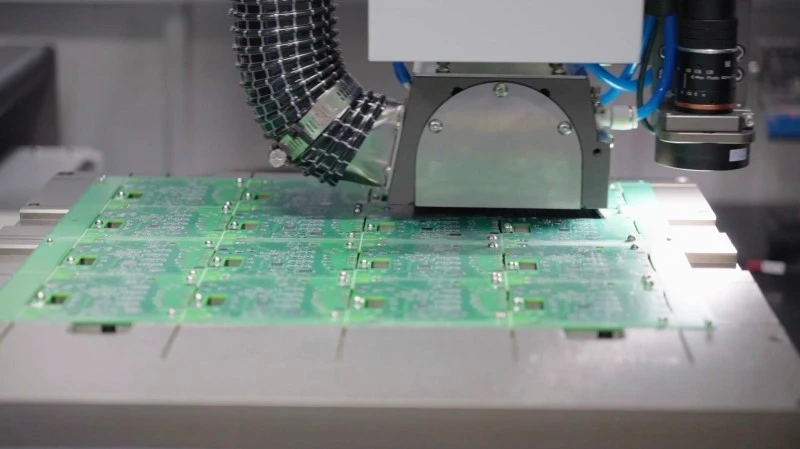
Traceability Data Requirements
A complete traceability system for medical device depaneling must capture the following data at minimum: panel lot number, individual board serial number or lot code, machine ID, spindle speed set-point and actual reading, feed rate, runout measurement value, routing bit serial number, XY depaneling position coordinates, operator ID, and timestamp. Each data point must be linked to the production lot and traceable to the individual PCBA serial number.
IPC-1601 provides guidance on handling and storage of printed boards, but the depaneling-specific data retention requirement under FDA 21 CFR Part 820 mandates retention of all production and process control records for a period of time consistent with the lifecycle of the device, with a minimum of 2 years from the date of release.
Process Validation and Parameter Monitoring
Calibration of depaneling equipment must follow ISO 17025 standards, with verification intervals no greater than 12 months. The MES system must enforce that no depaneling operation proceeds unless all critical parameters are within pre-defined acceptance ranges, with automatic rejection of out-of-specification lots.
Medical device manufacturers have faced Class I recalls when depaneling process data showed spindle speed oscillations of only 3–7% within specification but still generated a specific failure signature across a defined production window. Without traceability linking individual parameter readings to specific board serial numbers, this pattern would have remained undetected.
The core principle is that traceability in medical device depaneling is a process control tool, not merely a regulatory checkbox. Every operational parameter, tool change event, and in-process measurement must be documented and linked to the specific PCBA unit or lot. When a failure surfaces in a critical care device, quality engineers must be able to determine exactly which units are affected and what specifically caused the problem — not simply confirm that someone signed a checklist.
Recommended Equipment
Looking for proven depaneling solutions? Seprays offers a full range of equipment backed by 30+ years of industry experience. Here are two options worth considering for your production line:
- ZM30-D Multi-Tool Multi-Group PCB Depaneling Machine — One-time full LED board cutting — daily output exceeding 100,000 pieces with custom configurations
- PCB/FPC Stamping Type Board Separation Machine — Handles PCB, FPC flexible, and rigid-flex boards — versatile stamping depaneling solution
Frequently Asked Questions
I don’t have access to the article “Traceability Requirements for Medical Device PCBA Depaneling” in our current context. Could you please:
1. **Provide the article content** – paste it directly, or
2. **Share the file path** – if it’s saved locally, tell me where and I’ll read it, or
3. **Use the IMA knowledge base format** – if it’s in your IMA knowledge base, share it as `[qclaw_read_ima_content:filename](mediaId)`
Once I have the article, I’ll generate exactly 3 practical Q&A pairs in the HTML format you specified.
About Seprays
About Seprays Precision Machinery
Founded in 1993, Seprays has over 30 years of expertise in PCB depaneling solutions. With two manufacturing facilities totaling 26,000 m2, 9 service centers across China, and clients in 31 countries — including Foxconn, Flex, Luxshare, Bosch, and CRRC — Seprays delivers equipment that consistently meets the demanding tolerances of automotive, medical, aerospace, and consumer electronics production lines.
Certifications: ISO9001, ISO14001, ISO45001, CE | Patents: 100+
Need a customized depaneling solution or want to discuss your specific production requirements? Our technical team is ready to help.
Contact: jimmy@seprays.com