
A
production line running 15 different PCB panel configurations per shift, with lot sizes ranging from 5 to 200 units, faces a tooling changeover that interrupts spindle operations every 23 minutes on average. This is the operational reality of high-mix low-volume (HMLV) electronics assembly, and it exposes a fundamental tension between the efficiency assumptions built into most depaneling equipment and the flexibility demanded by today’s manufacturing schedules.
The core challenge is not speed itself. A well-tuned router-type depaneling system can achieve cycle times under 8 seconds per separation for a standard array. The problem is the overhead: fixture setup, tool selection, program recall, and in-process inspection each consume time that, in high-volume production, becomes statistically insignificant against thousands of units. In HMLV environments, that overhead recurs so frequently that it often exceeds the actual cutting time, creating a utilization efficiency curve that drops sharply as product variety increases and batch sizes shrink.
Tooling strategy is the first variable that must be anatomized. For routed separation, carbide or diamond-coated end mills in diameters from 1.2mm to 3.0mm dominate the field. Spindle speeds between 40,000 and 80,000 RPM are typical, with corresponding feed rates of 80 to 200 mm/min depending on board thickness and substrate material. FR-4 boards up to 1.6mm thick accept feed rates toward the upper end of this range, while flex-rigid constructions and thick aluminum-backed substrates require stepped reduction, often to 40-60 mm/min, to prevent delamination at the cut edge. The critical tolerance at the routed edge is ±0.05mm on the kerf width and ±0.08mm on the positional accuracy of the separation path relative to the board outline, as specified by IPC-A-600 for Class 3 electronic assemblies.
Laser depaneling has gained substantial ground in HMLV contexts precisely because it eliminates mechanical tooling overhead almost entirely. A CO2 or UV laser system operating at 355nm wavelength can ablate FR-4, polyimide, and ceramic substrates without physical contact, meaning no tool wear, no spindle runout, and no cutting forces transmitted to the panel. The kerf width for a UV laser system is typically 30-50 micrometers, compared to 0.8-1.2mm for a mechanical router. This difference is not merely dimensional; it directly translates into usable board area reclaimed from the panel perimeter, which becomes economically meaningful when individual unit costs in small-lot production are high. The trade-off is throughput: laser cutting speeds of 20-50 mm/sec are slower than router feed rates, and the heat-affected zone (HAZ) must be controlled, typically by limiting pulse energy to below 0.5mJ per pulse for organic substrates to avoid charring beyond 50 micrometers from the cut edge.
Fixture design and program management represent the non-cutting variables that most severely impact HMLV efficiency. Vacuum or pneumatic clamping systems with quick-change base plates reduce individual product changeover to under 3 minutes when properly engineered. A modular fixture system with pre-loaded reference plates for each board variant allows an operator to swap a complete setup in under 90 seconds, a capability that separates competitive HMLV operations from those running unnecessary idle time. Machine control software capable of storing 500 or more product programs with individual parameter sets, and supporting rapid recall by barcode or work order number, is no longer a premium feature but a baseline expectation. Without this, engineering time spent on program management becomes a bottleneck that outweighs any gains in cutting performance.
Stress management during separation deserves particular attention in HMLV scenarios because product variety means a correspondingly wide range of board constructions, thicknesses, and component layouts will pass through the same equipment. The mechanical shock of a punched or snapped separation can generate transient stresses of 5-15 N at the component heel, sufficient to crack ceramic capacitors, delaminate BGA solder joints, or fracture trace-to-pad connections in boards thinner than 0.8mm. Router cutting, when properly configured with a descending Z-axis plunge and controlled chip load, distributes this stress over a wider area and time domain. IPC-7711/7721 provides rework and modification guidance that references component stress limits, but proactive HMLV operations validate their specific board assemblies against shear and pull testing at the depaneling stage, with acceptable bond strength remaining above 3.5 N/mm² for Sn-Pb assemblies and above 4.0 N/mm² for lead-free variants after separation.
The convergence of these factors defines what constitutes an efficient HMLV depaneling strategy: minimal changeover time through modular tooling and program management, appropriate technology selection based on board construction rather than defaulting to a single method, rigorous stress characterization for each product family, and a tolerance framework aligned with the applicable IPC class of the end product. No single machine configuration solves all of these simultaneously, but a production floor that treats depaneling as a configurable process rather than a fixed operation consistently outperforms those that treat it as a peripheral step. The goal is not maximizing cutting speed in isolation; it is maximizing total throughput per shift by minimizing the sum of cutting time, changeover time, and defect-driven rework.
Recommended Equipment
Looking for proven depaneling solutions? Seprays offers a full range of equipment backed by 30+ years of industry experience. Here are two options worth considering for your production line:
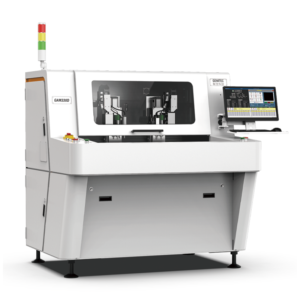
- GAM 340AT In-Line Automatic PCB Router Machine — Dual workbench with auto-focus vision camera — maximizes throughput for inline SMT integration
- GAM330AT Fully Automatic PCB Depaneling Machine — Self-feeding operation with automatic sorting — ideal for high-volume automated production lines
Frequently Asked Questions
Q1: What is the primary challenge in depaneling for high-mix low-volume production runs?
A1: The primary challenge is tooling changeover time. When production runs involve dozens of different board formats with small quantities per run, frequent router bit or knife blade changes become a significant bottleneck. Unlike high-volume production where a single panel layout runs continuously, HMLV scenarios demand rapid format switching while maintaining ±0.05mm positioning accuracy and clean edge quality without delamination or cracking.
Q2: How does routing compare to punching for HMLV depaneling scenarios?
A2: Routing offers superior flexibility for HMLV because it requires no custom die tooling—only a program change to adjust the cutting path. Punching delivers high throughput for identical panels but carries prohibitive setup costs and lead times for low-volume多样化 runs. According to IPC-A-600 standards, routed edges provide better inspectability of substrate damage, and modern servo-driven routers can achieve cut speeds of 50-150mm/sec with real-time spindle load monitoring to detect impending bit dulling before quality suffers.
Q3: What depaneling strategy minimizes interruption to SMT line flow in job-shop environments?
A3: Off-line depaneling with a standalone work station is typically preferred over in-line depaneling for HMLV because it prevents a single problematic panel from halting the entire SMT line. A dedicated depaneling cell with automated vision alignment and quick-change fixturing can typically handle 20-40 different panel formats per shift without compromising the main assembly line’s utilization rate, which must remain above 85% to justify the capital equipment investment in today’s competitive EMS market.
About Seprays
About Seprays Precision Machinery
Founded in 1993, Seprays has over 30 years of expertise in PCB depaneling solutions. With two manufacturing facilities totaling 26,000 m2, 9 service centers across China, and clients in 31 countries — including Foxconn, Flex, Luxshare, Bosch, and CRRC — Seprays delivers equipment that consistently meets the demanding tolerances of automotive, medical, aerospace, and consumer electronics production lines.
Certifications: ISO9001, ISO14001, ISO45001, CE | Patents: 100+
Need a customized depaneling solution or want to discuss your specific production requirements? Our technical team is ready to help.
Contact: jimmy@seprays.com