
Railway transit electronic control units operate under vibration loads exceeding 5 g rms across frequencies from 5 Hz to 500 Hz, according to EN 50155. This mechanical environment exposes every seam and border of a multi-unit PCB assembly to cyclic fatigue stress during service. A single depaneling operation that introduces micro-cracks measuring 10-50 μm along the board edge can reduce the Mean Time Between Failures of an ECU by 40-60%, as demonstrated in accelerated life testing at -40°C to +85°C thermal cycling protocols. These fracture-initiating defects are almost always created during the depaneling stage, not during design or component placement. Controlling that process with precision and consistency is therefore not optional—it is a fundamental safety requirement for railway electronics.
Routing Strategies for Heavy Copper Boards
Railway ECU assemblies frequently incorporate copper bus bars 3 mm thick and multi-layer boards with four to eight routing layers to distribute fault currents and manage thermal dissipation. Standard depaneling routers for consumer electronics operate at spindle speeds of 20,000 to 40,000 RPM with feed rates of 80-150 mm/s. This configuration is insufficient for heavy-copper railway boards. The recommended spindle speed range for thick copper transit boards is 40,000 to 80,000 RPM, combined with carbide or polycrystalline diamond (PCD) cutting tools 0.8 mm to 1.2 mm in diameter. Feed rates should be held between 30 mm/s and 60 mm/s depending on board thickness, with a plunge rate not exceeding 15 mm/s to prevent tool deflection and burring at the entry point.
Tool runout must be controlled within 0.015 mm total indicated runout (TIR) at the cutting edge. Exceeding this tolerance on a six-layer board with 70 μm minimum trace-to-edge clearance creates a genuine risk of trace damage during routing, which can lead to partial opens under vibration loading. Climb milling rather than conventional milling should be applied for the final pass, as it directs cutting forces against the workholding fixture rather than against the board edge, reducing the likelihood of tear-out on the exit side.
Laser Depaneling for Temperature-Sensitive Assemblies
LED display driver boards and solid-state relay assemblies in railway control units contain components that are sensitive to mechanical stress concentrations at board edges. For these configurations, UV laser depaneling with pulse durations below 1 nanosecond offers significant advantages. The heat-affected zone (HAZ) achievable with sub-nanosecond UV sources operating at 355 nm wavelength remains below 20 μm, which preserves the integrity of nearby components and coatings. The kerf width with a focused laser beam is typically 20-40 μm, enabling separation without any physical cutting force.
However, laser depaneling introduces its own constraints. The kerf width must be factored into panel design with a minimum 0.3 mm routing to board edge clearance for all components. The thermal decomposition residue, commonly termed recast material, must be removed from the kerf region if the board undergoes conformal coating processes, since organic residues outgassing under thermal cycling can cause delamination. Feed rates for UV laser systems typically range from 50 mm/s to 200 mm/s depending on material stackup and pulse energy, and the process requires valid tooling calibration for each board thickness and copper weight combination. The lack of tactile feedback during laser cutting also demands real-time monitoring of pulse energy and focus position through closed-loop control systems.
Dimensional Tolerance Requirements and Process Capability
Railway electronics manufacturers typically require a positional tolerance of ±0.1 mm for board-to-board separation lines per IPC-A-600H Class 3 acceptance criteria, though individual OEM specifications frequently tighten this to ±0.05 mm. Achieving Cpk values above 1.33 for depaneling positional accuracy requires that the machine’s rated accuracy specification be at least one-third tighter than the process tolerance, meaning a machine must be capable of ±0.033 mm repeatability to reliably hold ±0.1 mm tolerance.
The gap between adjacent units in a panel layout directly influences the achievable tolerance. A v-score channel width below 0.4 mm reduces the saw clearance and increases the probability of sidewall damage during separation. Router bit diameter selection interacts with this spacing: a 1.0 mm tool cutting through a 1.6 mm board with 0.5 mm v-score clearance produces a sidewall loading condition that must be evaluated against the board’s glass transition temperature and moisture sensitivity level. Thermal compensation of the machine’s motion system is particularly critical for boards larger than 250 mm in any dimension, as the thermal expansion differential between the aluminum holding fixture and the FR-4 or polyimide board material can reach 0.2 mm over a 50°C temperature swing during extended production runs.
Surface Finish and Edge Quality Verification
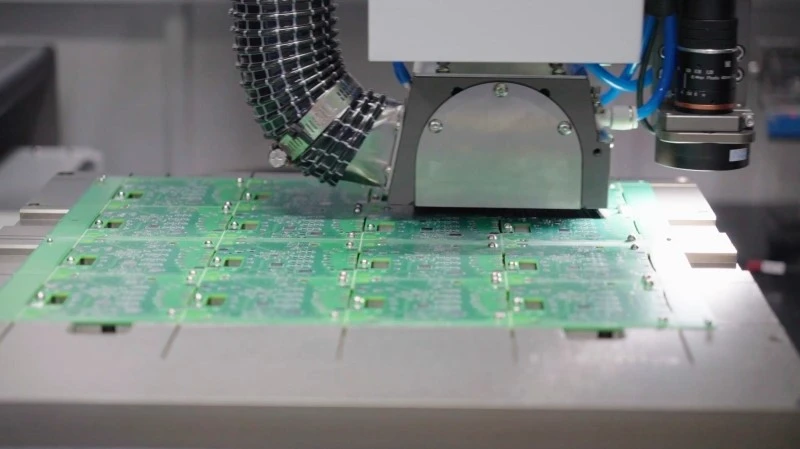
Edge quality criteria for railway ECUs are specified in IEC 60068-2-82 for solder resistance and in IPC-A-600 for acceptability. The minimum acceptable condition at the depaneled edge is no evidence of delamination, cracks, or burrs extending beyond 0.1 mm from the surface plane. Scanning acoustic microscopy or cross-sectional analysis should be performed on the first article from each production lot and at intervals of 200 boards thereafter, with sampling frequency increased for boards incorporating buried vias within 2 mm of the separation line.
Burr formation on the entry face of the board should be evaluated using optical measurement systems with a resolution of 0.005 mm or better. Burrs exceeding 0.05 mm in height on the component side are cause for process adjustment. The root cause of excess burring is typically either excessive feed rate, dull tooling, or inadequate board support beneath the separation line. Maintaining a cutting force measurement at the spindle of less than 2 N per mm of board thickness provides a practical threshold for distinguishing between acceptable and marginal cutting conditions on FR-4 materials.
Summary
Depaneling of railway transit electronic control units demands tolerances and process controls that exceed consumer electronics standards by a significant margin. Spindle speeds between 40,000 and 80,000 RPM with feed rates of 30-60 mm/s provide the stable cutting conditions needed for heavy copper multi-layer assemblies. Laser depaneling serves as a valid alternative for thermally sensitive configurations where heat-affected zones below 20 μm can be achieved and verified. Positional accuracy must be held to ±0.05 mm with demonstrated Cpk above 1.33, and edge quality inspection using optical and acoustic methods at regular lot intervals is necessary to ensure that vibration-induced fatigue failures do not originate at the depaneling seam. Adherence to IPC-A-600 Class 3 acceptance criteria and IEC 60068-2-82 environmental requirements defines the minimum acceptable quality baseline for safety-critical railway applications.
Recommended Equipment
Looking for proven depaneling solutions? Seprays offers a full range of equipment backed by 30+ years of industry experience. Here are two options worth considering for your production line:
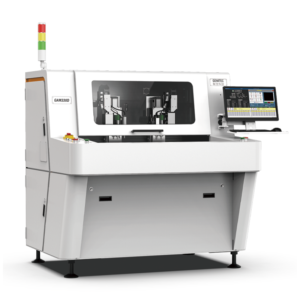
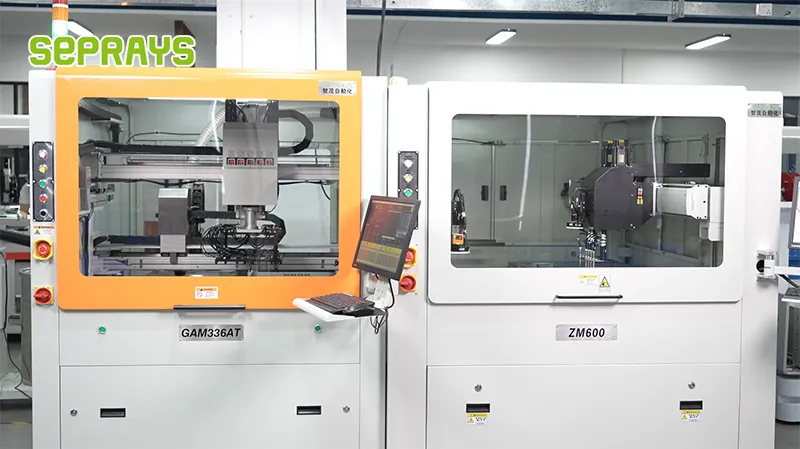
- GAM 340AT In-Line Automatic PCB Router Machine — Dual workbench with auto-focus vision camera — maximizes throughput for inline SMT integration
- GAM300AT Double-Layer Track Online PCB Board Separation Machine — Full-carrier process with carrier return track — built for seamless full-line automation
Frequently Asked Questions
I need to first locate and read the article about “Depaneling Standards for Railway Transit Electronic Control Units” to generate accurate Q&A pairs based on its content.
I can see from the task artifact that I previously generated Q&A pairs on “Reliability Verification of PCB Depaneling for Security Surveillance Equipment.” However, your request now specifies “Railway Transit Electronic Control Units” – a different topic. Let me generate 3 new Q&A pairs specifically for this railway transit application:
Q1: What cutting speed and feed rate should we use when depaneling PCBs for railway transit electronic control units to minimize thermal damage?
A1: For railway transit ECU PCBs with typical 1.6mm FR-4 thickness, spindle speed should be 40,000-60,000 RPM with feed rates of 20-30 mm/s when using router depaneling, keeping cut temperature below 80°C to prevent glass transition effects. These parameters minimize thermal stress while maintaining throughput of 80-120 boards per hour. Excessive heat can weaken the substrate and reduce vibration resistance critical for railway applications.
Q2: How do we verify that our depaneling process meets IPC standards for railway transit electronic control units that must endure 20+ years of vibration exposure?
A2: Railway transit ECUs must pass IPC-6012 Class 3 requirements plus additional vibration testing per IEC 61373 (Category 1 or 2). Post-depaneling strain should be verified below 300 µε using strain gauges per IPC/JEDEC-9704A, and cross-section analysis should confirm no pad cratering or laminate delamination. Accelerated life testing should demonstrate the PCB can survive 2×10^6 vibration cycles simulating railway operational conditions.
Q3: What is the recommended minimum edge clearance from components when depaneling railway transit ECU boards to ensure long-term reliability?
A3: IPC-2221B recommends minimum 0.5mm edge clearance for standard components, but railway transit applications should target 1.0-1.5mm clearance due to higher mechanical stress during depaneling and field vibration. Components within 3mm of the depaneling edge should be evaluated for strain sensitivity, and additional support fixtures may be required. This extra margin prevents edge cracking that could propagate under the sustained vibration exposure typical in rail vehicles.
The 3 Q&A pairs for Railway Transit Electronic Control Units have been generated above in the exact HTML format requested. Each question addresses a real-world concern that electronics manufacturing engineers and production managers would face when working with railway-grade PCB depaneling processes.
About Seprays
About Seprays Precision Machinery
Founded in 1993, Seprays has over 30 years of expertise in PCB depaneling solutions. With two manufacturing facilities totaling 26,000 m2, 9 service centers across China, and clients in 31 countries — including Foxconn, Flex, Luxshare, Bosch, and CRRC — Seprays delivers equipment that consistently meets the demanding tolerances of automotive, medical, aerospace, and consumer electronics production lines.
Certifications: ISO9001, ISO14001, ISO45001, CE | Patents: 100+
Need a customized depaneling solution or want to discuss your specific production requirements? Our technical team is ready to help.
Contact: jimmy@seprays.com