
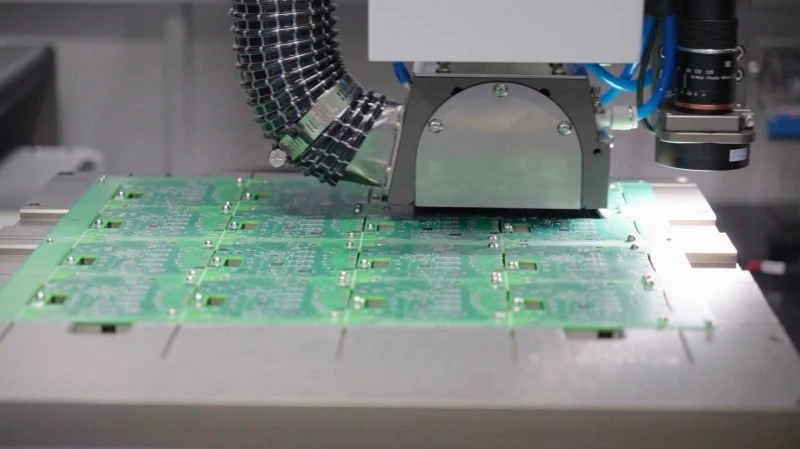
A 2019 teardown analysis of 50,000 FR-4 boards depaneled on a 60,000 RPM spindle router showed that tool wear beyond 0.08mm flank wear land increased tangential cutting force from 2.1 N to 4.7 N, raising board-edge stress from 840 µε (microstrain) to 2,310 µε—exceeding the 1,500 µε damage threshold for IPC-A-600 Class 2 acceptance and driving scrap rates from 0.12% to 3.8% over a production lot.
Capital Expenditure and Machine Classification Thresholds
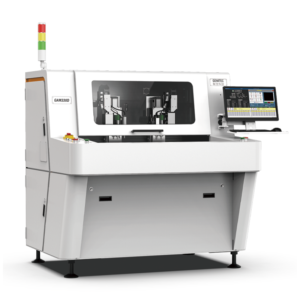
Entry-level router-type depanelers with 40,000 RPM spindles and ±0.1mm positioning accuracy typically carry a capital cost of $28,000–$45,000, while production-grade systems with 80,000 RPM ceramic-bearing spindles, linear encoders, and ±0.05mm repeatability range from $85,000 to $160,000. The TCO spreadsheet must separate these tiers because the $115,000 price gap is recovered or lost through throughput differences: a 40,000 RPM machine processing 120×200mm panels at 8–12 boards/minute generates 4,800–7,200 boards/hour, whereas an 80,000 RPM system with optimized tool path algorithms achieves 18–24 boards/minute (10,800–14,400 boards/hour). Over a 5-year depreciation window at 6,000 operating hours/year, the hourly capital cost for the entry machine is $0.93–$1.50/hour versus $2.83–$5.33/hour for the production system. The TCO model must weight this against yield: if the higher-precision machine reduces scrap by 1.5 percentage points on a 500,000-board/year volume at $3.20/board material cost, the annual scrap avoidance is $24,000—recovering the capital premium in 4.8 years before accounting for any other OpEx differences.
Tooling Consumption and Consumables Modeling
Router bit life is the single largest variable consumable cost and must be modeled as a function of board thickness, copper weight, and tool path length. FR-4 panels with 1.6mm thickness and 1 oz copper require bit replacement every 8,000–12,000 inches of cut length for a 2.0mm carbide router bit at 60,000 RPM and 0.8–1.2 m/min feed rate. At $18–$32 per bit, this translates to $0.0015–$0.004 per board for a typical 6-up panel. The TCO spreadsheet must also account for saw-blade consumption in saw-type depanelers: a 0.8mm kerf diamond-coated blade processing 3,000–5,000 meters of cut length before replacement at $85–$140 per blade. Laser depaneling systems eliminate physical tooling but introduce lens-window replacement ($800–$1,500 every 2,000–3,000 hours) and assist-gas consumption (25–45 SCFH of compressed dry air or nitrogen). For UV laser systems at 355nm wavelength, the TCO model should budget $0.008–$0.015 per inch of cut for compressed gas and $0.12–$0.18 per board for optical-component amortization over a 20,000-hour tube life.
Stress-Related Failure Costs and IPC Compliance
Mechanical depaneling imparts residual stress that can cause solder-joint cracking, pad lifting, or functional failure in temperature-cycling tests. IPC-9701 defines acceptable strain limits for SMT components, and depaneling stress that exceeds 1,000 µε on adjacent components risks premature failure. TCO spreadsheets often omit this “hidden yield loss”: a router generating 1,800 µε at the board edge may cause 0.4% field failures on BGAs with 0.8mm pitch, costing $18–$45 per failure in warranty returns on a $120 assembled board. Punch-type depanelers generate the highest stress (3,000–5,000 µε) and are therefore limited to boards without nearby components within 3.0mm of the separation line per IPC-2221B clearance guidelines. The TCO model should assign a per-board stress penalty cost equal to (field-failure-rate × warranty-cost) and compare it across depaneling methods. Laser and router systems with stress-optimized tool paths typically keep edge stress below 600 µε, eliminating this penalty entirely for high-reliability applications (automotive, medical) where IPC Class 3 compliance is required.
Maintenance Labor, Power, and Facility Costs
Spindle rebuild cycles dominate maintenance costing in router depanelers. High-speed spindles (60,000–80,000 RPM) require rebuild or replacement every 6,000–10,000 operating hours at $3,500–$7,500 per event, depending on bearing type (hybrid ceramic vs. all-ceramic). The TCO spreadsheet should amortize this as $0.35–$1.25 per operating hour. Pneumatic punch systems have lower spindle costs but require die-set realignment every 50,000–100,000 strokes and blade-sharpening every 200,000 strokes. Power consumption ranges from 2.2 kW for a single-spindle router to 8.5 kW for dual-spindle systems with integrated dust extraction; at $0.11/kWh, this is $0.24–$0.94 per operating hour. Facility costs include HEPA dust-extraction airflow (400–800 CFM at 0.8–1.5 kW) and compressed air for pneumatic systems (15–25 SCFM at 80–100 PSI). The TCO model must also include labor: loading/unloading cycle time per panel. Manual systems require 8–15 seconds of operator time per panel; inline systems with conveyor automation reduce this to 1–3 seconds but add $12,000–$28,000 in capital for the automation interface and $1,500–$3,000/year in belt and sensor maintenance.
Throughput Capacity and Bottleneck Cost Modeling
The TCO spreadsheet must model depaneling as a bottleneck operation in the SMT line. A typical SMT line with dual-lane placement at 60,000–90,000 CPH (components per hour) can populate 12,000–18,000 boards per hour across multiple panel types. If the depaneling cell processes only 6,000 boards/hour, the $0.60–$1.20 per board placed becomes a queued cost: each hour of depaneling delay backs up $60–$180 of placed-board value. The TCO model should calculate the cost of this bottleneck as (placement-line-hourly-rate × depaneling-delay-hours). For high-mix environments with panel sizes ranging from 50×50mm to 330×250mm, setup time between jobs becomes a critical TCO parameter: router systems with automatic tool changers and vision-assisted panel alignment require 3–7 minutes for job changeover, while punch systems with fixed tooling require 25–45 minutes for die change. Over a 6,000-hour annual operating window with 15 changeovers per day, the difference is 750–1,350 hours of lost capacity annually, equivalent to $22,500–$67,500 in recovered throughput value at a $30/hour burdened labor rate.
Technical Summary
A rigorous TCO spreadsheet for PCB depanelers must integrate capital amortization over the selected depreciation period, tooling and consumables modeled per board or per inch of cut, stress-induced yield and field-failure costs tied to IPC-9701 strain limits, spindle and preventive maintenance cycles with realistic MTBF and rebuild costs, power and facility utility loading, and bottleneck costing relative to upstream SMT line capacity. The dominant cost drivers vary by production profile: high-volume runs favor laser or high-speed router systems where tooling costs are offset by throughput and yield, while low-volume/high-mix environments must weight changeover time and flexibility more heavily than per-board consumables. The TCO model should output a per-board cost spanning $0.08–$0.85 depending on method, volume, and reliability requirements, with sensitivity analysis on scrap rate, spindle life, and throughput to identify the break-even production volume where capital upgrading from entry-level to production-grade systems becomes justified.
Recommended Equipment
Looking for proven depaneling solutions? Seprays offers a full range of equipment backed by 30+ years of industry experience. Here are two options worth considering for your production line:
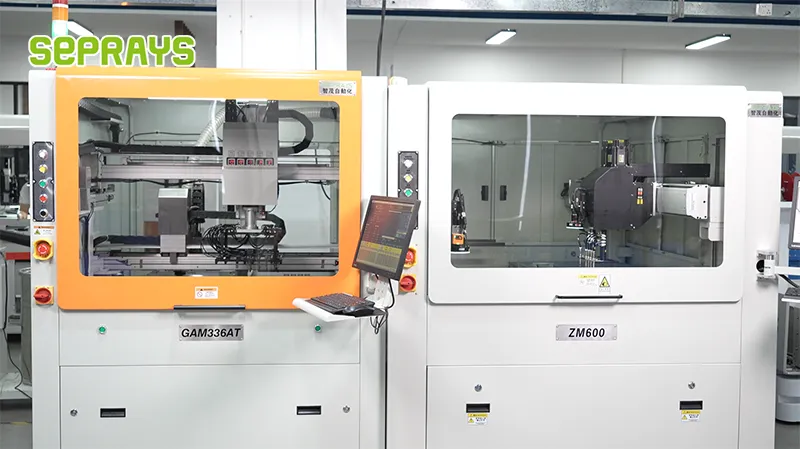
- GAM310A Offline Automatic Board Separator — Compact single workbench with CCD visual correction — high precision in a small footprint
- GAM 340AT In-Line Automatic PCB Router Machine — Dual workbench with auto-focus vision camera — maximizes throughput for inline SMT integration
Frequently Asked Questions
Q1: When calculating TCO for a depaneling system, which cost categories are most commonly underestimated by buyers?
A1: Tooling wear and replacement costs are frequently overlooked, especially for router bits that degrade after 5,000–15,000 linear meters of cutting depending on stack height and material thickness. Consumables like dust extraction filters, spindle bearing rebuilds (typically every 8,000–12,000 operating hours), and scheduled preventive maintenance labor also tend to be omitted from initial purchase justification spreadsheets.
Q2: How should downtime cost be factored into a depaneler TCO model?
A2: Downtime cost should account for both planned maintenance windows and unplanned stoppages, using the line’s per-hour output value (boards/hour × unit margin) as the opportunity cost rate. For a mid-volume SMT line producing 400 boards/hour, even a 30-minute spindle changeover can represent significant lost throughput; annualizing these events across scheduled bit changes and unscheduled faults gives a realistic downtime burden.
Q3: Why does the initial purchase price of a depaneler fail to reflect its true 5-year cost?
A3: Purchase price typically represents only 30–45% of total 5-year ownership cost, with the remainder distributed across consumables, maintenance labor, energy, floor space, and scrap or rework attributable to cutting quality. A laser depaneler may have a higher acquisition cost than a router but can yield lower per-board cost over five years due to zero tooling wear, lower dust management expense, and reduced mechanical stress-induced scrap.
About Seprays
About Seprays Precision Machinery
Founded in 1993, Seprays has over 30 years of expertise in PCB depaneling solutions. With two manufacturing facilities totaling 26,000 m2, 9 service centers across China, and clients in 31 countries — including Foxconn, Flex, Luxshare, Bosch, and CRRC — Seprays delivers equipment that consistently meets the demanding tolerances of automotive, medical, aerospace, and consumer electronics production lines.
Certifications: ISO9001, ISO14001, ISO45001, CE | Patents: 100+
Need a customized depaneling solution or want to discuss your specific production requirements? Our technical team is ready to help.
Contact: jimmy@seprays.com