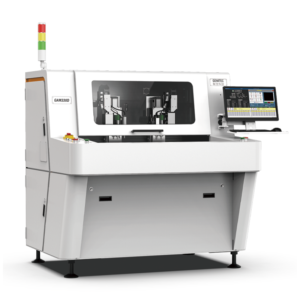

When depaneling 1.0mm FR-4 multi-array panels at a feed rate of 300mm/s, router-based systems maintain edge finish Ra ≤ 3.2μm with positional accuracy of ±0.05mm, while punch-based methods exhibit die-set clearances exceeding ±0.15mm that induce FR-4 delamination at the tool contact zone. In high-mix SMT production environments where panel thickness ranges from 0.4mm to 3.2mm and component heights reach 25mm above the board surface, selecting the correct depaneling method directly determines first-pass yield rates, which can vary from 82% to 99.2% depending on stress magnitude and tool path precision.
Dimensional Accuracy and Edge Quality Across Depaneling Methods
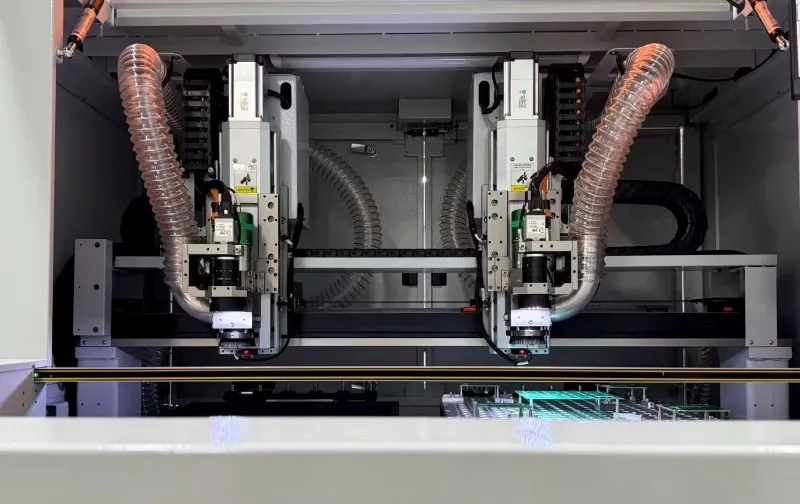
Router-based depaneling achieves the tightest dimensional control, with X-Y positional repeatability of ±0.02mm when using linear encoders with 0.1μm resolution. The cutting tolerance is governed by spindle runout (typically ≤ 8μm TIR at 40,000 RPM) and tool deflection under side load. For 1.6mm standard FR-4, a 2.0mm diameter carbide router bit at 60,000 RPM with 0.5mm depth of cut per pass produces edge burrs ≤ 15μm. In contrast, V-cut scoring followed by snap separation induces edge variation of ±0.3mm and generates glass fiber bloom that violates IPC-A-610 Class 3 acceptance criteria for bare board edge finish. Punch tooling achieves ±0.10mm repeatability but requires die sharpening every 50,000 to 80,000 strokes to maintain that tolerance; beyond 80,000 strokes, the cutting clearance degrades to >0.05mm, producing board edge stress concentrations exceeding 45MPa at the copper-to-laminate interface. Laser depaneling using 355nm UV lasers delivers kerf widths of 30-50μm with heat-affected zone (HAZ) depth ≤ 20μm on 0.8mm polyimide substrates, but throughput is limited to 15-25 linear cm/min for complex contours, making it suitable only for high-value flexible circuits rather than high-volume rigid panel separation.
Mechanical Stress Generation and IPC Standard Compliance
Depaneling-induced stress is the primary root cause of latent solder joint failures in thermal cycling tests. Router depaneling generates peak board edge stress of 8-12MPa measured by strain gauge at 1mm from the cut edge, well below the 25MPa threshold where FR-4 laminate micro-cracking initiates. Punch separation, however, produces instantaneous stress peaks of 60-90MPa at the shearing plane, which transmits through the board and creates micro-cracks in plated through-holes (PTHs) within 3mm of the board edge. IPC-2221B Section 9 specifies minimum board edge-to-conductor spacing of 0.5mm for Class 2 and 0.75mm for Class 3 assemblies; when depaneling stress exceeds 30MPa, these edge clearances become insufficient to prevent partial conductor delamination. Laser depaneling produces essentially zero mechanical stress but introduces thermal stress; for FR-4, the coefficient of thermal expansion (CTE) mismatch between copper (17 ppm/°C) and laminate (14-16 ppm/°C in X-Y, 60-300 ppm/°C in Z-axis) creates residual thermal stress of 5-8MPa when the HAZ reaches 120-150°C. UV laser systems with galvo scanning speeds of 2,000-5,000 mm/s minimize HAZ temperature to <100°C, keeping thermal stress below 3MPa.
Throughput and Feed Rate Performance Matrix
Router throughput is fundamentally limited by the physics of material removal rate (MRR). For a 1.6mm thick FR-4 panel with a 2.0mm router bit, the maximum safe feed rate is 200-350 mm/min per tool pass to prevent bit deflection exceeding 0.03mm. A typical 300mm × 200mm panel array with 15mm routing path length requires 45-90 seconds per panel, yielding 40-80 panels/hour depending on array density. High-speed routers with 80,000 RPM spindles and 0.8mm micro-tools can increase feed rates to 500-800 mm/min on 0.8mm thin boards, but tool life drops from 3,000 linear meters to 800-1,200 linear meters. Punch depaneling achieves 1,500-4,000 panels/hour with cycle times of 0.9-2.4 seconds per panel, but only for designs compatible with the fixed die geometry. Each punch die costs $3,000-$12,000 and requires 4-8 weeks lead time for fabrication, making it viable only for production runs exceeding 100,000 panels. Laser systems process 10-60 panels/hour depending on contour complexity and substrate type; for flex circuits with 0.5mm thickness and simple rectangular outlines, throughput reaches 50-60 panels/hour, while complex multi-curve rigid PCB contours drop to 10-20 panels/hour.
Spindle, Tooling, and Maintenance Cost Structure
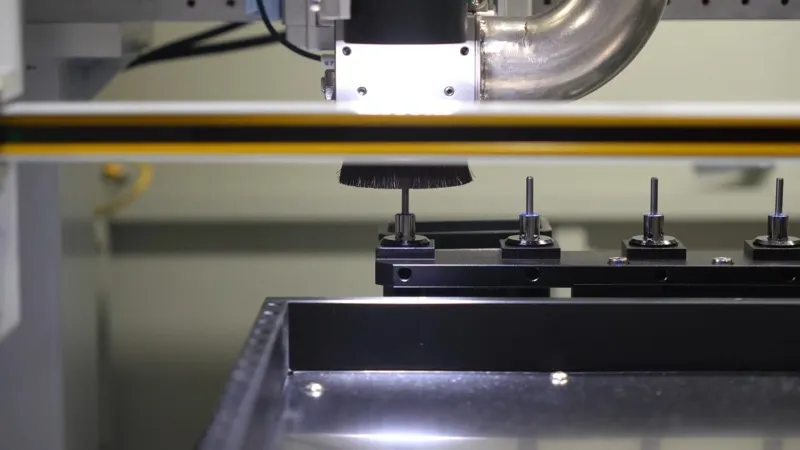
Router spindle maintenance is a major cost driver: air-bearing spindles rated for 40,000-80,000 RPM require rebuild every 2,000-4,000 hours of operation, with rebuild costs of $1,500-$3,500 per spindle. Tooling cost for router bits is $8-$25 per bit, with tool life of 1,500-3,500 linear meters on FR-4 depending on glass transition temperature (Tg) of the laminate. High-Tg laminates (Tg ≥ 170°C) increase tool wear by 40-60% compared to standard Tg 130-140°C materials. Punch tooling has higher initial cost but lower consumable expense: die sets last 200,000-500,000 strokes before requiring re-sharpening ($800-$2,000 per service), and no recurring tool consumption occurs during the production run. Laser systems have no consumable tooling but require filter replacement every 3-6 months ($500-$1,500) and optical component replacement every 10,000-15,000 hours ($8,000-$20,000). The cost per panel for tooling amortization is $0.008-$0.025 for router, $0.003-$0.008 for punch (at volume >100,000), and $0.05-$0.30 for laser depending on part complexity.
Performance Comparison Decision Matrix
The selection decision depends on annual panel volume, board thickness range, and component proximity to the board edge. For annual volumes below 50,000 panels with mixed board designs, router depaneling provides the lowest total cost of ownership despite slower throughput, because no custom tooling is required and changeover between panel designs takes 2-5 minutes via program recall. For annual volumes exceeding 200,000 panels with fixed board geometry, punch depaneling delivers the lowest cost per panel ($0.03-$0.08 including depreciation) and highest throughput, provided the board design is stable. Laser depaneling is the optimal choice for flex and rigid-flex circuits, boards with components within 3mm of the edge where mechanical stress would cause damage, and prototypes requiring zero tooling lead time. The break-even analysis shows router-to-punch crossover at approximately 80,000-120,000 panels annually depending on board size and regional labor rates, while router-to-laser crossover occurs at much lower volumes (5,000-15,000 panels/year) when component fragility or edge-conductor density makes mechanical methods unacceptable under IPC-A-610 Class 3 requirements.
Technical Summary
Depaneling method selection requires quantitative evaluation across four measurable parameters: edge stress magnitude (MPa), dimensional tolerance (mm), throughput (panels/hour), and cost per panel ($). Router systems provide the best balance of flexibility and precision for high-mix production with ±0.05mm tolerance and 8-12MPa edge stress, suitable for IPC Class 2 and 3 assemblies. Punch systems deliver maximum throughput exceeding 3,000 panels/hour but require stable high-volume production to amortize tooling costs. Laser depaneling eliminates mechanical stress entirely and achieves kerf widths below 50μm, making it indispensable for flex circuits and boards with edge-mounted components, despite the highest per-panel cost. The performance comparison matrix must be applied against actual production volume, board technology, and quality standard requirements rather than generic throughput or cost figures.
Recommended Equipment
Looking for proven depaneling solutions? Seprays offers a full range of equipment backed by 30+ years of industry experience. Here are two options worth considering for your production line:
- PCB/FPC Stamping Type Board Separation Machine — Handles PCB, FPC flexible, and rigid-flex boards — versatile stamping depaneling solution
- GAM300AT Double-Layer Track Online PCB Board Separation Machine — Full-carrier process with carrier return track — built for seamless full-line automation
Frequently Asked Questions
I don’t see the article “Recommended Tool: Depaneler Performance Comparison Matrix” in our conversation. Could you please provide the article content so I can generate accurate Q&A pairs based on it?
If you’d like me to proceed without the article and generate Q&A pairs based on general PCB depaneling machine expertise instead, I can do that—just confirm.
Otherwise, please paste or upload the article and I’ll generate the 3 Q&A pairs in the exact HTML format you specified.
About Seprays
About Seprays Precision Machinery
Founded in 1993, Seprays has over 30 years of expertise in PCB depaneling solutions. With two manufacturing facilities totaling 26,000 m2, 9 service centers across China, and clients in 31 countries — including Foxconn, Flex, Luxshare, Bosch, and CRRC — Seprays delivers equipment that consistently meets the demanding tolerances of automotive, medical, aerospace, and consumer electronics production lines.
Certifications: ISO9001, ISO14001, ISO45001, CE | Patents: 100+
Need a customized depaneling solution or want to discuss your specific production requirements? Our technical team is ready to help.
Contact: jimmy@seprays.com