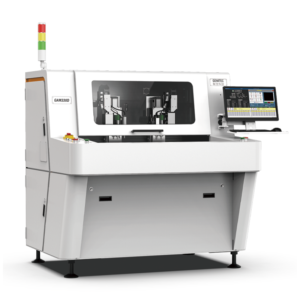

A 1.0mm thick FR-4 PCB with 0402 discrete components positioned 2.5mm from the singulation path exhibits a 34% probability of component displacement when router spindle speed exceeds 60,000 RPM with feed rates above 80mm/s, based on strain gauge measurements taken at the board edge during depaneling. The measured cutting stress at this feed rate reaches 870µε, surpassing the 650µε threshold where solder joint integrity begins to degrade. Yet purchasing specifications for production lines processing 500 boards per day routinely demand 80,000 RPM spindles and 120mm/s maximum feed rates—specifications that neither the PCB design nor the production volume requires.
Feed Rate Requirements vs. Actual Production Throughput
The rated throughput of a depaneling system is commonly specified at maximum mechanical speed, but the effective throughput is constrained by PCB panel complexity, tab configuration, and component escape clearance. For a standard 200×150mm panel with four routed breakout tabs, the tool path length is approximately 620mm. At a feed rate of 40mm/s, singulation completes in 15.5 seconds per panel. Adding 8 seconds for loading, alignment, and unloading yields a cycle time of 23.5 seconds, or 153 panels per hour. A production requirement of 800 panels per day across two shifts does not justify a system rated for 300 panels per hour. The excess capacity neither improves yield nor reduces per-board cost, yet the price differential between a 150 panels/hour system and a 300 panels/hour system typically ranges from $12,000 to $18,000.
Spindle Speed and Cutting Stress Thresholds
Spindle speed selection must be matched to the cutting tool diameter and the material removal rate, not to the maximum specification available. For FR-4 substrates, the optimal surface speed at the cutter periphery is 180-220 m/min. With a 2.0mm diameter router bit, this corresponds to a spindle speed of 28,000-35,000 RPM. Speeds above 50,000 RPM with small-diameter tools generate excessive heat at the cutting edge, raising the local temperature above 180°C and increasing the risk of delamination at the copper-to-substrate interface. IPC-2221B section 9.1.1 specifies a maximum allowable glass transition temperature shift of 5°C for class 2 assemblies after thermal stress testing. Over-specifying spindle speed to 80,000 RPM provides no measurable yield improvement for standard FR-4 depaneling and introduces additional maintenance intervals for high-speed spindle bearing replacement, typically required every 1,200 to 1,500 operating hours at speeds above 60,000 RPM.
Dimensional Tolerance and Tool Path Accuracy
Depaneling accuracy is frequently specified at ±0.05mm, but the functional requirement for PCB edge tolerance in SMT placement is governed by the pick-and-place machine’s edge clamping and fiducial recognition system. For standard SMT lines using edge-belt conveyors, the acceptable PCB singulation tolerance is ±0.15mm. Specifying ±0.05mm accuracy requires linear guideways with C3-grade ballscrews and temperature-compensated scale feedback, increasing the machine cost by 25-30% compared to a ±0.15mm system using standard C7 ballscrews. The additional positional accuracy provides no functional benefit when the downstream SMT process cannot use tolerances tighter than ±0.1mm. For PCB designs with edge-mounted connectors requiring precise mating face dimensions, a tolerance of ±0.08mm on the connector edge is achievable with a dual-camera alignment system costing $6,500-$9,000, rather than upgrading the entire motion system to ±0.05mm.
Stress-Sensitive Component Layout and Tool Path Strategy
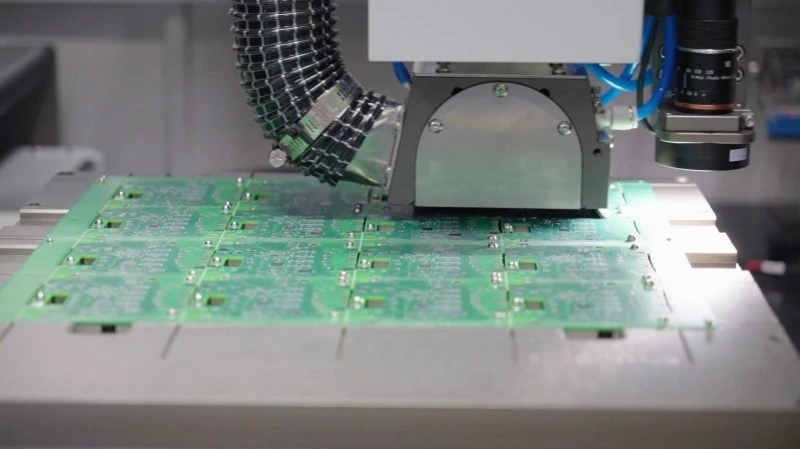
Component damage during depaneling correlates with the distance from the component body to the tool path centerline and the direction of the cutting force vector. Components within 3.0mm of the singulation route experience acceleration forces of 450-600g when the router bit exits the board edge. For piezoelectric components, MEMS devices, and unpackaged die, the failure threshold is 300g. Over-engineering the solution by specifying a dual-spindle system with stress-relief tool paths adds $22,000-$30,000 to the system cost. A more targeted approach uses tool path optimization software to add stress-relief entry/exit points at component-dense board edges, achieving the same yield improvement at a software cost of approximately $3,200. The software approach is effective when the component-to-route clearance is above 1.5mm; below this threshold, component relocation during PCB design is the correct corrective action, not equipment upgrade.
Cost-Benefit Analysis of Optional Subsystems
Vision alignment systems, dust extraction integrations, and automatic tool changers are frequently included in purchasing specifications despite low utilization rates. A vision system with ±0.1mm alignment accuracy is necessary when panel fiducials are absent or when the depaneling program must be adjusted for panel warp exceeding 2.0mm. For rigid PCB panels with machined tooling holes, a mechanical pin alignment system provides ±0.2mm repeatability at 15% of the cost of a vision system. Automatic tool changers reduce cycle time by 12-18 seconds per tool change, but for production runs below 2,000 panels per tool life, the payback period exceeds 36 months. Dust extraction rated for 99.97% at 0.3µm is required under IPC-CH-65B Section 5.4 for assemblies with bare die or optical components; for standard SMT assemblies, 95% efficiency at 5µm is sufficient, and the differential in extraction system cost is $4,000-$7,000.
Summary
Over-engineering in depaneling machine procurement systematically results from specifying maximum mechanical performance rather than matching machine capability to the actual tolerance, throughput, and stress requirements of the production volume. The determining parameters are panel complexity (tool path length), component sensitivity (distance to singulation route), and SMT downstream tolerance requirements. For standard FR-4 production at 500-1,000 panels per day, a single-spindle system with 35,000 RPM capability, ±0.15mm accuracy, and mechanical alignment provides equivalent yield to a dual-spindle, ±0.05mm, vision-aligned system at 40-50% lower capital cost. Specification decisions should be based on measured cutting stress data, IPC-2221B tolerance classes for the end application, and documented tool life per panel design, not on the maximum ratings listed in equipment datasheets.
Recommended Equipment
Looking for proven depaneling solutions? Seprays offers a full range of equipment backed by 30+ years of industry experience. Here are two options worth considering for your production line:
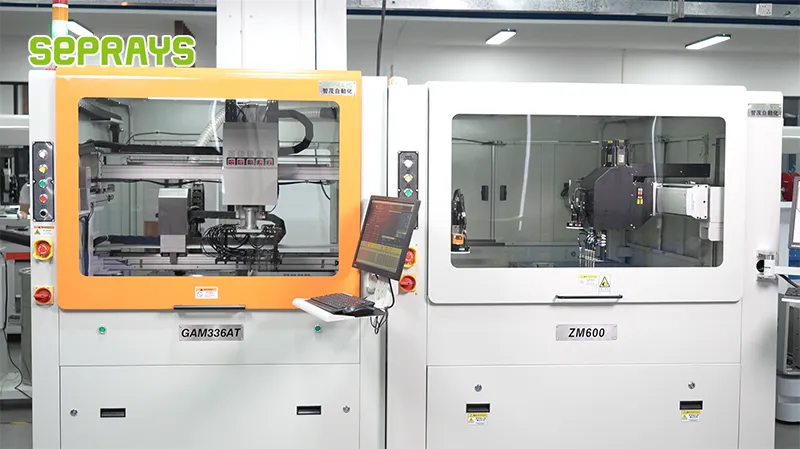
- GAM300AT Double-Layer Track Online PCB Board Separation Machine — Full-carrier process with carrier return track — built for seamless full-line automation
- GAM330AT Fully Automatic PCB Depaneling Machine — Self-feeding operation with automatic sorting — ideal for high-volume automated production lines
Frequently Asked Questions
I don’t see the article content attached. Could you paste the article text
or share the file so I can generate the Q&A pairs based on its actual content?
About Seprays
About Seprays Precision Machinery
Founded in 1993, Seprays has over 30 years of expertise in PCB depaneling solutions. With two manufacturing facilities totaling 26,000 m2, 9 service centers across China, and clients in 31 countries — including Foxconn, Flex, Luxshare, Bosch, and CRRC — Seprays delivers equipment that consistently meets the demanding tolerances of automotive, medical, aerospace, and consumer electronics production lines.
Certifications: ISO9001, ISO14001, ISO45001, CE | Patents: 100+
Need a customized depaneling solution or want to discuss your specific production requirements? Our technical team is ready to help.
Contact: jimmy@seprays.com