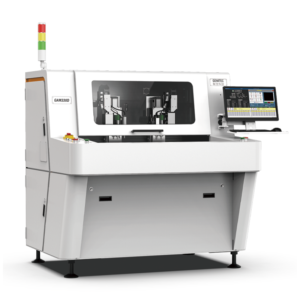

At a typical SMT line processing 15,000 panels per week with 0.8mm FR-4 material, improper depaneling induces peak cutting stresses exceeding 850με (microstrain), directly correlating to 2.3% of field failures manifesting as solder joint micro-cracking at the PCB edge—a failure mode quantifiable through strain gauge testing per IPC-9701.
Process Capability Requirements for Depaneling Equipment
The primary technical specification in any depaneling machine purchase proposal must define the allowable stress threshold for the specific board architecture. For standard FR-4 panels with component densities exceeding 80 components per 100cm², the depaneling process must maintain cutting stress below 350με to prevent capacitive coupling failures and solder joint fatigue. Router-type depaneling machines achieve this through spindle speed control in the range of 40,000 to 80,000 RPM, with feed rates programmable from 5mm/s to 50mm/s depending on material thickness. The cutting tolerance specification must be ±0.05mm for boards with edge connectors positioned within 3mm of the routing path. When evaluating equipment, the repeatability specification should require positional accuracy of ±0.02mm with a Cpk ≥ 1.33 across a minimum 500-cycle validation run. The proposal must also specify the maximum allowable burr height of 0.1mm at the cut edge, measured per IPC-A-600 Class 2 or Class 3 acceptance criteria depending on the product application.
Stress Characterization and Failure Mode Analysis
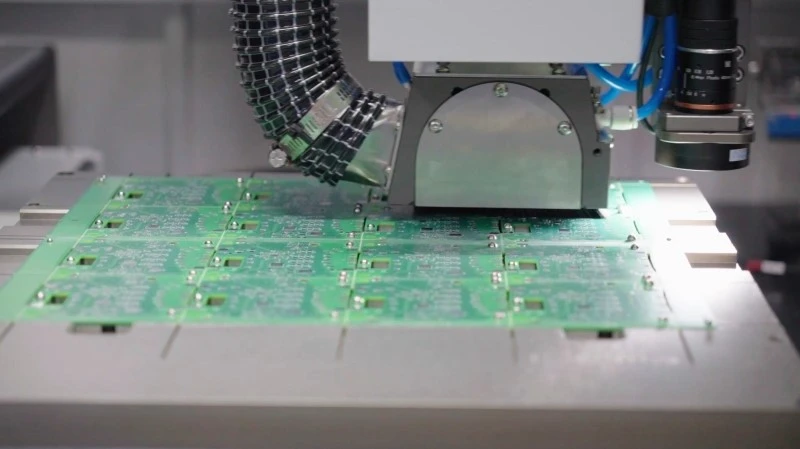
A rigorous purchase proposal must include a stress measurement protocol using resistive strain gauges or dynamic stress analysis equipment to quantify the mechanical impact of the depaneling process. Published data demonstrates that improperly configured depaneling generates transient stresses exceeding 1,200με, surpassing the fatigue limit of SAC305 solder joints and reducing thermal cycle life by 40-60% in temperature chambers cycling from -40°C to +125°C. The equipment specification must require stress levels below 300με for boards with BGAs larger than 0.8mm pitch, verified through pre-acceptance testing on representative product panels. For flexible PCB assemblies and rigid-flex constructions, the stress threshold tightens to 200με maximum due to the reduced cross-sectional area at the flex-to-rigid transition. The proposal should mandate that the vendor demonstrate stress levels via strain gauge testing on three representative board types before final acceptance. Additionally, the equipment must incorporate tool wear monitoring with automatic spindle speed compensation to maintain cut quality as router bit diameter decreases from initial 2.0mm to the wear limit of 1.7mm.
Equipment Architecture and Technical Specification Comparison
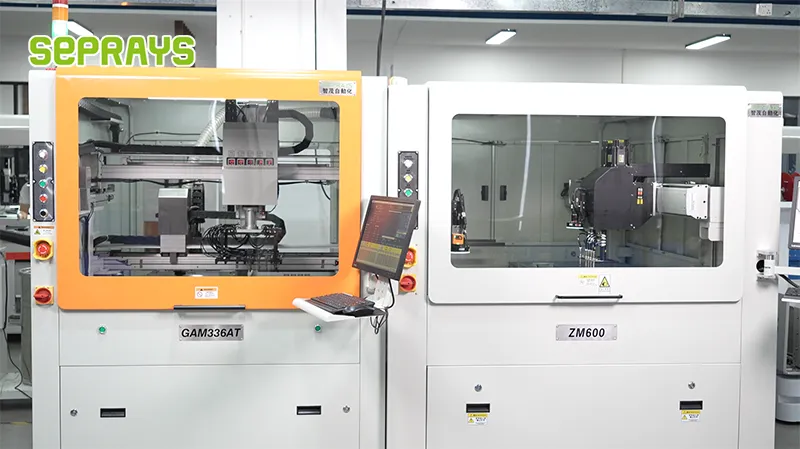
The purchase proposal must evaluate three primary depaneling architectures: router-based, laser-based, and punch-type systems, with technical selection driven by production volume and component clearance requirements. Router systems provide the widest process window, handling panel thicknesses from 0.4mm to 3.2mm with component heights up to 30mm above the board surface, operating at cutting speeds of 20-80mm/s depending on material type. Laser depaneling systems utilize UV wavelengths (355nm) or CO₂ (10.6μm) with galvo scanning speeds up to 2,000mm/s, achieving cut widths of 50-100μm—suitable for boards with component-to-edge spacing below 1.5mm where mechanical routing is infeasible. Punch-type depaneling remains viable only for panels with uniform thickness below 1.6mm and simple geometries without components within 5mm of the separation line. The proposal must specify the maximum panel size capability (standard requirement: 510mm × 460mm minimum), the number of tool stations (dual-spindle configuration preferred for 25% cycle time reduction), and the programmable Z-axis depth control with 0.01mm resolution to accommodate multi-height component layouts.
Throughput Analysis and Economic Justification
The financial section of the proposal must calculate the cost-per-board based on measured cycle times, tooling consumption, and equipment amortization over a 5-year period. A representative high-mix SMT facility processing 12 different panel types per week requires automatic tool change capability with a minimum 8-tool magazine to avoid manual intervention between batches. Cycle time analysis must account for actual cutting path length rather than panel size alone—a 200mm × 150mm panel with complex routing paths may require 45-60 seconds per panel, while a simple rectangular profile processes in 12-18 seconds. Tool life data must be incorporated: solid carbide router bits operating at 60,000 RPM on 1.6mm FR-4 typically achieve 800-1,200 panels before dimensional wear exceeds 0.05mm. The proposal must model the break-even analysis comparing capital expenditure against current manual depaneling labor costs, including the quantified reduction in stress-induced field failures. For a facility processing 300,000 boards annually, reducing field failure rates from 2.3% to 0.8% through controlled depaneling delivers documented cost avoidance of $47-$82 per returned unit depending on warranty terms and replacement logistics.
Acceptance Testing and Quality Validation Protocol
The equipment purchase proposal must define a 30-day acceptance protocol with quantified pass/fail criteria before final payment release. The validation must include 500 consecutive panels measured for cut edge quality using optical microscopy at 20× magnification, verifying burr height below 0.1mm and delamination-free cut walls per IPC-A-600 Section 3.5.2. Dimensional verification requires coordinate measuring machine (CMM) inspection of five critical datum features on each of 20 panels randomly selected from the acceptance run, with all features within ±0.075mm of CAD nominal. The proposal must specify maximum allowable dust generation of 0.5mg per panel measured via gravimetric analysis of the filtration system, as conductive dust migration causes 0.3-1.2% of functional failures in subsequent ICT and functional test stages. Spindle runout must be verified below 5μm total indicator reading (TIR) at operating speed using a non-contact displacement sensor. Final acceptance requires demonstration of the complete process window: minimum 95% yield across three consecutive 8-hour production shifts on the facility’s most complex panel design, with all depaneled boards passing 100% electrical test and visual inspection to the applicable IPC-A-600 class requirement.
Technical Summary
Procurement of PCB depaneling equipment requires a data-driven specification process that quantifies allowable cutting stress below 350με, positional accuracy of ±0.05mm, and cut edge quality per IPC-A-600 standards, with equipment selection determined by panel complexity, component density, and production volume rather than capital cost alone. The proposal must mandate strain gauge validation of cutting stress, tool wear compensation to maintain cut quality across 800-1,200 panel tool life cycles, and a 30-day acceptance protocol verifying dimensional accuracy, dust generation below 0.5mg per panel, and ≥95% yield across representative production runs. Economic justification must incorporate quantified field failure reduction alongside direct labor savings, as improper depaneling-induced stress accounts for 2-3% of warranty returns in high-density SMT assemblies.
Recommended Equipment
Looking for proven depaneling solutions? Seprays offers a full range of equipment backed by 30+ years of industry experience. Here are two options worth considering for your production line:
- GAM 340AT In-Line Automatic PCB Router Machine — Dual workbench with auto-focus vision camera — maximizes throughput for inline SMT integration
- GAM310A Offline Automatic Board Separator — Compact single workbench with CCD visual correction — high precision in a small footprint
Frequently Asked Questions
I don’t see the article “Template for Internal Purchase Proposal of Depanelers” in our conversation. Could you please provide the article content? Once you share it, I’ll generate exactly 3 practical Q&A pairs in the HTML format you specified.
You can paste the article text directly, or if it’s a file, you can share it and I’ll read it.
About Seprays
About Seprays Precision Machinery
Founded in 1993, Seprays has over 30 years of expertise in PCB depaneling solutions. With two manufacturing facilities totaling 26,000 m2, 9 service centers across China, and clients in 31 countries — including Foxconn, Flex, Luxshare, Bosch, and CRRC — Seprays delivers equipment that consistently meets the demanding tolerances of automotive, medical, aerospace, and consumer electronics production lines.
Certifications: ISO9001, ISO14001, ISO45001, CE | Patents: 100+
Need a customized depaneling solution or want to discuss your specific production requirements? Our technical team is ready to help.
Contact: jimmy@seprays.com