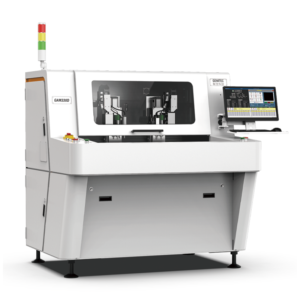

Saw-blade depaneling is fast but unforgiving. A 1.6 mm FR-4 stack-up with 12 copper layers looks nothing like a 0.8 mm two-layer panel when it meets a 300 mm diameter tungsten blade running at 4,500 RPM.
1. What Saw-Blade Depaneling Actually Does
A PCB saw blade depaneling machine uses a thin (0.4–0.8 mm) circular tungsten or diamond-coated blade spinning at 3,000–6,000 RPM to slice through the connecting bridges between boards. The cut is straight — saw blades cannot follow curves, mouse bites, or complex tab geometries.
Where saw-blade works well:
- Thick FR-4 multilayers (3.2 mm, 6.4 mm) where router bit breakage would be high
- Aluminum-backed and copper-substrate PCBs (high thermal mass)
- Long straight cuts between identically-shaped boards on a panel
- Ceramic PCBs (DBC, AMB) where the rigidity resists deflection
Where saw-blade struggles:
- Curved or irregular board outlines
- Panels with components placed within 1.5 mm of the cut line (vibration)
- Stack-ups that flex under blade pressure (thin FR-4 below 0.8 mm)
- Panels with internal cutouts the saw cannot reach
2. What a PCB Router Does Differently
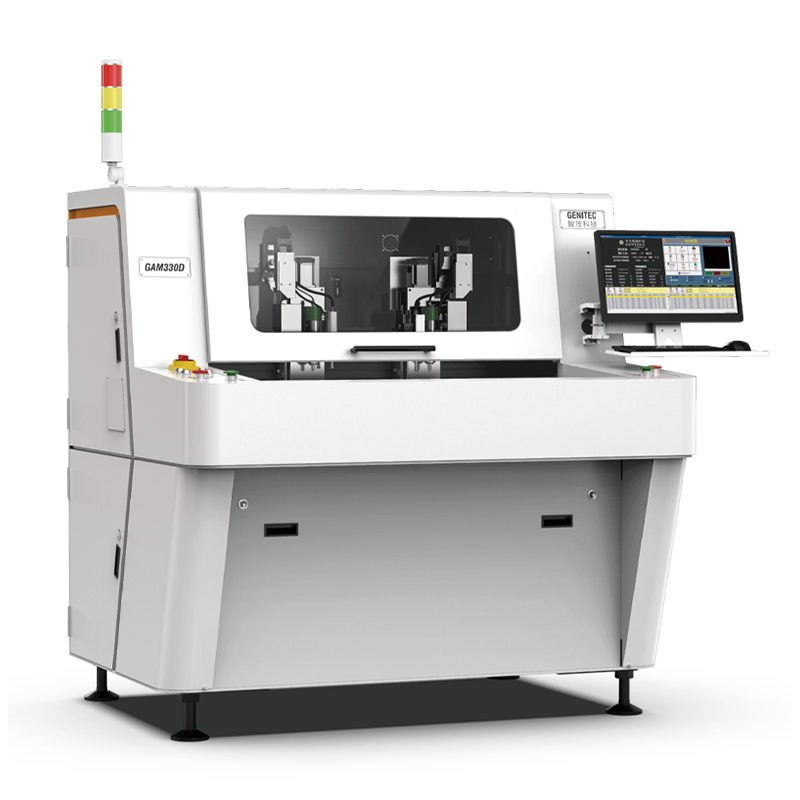
A PCB router machine uses a 0.8–1.5 mm tungsten carbide or diamond-coated milling bit on a high-speed spindle (40,000–100,000 RPM) traced along a programmed path. The path can be any 2D shape — straight cuts, curves, mouse bites, internal slots, and combinations.
The router’s edge quality is fundamentally different: instead of crushing the laminate with a blunt blade, it shears material cleanly. For most FR-4 stack-ups, the result is:
- ±0.05 mm cut tolerance vs ±0.20 mm for saw
- No heat-affected zone — bit temperature stays below 80 °C
- No micro-cracks along the cut edge (a saw’s biggest failure mode on multilayer stack-ups)
- Tool change every 30–80 m of cut, depending on stack-up (bit cost is the operating expense)
3. Decision Matrix
| Criterion | PCB Router | Saw Blade |
|---|---|---|
| Maximum board thickness | 4.0 mm typical; up to 6 mm with slow feed | 10+ mm (no practical limit) |
| Cut tolerance | ±0.05 mm | ±0.20 mm |
| Cut shapes | Any 2D path (curves, slots, mouse bites) | Straight lines only |
| Edge stress / micro-cracks | Minimal (shearing) | Moderate to high on multilayer |
| Dust generation | FR-4 fines + vacuum extraction | Coarse chips + larger dust load |
| Blade / bit life | 30–80 m per bit (₵$15–25) | 5,000–20,000 cuts per blade (₵$80–200) |
| Cycle time per board (typical) | 8–20 sec | 2–4 sec (faster but no curves) |
| Capital cost (2026) | $30K–$120K | $8K–$25K |
| Best fit | Curved panels, multilayer, mixed boards | Thick straight-cut multilayers, ceramic, DBC |
4. When to Pair Both (Hybrid Cell)
Many EMS providers running automotive or aerospace work keep both technologies side by side. The router handles curved mouse-bites and mixed-board panels; the saw handles the thick straight-line backbone on long multilayers. The capital cost is justified once volume exceeds 8–12K boards/month.
For an in-depth comparison of router vs another common technology, see our PCB laser depaneling page — laser handles ceramics and ultra-thin flex where neither router nor saw performs well.
5. Specs That Matter When You Compare Quotes
- Spindle RPM: 40K is the floor for clean cuts on FR-4; 60K+ for high-frequency laminates
- Vision alignment: CCD with sub-pixel registration for ±0.01 mm placement
- Dust extraction: HEPA-grade top + bottom, integrated with the spindle housing
- Bit-change automation: auto tool changer (ATC) for unattended shifts
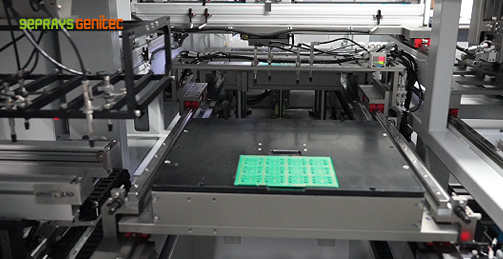
- Panel handling: SMEMA-compatible conveyors for inline integration
6. Common Defects and How to Avoid Them
The top failure mode for saw-blade on multilayer is micro-cracking along the cut edge — invisible until thermal-shock or reflow exposes it. With a router, the analogous failure is bit wear: a dull bit tears the copper cladding instead of cutting it.
Use a fresh bit every 30–60 m of cut on FR-4; every 15–20 m on high-Tg or high-frequency laminates. A PCB router machine with auto tool-change handles this without operator intervention.
7. Pricing Reality in 2026
Entry-level offline PCB router machines start around $28K. Inline cells with vision and ATC run $80K–$140K. Saw-blade machines are 3–5× cheaper to buy but the operating cost (blades, dust system maintenance) is higher per cut.
8. Recommendation
If your panel is 95% straight cuts on multilayers above 2.0 mm, a saw-blade machine is the right primary tool. If your panels include curved outlines, mouse bites, mixed boards, or stack-ups below 1.6 mm, a PCB router machine will outperform saw in yield and edge quality. For most EMS providers serving automotive, medical, or industrial, a router-first hybrid cell is the standard configuration.
For a comparison with another common method, see our PCB router machine overview page and the laser-depaneling decision guide.
About Seprays Precision Machinery

Founded in 1993, Seprays Precision Machinery has over 30 years of expertise in PCB depaneling solutions. With two manufacturing facilities totaling 26,000 m², 9 service centers across China, and clients in 31 countries — including Foxconn, Flex, Luxshare, Bosch, and CRRC — Seprays delivers equipment that consistently meets the demanding tolerances of automotive, medical, aerospace, and consumer electronics production lines.
Certifications: ISO 9001, ISO 14001, ISO 45001, CE. Patents: 100+. Need a customized depaneling solution or want to discuss your specific production requirements? Our technical team is ready to help. Contact: jimmy@seprays.com
FAQ
Q1: What spindle speed is right for FR-4 PCB routing?
A: 40,000–60,000 RPM is the standard range for FR-4. Lower speeds cause tearing; higher speeds require diamond-coated bits.
Q2: How often should I replace the spindle on a PCB router machine?
A: Every 25,000 hours in a clean environment, 12,000–15,000 hours with average dust management, 8,000 hours if dust extraction is poor.
Q3: Can a PCB router machine cut ceramic PCBs?
A: Yes, with diamond-coated bits and reduced feed rates (30–60 mm/min). For ultra-thin ceramics, consider laser depaneling instead.
Q4: What is the typical bit life on FR-4?
A: 30–80 m of cut per bit, depending on stack-up thickness and RPM. Plan $0.10–0.30 in bit cost per board.
Q5: How do I know if my spindle bearings are wearing?
A: Audible noise, vibration above 4 mm/s RMS, or degraded cut quality that doesn’t improve with bit replacement. Plan a spindle swap.