
PCB routing and laser depaneling are both widely used for separating PCB and PCBA panels, but they solve different production requirements.
The following 5-step selection method can help you determine which process is more suitable for your PCB production.
1. Router vs. Laser Depaneling: The Key Difference at a Glance
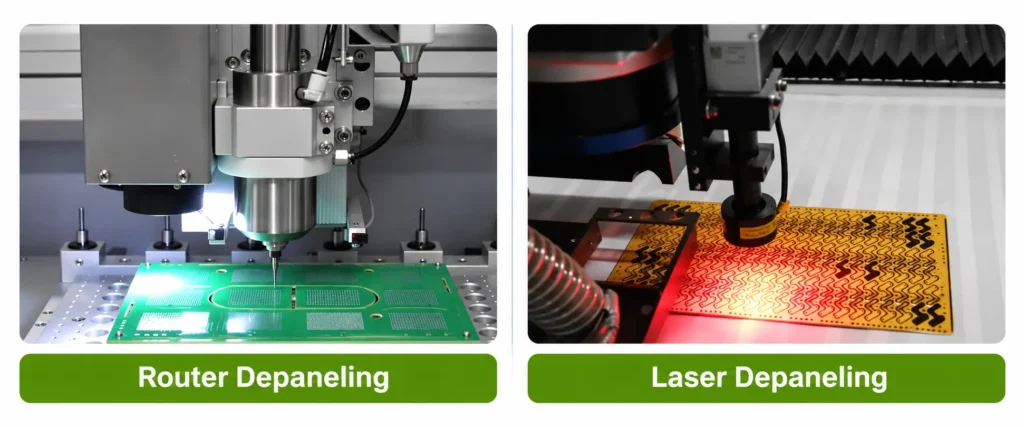
The main difference is the cutting method.
A router depaneling machine uses a physical router bit to remove material along the programmed cutting path, while a laser depaneling machine uses a focused laser beam without a cutting tool contacting the PCB.
| Comparison | Router Depaneling | Laser Depaneling |
|---|---|---|
| Cutting Method | Mechanical router bit | Non-contact laser |
| Mechanical Stress | Low, but still mechanical | No physical cutting contact |
| Typical Products | Mainly rigid PCB / PCBA | PCB, FPC and thin or sensitive substrates |
| Cutting Path | Flexible | Highly flexible |
| Process By-product | Cutting dust | Laser fumes |
| Cutting Tool Wear | Router bit is consumable | No router-bit wear |
| Main Selection Focus | Productivity, automation, rigid PCB | Precision, low stress, complex geometry |
The question is not which technology is universally better, but which cutting process better matches your PCB and production requirements.
2. How to Choose Between Router and Laser Depaneling in 5 Steps
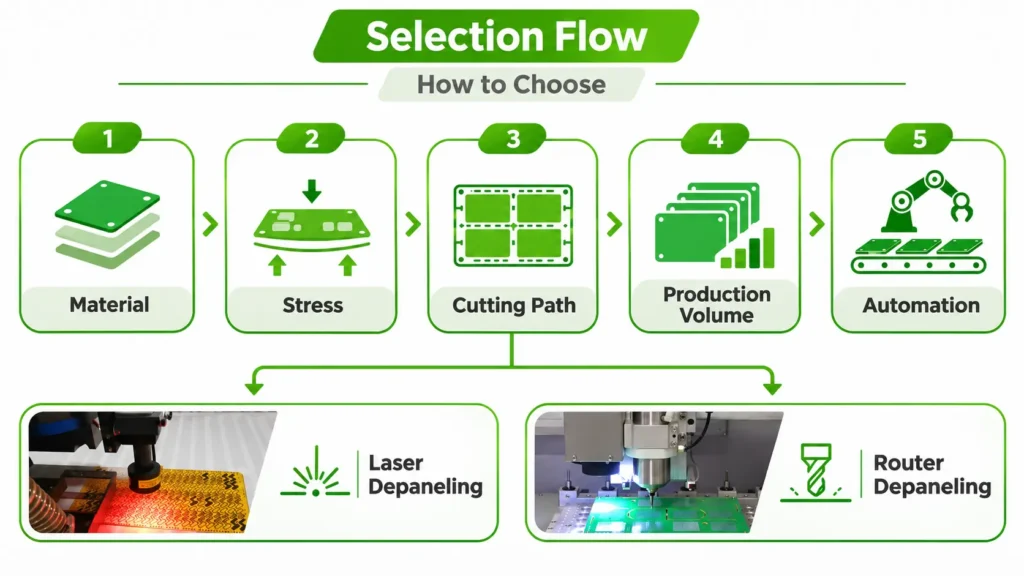
The selection process can be simplified into five steps:
Step 1 → Check PCB Material and Stress Sensitivity
Step 2 → Check Board Structure, Cutting Path and Component Clearance
Step 3 → Compare Production Volume and Automation Requirements
Step 4 → Compare Cut Quality, Dust / Fume and Maintenance
Step 5 → Verify the Process With Your Actual PCB
These five steps help move the decision away from a simple machine-specification comparison and toward the actual PCB and production process.
3. Step 1: Start With PCB Material and Mechanical Stress
For conventional rigid PCB and PCBA production, router depaneling is often a practical starting point.
The PCB is mechanically separated by a rotating router bit, making the process suitable for many FR4 boards and tab-routed panels. The final result depends on the router bit, fixture support, cutting parameters, and machine structure.
Laser depaneling uses non-contact processing. There is no router bit physically cutting through the panel, so the process can be particularly useful for FPCs, thin substrates, precision products, or applications where mechanical stress must be minimized.
For standard rigid PCB production, routing is often practical; when material sensitivity or mechanical stress becomes the main concern, laser depaneling deserves stronger consideration.
4. Step 2: Check Cutting Path, Board Structure and Component Clearance
The next question is whether the cutting system can follow the required path without interfering with the PCB or nearby components.
Router depaneling can process straight lines, curves, circles, and irregular routing paths. However, the spindle, router bit, dust collection structure, and fixture all require physical space around the cutting area.
Laser depaneling offers greater freedom when the cutting path becomes narrow or geometrically complex because no router bit has to physically pass through the panel.
For PCBAs with components close to the cutting line, component height and available clearance should therefore be checked carefully when evaluating a router machine.
Board thickness and material structure should also be considered. Neither technology should be selected from thickness alone—the actual material, cutting path, edge-quality requirement, and process parameters should be evaluated together.
5. Step 3: Compare Production Volume and Automation Requirements
Once the PCB itself has been evaluated, the next step is to consider production volume.
Router depaneling is widely used for continuous rigid-PCB production and can be configured as offline, dual-table, or inline automated equipment.
Laser depaneling can also be automated, but its actual production performance depends on the laser source, material, cutting length, path complexity, and required process quality.
For either technology, do not compare only the cutting movement itself.
Loading → Positioning → Vision Alignment → Cutting → Unloading
The correct comparison is the complete Cycle Time, not simply routing speed or laser cutting speed.
6. Step 4: Compare Cut Quality, Dust / Fume and Maintenance
Cut Quality
Router depaneling can produce clean and consistent edges when the router bit, fixture, machine positioning, and cutting parameters are properly matched.
Laser depaneling provides non-contact cutting and can be useful for fine contours and precision applications, although the final cut quality still depends on the PCB material and laser parameters.
Dust vs. Fume
Router cutting removes PCB material mechanically and therefore requires an effective dust collection system around the cutting area.
Laser depaneling does not generate router dust in the same way, but laser processing produces fumes and therefore requires suitable extraction.
Maintenance
Router bits are consumable tools and need periodic replacement.
Laser systems do not use router bits, but the laser source, optical system, extraction system, and other machine components still require appropriate maintenance.
Neither process is maintenance-free—the maintenance requirements are simply different.
7. GAM336AT Router vs. ZAM330AT Laser: Two Real Machine Examples
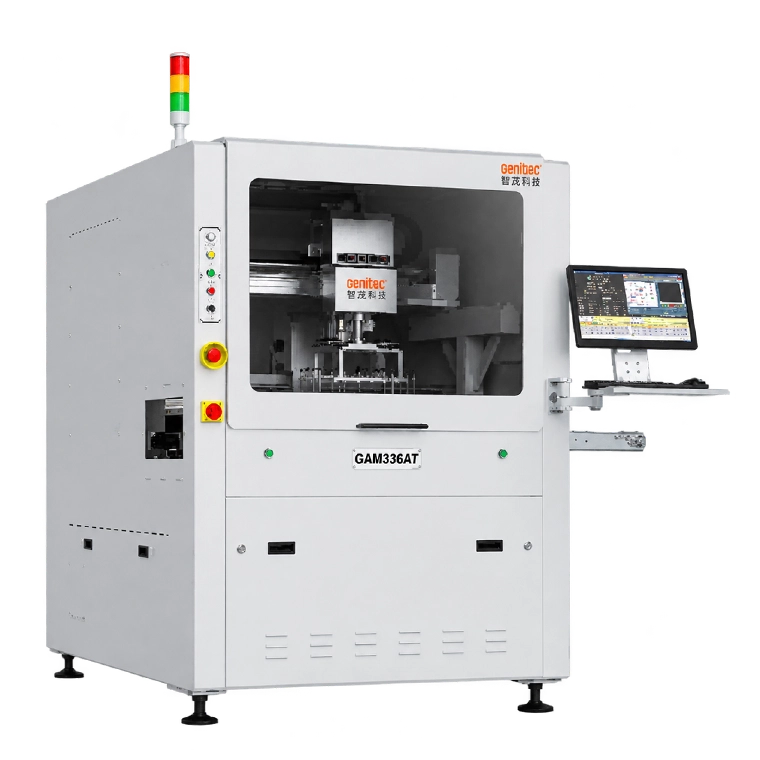
GAM336AT In-Line Automatic PCB Router Machine
The GAM336AT represents an inline mechanical-routing solution designed around continuous PCB production and automation.
- Inline automatic PCB routing
- Dual-table structure
- Valid cutting size starting from 350 × 300 mm depending on model
- Repeat precision: ±0.01 mm
- Cutting precision: ±0.05 mm
- Adjustable spindle speed up to 100,000 rpm
- Automatic tool change
This type of configuration is suitable when the production goal is continuous mechanical routing combined with automated PCB transfer and stable production flow.
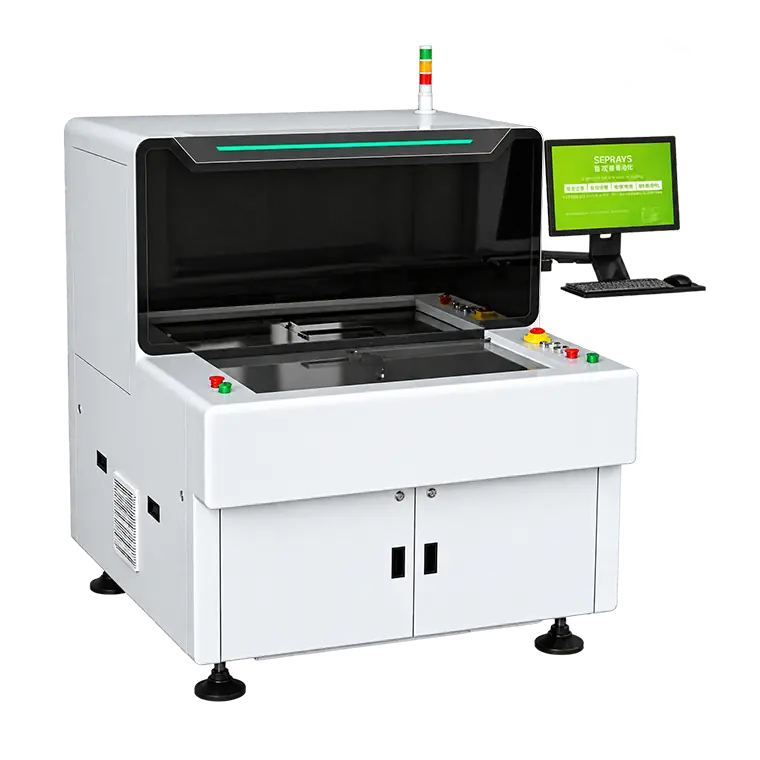
ZAM330AT PCB/FPC Laser Depaneling Machine
The ZAM330AT represents a precision laser-depaneling solution using non-contact processing.
- 350 × 400 mm valid cutting area
- Machine precision: ±30 μm
- Repeat precision: ±3 μm
- X/Y resolution: 1 μm
- Green / UV laser options
- Picosecond / nanosecond laser-source options depending on configuration
This configuration focuses more on precision, non-contact cutting, and the ability to match different laser sources to different PCB or FPC materials.
| Comparison | GAM336AT Router | ZAM330AT Laser |
|---|---|---|
| Cutting Process | Mechanical routing | Non-contact laser |
| Production Focus | Inline routing / continuous production | Precision / low-stress processing |
| Cutting Area | From 350 × 300 mm depending on model | 350 × 400 mm |
| Precision Focus | CCD positioning + routing accuracy | High-resolution laser positioning |
| Cutting Consumable | Router bit | No router bit |
Not sure which process fits your PCB? Send your sample or Gerber / DXF file to SEPRAYS for a quick process evaluation.
8. Which One Should You Choose?
If you need a quick decision, use these priorities:
- Conventional rigid PCB / PCBA production: Start by evaluating router depaneling.
- High-volume inline PCB production: Router depaneling is often worth prioritizing.
- FPC or thin sensitive substrates: Evaluate laser depaneling.
- Very low mechanical stress requirement: Evaluate laser depaneling.
- Complex or narrow cutting paths: Laser depaneling may provide more flexibility.
- Flexible mechanical routing with offline or inline automation: Evaluate router depaneling.
For applications that sit between these categories, actual sample testing is more reliable than choosing a process based only on the technology name.
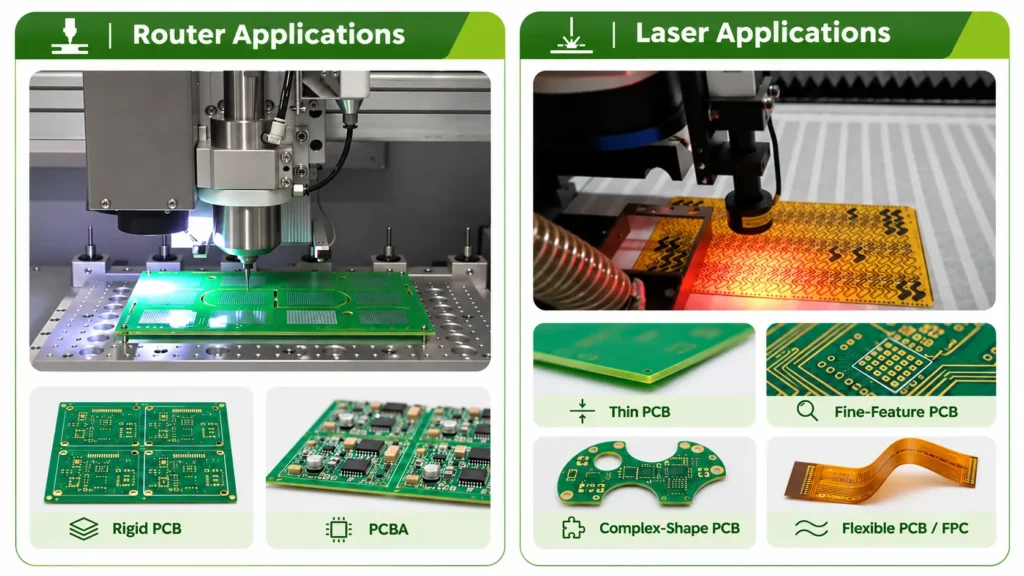
9. Typical Applications for Laser and Router Depaneling Machines
Laser Depaneling Machine Applications
① FPC and thin-substrate processing
Non-contact laser cutting is useful when the material is thin, flexible, or sensitive to mechanical force.
② PCB products with complex or narrow cutting paths
Laser processing can follow fine contours where physical router-bit clearance may be limited.
③ Applications requiring very low mechanical stress
Suitable for products where physical cutting pressure or mechanical contact should be minimized.
Router Depaneling Machine Applications
① Conventional rigid PCB and PCBA production
Routing is widely suitable for FR4 boards and tab-routed PCB panels.
② High-volume or inline automated production
Router machines can be integrated with conveyors, dual tables, loading systems, and downstream automation.
③ Products requiring flexible mechanical cutting paths
Router systems can process straight lines, curves, circles, and irregular contours while maintaining high production flexibility.
The final selection should still be verified using the actual PCB, because material, thickness, component layout, panel design, and target output can all affect the result.
10. Where Can You Find a Reliable PCB Depaneling Machine Manufacturer?
A reliable PCB depaneling machine manufacturer should be able to provide more than a machine specification sheet.
The supplier should be able to support:
- different depaneling technologies;
- PCB / PCBA process evaluation;
- sample testing;
- fixture and automation planning;
- machine configuration;
- after-sales and technical support.
SEPRAYS provides router, laser, V-groove, and automated PCB depaneling solutions for different production requirements.
Customers can provide PCB / PCBA samples, Gerber or DXF files, board thickness, component height, cutting requirements, and target output for process evaluation before machine selection.
Need help choosing between router and laser depaneling? Contact SEPRAYS for sample testing and process evaluation.
Email:millie@seprays.com
WhatsApp:+86 139 2552 7370
11. Conclusion
Router and laser depaneling are not competing technologies for exactly the same applications.
Router depaneling is often a practical choice for rigid-PCB production and automation, while laser depaneling becomes especially valuable when non-contact processing, low mechanical stress, or complex precision cutting is required.
Start with the PCB itself, follow the selection steps, and verify the final decision with your actual product.