
Thin PCBs require more careful control of positioning, cutting conditions, and board handling than standard rigid boards.
The following points can help you quickly evaluate whether a router depaneling machine is suitable for your thin PCB production.
1. What Matters Most When Routing Thin PCBs?
When evaluating a router machine for thin PCBs, focus on four areas:
Board Handling → Cutting Control → Positioning Accuracy → Edge Quality
The goal is not simply to use a faster spindle or a smaller router bit.
2. Use This Simple 4-Step Selection Method
A practical selection process can be simplified into four steps:
Step 1 → Confirm PCB Thickness and Material
Step 2 → Check How the PCB Is Positioned and Controlled During Cutting
Step 3 → Check Positioning Accuracy and Cutting Quality
Step 4 → Confirm the Machine Fits Your Production Method
These four checks are usually enough to narrow down the suitable machine type before comparing detailed specifications.
3. Make Sure the Routing Process Is Suitable for Thin Boards
Thin PCBs can be processed reliably when the routing conditions are properly matched to the product.
The most important factors are:
- suitable router-bit size;
- stable PCB positioning;
- appropriate cutting parameters;
- a routing path that matches the PCB structure.
The machine should allow these factors to be adjusted according to the actual board rather than relying on one fixed process.
For thin PCBs, process control is more important than simply choosing the highest spindle speed.
4. Pay Attention to Positioning Accuracy and Cutting Margin
Thin boards often have limited space between the cutting path and nearby circuits or components.
This makes positioning accuracy especially important.
CCD vision positioning can help identify the PCB reference position before cutting, while good machine repeatability helps maintain the same routing path during repeated production.
If the cutting margin is small, buyers should pay particular attention to:
- positioning method;
- cutting accuracy;
- repeatability;
- routing-path consistency.
The smaller the available cutting margin, the more important accurate positioning becomes.
5. Check Edge Quality and Cutting Consistency
For thin PCB production, buyers should not judge the machine only by whether it can complete the cut.
The finished edge should also remain consistent from board to board.
When evaluating the routing result, check:
- whether the edge is clean;
- whether the contour matches the programmed path;
- whether burrs are within the acceptable range;
- whether repeated boards show similar cutting results.
A stable routing process should provide consistent quality across continuous production, not only on the first sample.
6. Match the Machine to Your Production Method
Thin PCB production may be handled with offline, dual-table, or inline router machines depending on output and automation requirements.
| Production Requirement | Suitable Direction |
|---|---|
| Frequent product changes | Offline router machine |
| Batch production with reduced loading wait time | Dual-table router machine |
| Continuous automated production | Inline router machine |
| Small cutting margin | Machine with reliable vision positioning |
| Multiple thin PCB models | Flexible program and parameter adjustment |
The most suitable machine structure depends on your production flow, not only on PCB thickness.
7. Quick Checklist Before Choosing a Thin PCB Router Machine
Before purchasing, confirm the following information with the machine supplier:
| Item | What to Confirm |
|---|---|
| PCB Thickness | Whether the machine can process your actual board thickness |
| PCB Material | FR4 or other substrate type |
| Cutting Path | Straight, curved, circular, or irregular contour |
| Cutting Margin | Distance from the routing path to circuits or components |
| Positioning | Whether vision positioning is required |
| Production Volume | Offline, dual-table, or inline production |
| Cut Quality | Edge-quality requirement after depaneling |
This information gives the supplier a much clearer basis for machine and process evaluation.
8. Let the Supplier Evaluate the Actual PCB Before Final Selection
For thin PCB applications, the most reliable way to choose a depaneling process is to evaluate the actual product.
You can provide SEPRAYS with:
- PCB or PCBA samples;
- board thickness and material;
- Gerber or DXF files;
- cutting-path requirements;
- component layout;
- acceptable stress level;
- target production output.
Based on this information, SEPRAYS can evaluate whether router depaneling is suitable, recommend an appropriate machine configuration, and arrange trial cutting when necessary.
For extremely thin or highly stress-sensitive products, laser depaneling may also be evaluated as an alternative.
Not sure which depaneling process fits your thin PCB? Send your requirements to SEPRAYS for a professional process evaluation and trial-cutting recommendation.
9. Conclusion
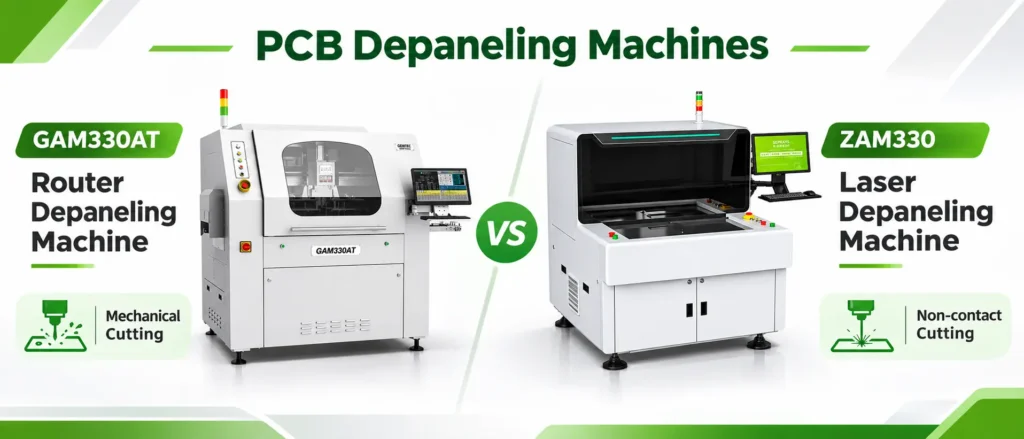
Choosing a router depaneling machine for thin PCBs mainly depends on board handling, cutting control, positioning accuracy, edge quality, and production requirements.
For most thin rigid PCBs, a properly configured router machine can provide stable and consistent depaneling. The final choice should be based on the actual PCB structure and production requirements rather than board thickness alone.
Contact SEPRAYS if you would like us to evaluate your thin PCB and recommend a suitable depaneling solution.
Email:millie@seprays.com
WhatsApp:+86 139 2552 7370