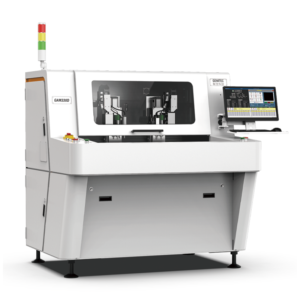

PCB Router for IoT & Wearable Devices: Miniaturized Depaneling Done Right
IoT and wearable devices — fitness bands, smartwatches, hearables, asset trackers, environmental sensors, medical wearables — push PCB depaneling to its limits. Boards are tiny (sometimes under 20 × 30 mm), densely populated with BGAs and 0201 passives, often built on flex or rigid-flex stack-ups. The PCB router machine for these products has to deliver millimeter accuracy without damaging near-edge components, and the process window is so tight that statistical process control is mandatory from day one.
This guide explains what makes IoT depaneling unique, which PCB router features matter, and how to validate the process for mass production.
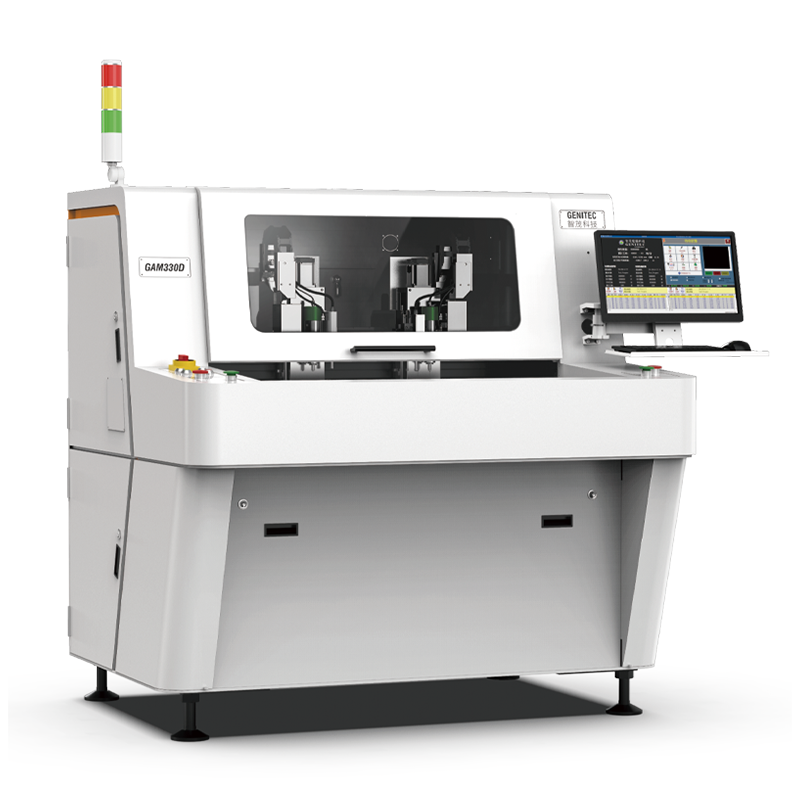
Why IoT Depaneling Is Different
Three characteristics dominate the IoT product class:
- Tiny board area. Single-board area often 15–50 mm. A standard FR-4 panel can hold 8–24 boards; routing precision becomes the dominant process variable.
- High component density. BGAs, µBGAs, 0201 / 01005 passives, narrow-pitch ICs. Component-to-edge clearance often under 0.4 mm.
- Flex / rigid-flex stack-ups. Many wearables have flex tails that connect to rigid mainboards. The two stack-ups need different cutting approaches.
These constraints rule out V-cut depaneling (V-groove cannot reach such tight outlines), and put huge pressure on PCB router machine precision and bit-life management.
Process Window for IoT / Wearable Depaneling
| Parameter | IoT Spec | Why |
|---|---|---|
| Spindle speed | 50,000–80,000 RPM | Cleaner cut on small outlines |
| Bit diameter | 0.6–1.0 mm | Tight curvature support |
| Edge clearance to components | ≥ 0.4 mm | Most modern IoT layouts |
| Edge roughness Ra | ≤ 1.6 µm | Aesthetic + mechanical |
| Bit wear monitoring | Force + vibration, continuous | Detects dulling before sub-clinical edge damage |
| Vacuum hold-down | ≥ 0.6 bar per zone | Flex boards wrinkle without strong hold-down |
| Process Cpk | ≥ 1.50 | Mass-production tolerances |
| Per-board cycle time | 6–12 sec (small board area) | Throughput target |
Choosing the PCB Router for IoT Production
Specify a PCB router machine with these features for IoT:
- Vision alignment at ≥ 5 MP camera resolution, with fiducial-based correction.
- High-speed spindle (60K+ RPM) with low run-out (≤ 3 µm).
- Bit wear monitoring — vibration sensor and force-monitored feed.
- Small-diameter bit support with auto-tool-changer for 0.6–1.0 mm bits.
- CAM-driven recipe management — fast changeover for high-mix production.
- Compatible with flex / rigid-flex — low-vibration spindle and dedicated flex fixtures.
For a high-precision router with these capabilities, see the Seprays PCB router machine family.
Common IoT Defects and Fixes
BGA fracture within 0.5 mm of cut
Mechanical force transmits through the laminate and shear-s the BGA pad-stack. Fix: vibration-monitored bit wear; minimum 0.4 mm clearance; or switch to laser depaneling for affected edges.
Flex tail stress-whitening
Polyimide materials tend to stress-whiten under mechanical force. Fix: laser depaneling for flex portions, OR a router with low-vibration spindle and tensioned fixture.
Edge burrs on 0.6 mm boards
Sub-millimeter boards delaminate at the cut edge if the bit is dull. Fix: vibration-monitored bit wear; replace bits every 5,000–10,000 cuts.
Inconsistent board dimensions
Thermal expansion between cutting cycles distorts dimensions. Fix: cool the spindle and the panel; maintain factory climate at 22 ± 2 °C.
Three IoT Sub-Categories and Their Processes
1. Wearables (smartwatches, fitness bands, hearables)
Miniaturized rigid-flex boards, sub-30 mm. Process: high-precision router with vision alignment; laser depaneling for the flex tails; cleanroom-compatible exhaust for medical-wearable applications.
2. Smart home devices (voice assistants, security sensors)
Larger boards, mixed FR-4 and PTFE WiFi/BT antennas. Process: inline PCB router machine with dual-spindle; throughput target ≥ 18 sec/board.
3. Industrial IoT / asset trackers
Mid-size ruggedized boards with vibration-damped enclosures. Process: offline or inline PCB router depending on volume; aluminum-substrate variants need diamond-coated bits or laser depaneling.
Process Validation for Mass Production
For IoT mass production, validate the depaneling step with:
- First-article inspection on 5 boards per part number — measure dimensions, cross-section the cut edge, run functional test on a sample.
- Capability study (Cpk) on 25 boards — verify Cpk ≥ 1.50 on cut-edge dimension and roughness.
- Long-run stress test — 1,000 cut cycle to validate bit wear curve.
- Drop test on the finished assembly — verify edge integrity under simulated handling.
- Continuous SPC during production, with bit-wear alarms.
ROI: A Wearable OEM Case Study
A smartwatch OEM producing 220,000 boards/month on 14 part numbers replaced manual V-cut + hand-depaneling with an inline PCB router machine plus laser depaneling station for flex tails:
- BGA-related defect rate: 2.6% → 0.2%
- Operator hours: 3 FTE → 0.5 FTE
- Bit consumption: $2,400/mo → $1,400/mo
- Payback: 8.2 months
Material-Specific Quick Reference
| Material | Best PCB Router Setup |
|---|---|
| FR-4 (standard) | 60K RPM, 1.0 mm bit, 2 mm/sec feed |
| High-Tg FR-4 | 50K RPM, 1.0 mm bit, 1.5 mm/sec feed |
| Polyimide flex | Low-vibration router OR laser depaneling |
| Rigid-flex hybrid | Two-stage router + laser cell |
| Aluminum substrate (MCPCB) | Diamond-coated bit OR laser |
Conclusion
IoT and wearable depaneling is unforgiving — the boards are small, the components are dense, and the cut-edge quality affects reliability. A PCB router machine with high-precision vision, vibration-monitored bit wear, and cleanroom-compatible exhaust delivers the most reliable mass-production depaneling. For mixed rigid-flex stack-ups, pair the router with a laser depaneling station — this is the standard layout for leading wearable OEMs. Seprays supplies and integrates both.
Frequently Asked Questions
1. Why does IoT depaneling need a router instead of V-cut?
V-cut only supports straight lines, but IoT boards have curves, internal cutouts, and complex outlines. A PCB router machine cuts any 2D geometry with sub-millimeter precision — V-cut cannot.
2. What bit diameter works best for 20 × 30 mm IoT boards?
0.8 mm is the typical sweet spot for IoT boards, supporting inner curves down to 1.5 mm radius. Below 0.6 mm, bit life drops sharply and vibration concerns grow.
3. Can a single PCB router handle IoT’s high part-number mix?
Yes — most IoT EMS lines run 8–40 part numbers through the same machine. With CAM-driven recipe management, changeover is under 60 seconds. The constraint is fixture design, not the router itself.
4. Is laser depaneling better than router for wearables?
For flex and rigid-flex portions, laser depaneling is the better choice — zero mechanical stress, sub-millimeter precision. For the rigid mainboards, a router is more economical. Most wearable OEMs use a hybrid cell.
5. What’s the typical cycle time for an IoT board?
6–12 seconds per board on a high-precision router with 0.8 mm bit. Dual-spindle routers can halve this for very high-volume IoT lines.
About Seprays Precision Machinery
Founded in 1993, Seprays Precision Machinery has over 30 years of expertise in PCB depaneling solutions. With two manufacturing facilities totaling 26,000 m², 9 service centers across China, and clients in 31 countries — including Foxconn, Flex, Luxshare, Bosch, and CRRC — Seprays delivers equipment that consistently meets the demanding tolerances of automotive, medical, aerospace, and consumer electronics production lines.
Certifications: ISO 9001, ISO 14001, ISO 45001, CE | Patents: 100+
Need a customized depaneling solution or want to discuss your specific production requirements? Our technical team is ready to help.
jimmy@seprays.com · PCB Router Machine · PCB Laser Depaneling