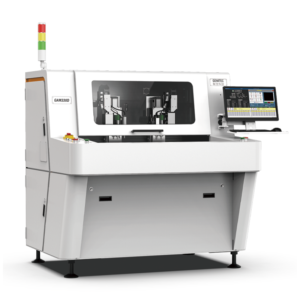

This guide explains the 7 specifications that actually separate a good PCB router from the rest, in the order you should evaluate them. Whether you are a startup EMS or a Tier-1 supplier adding capacity, by the end of this article you will know what to put on your RFQ.
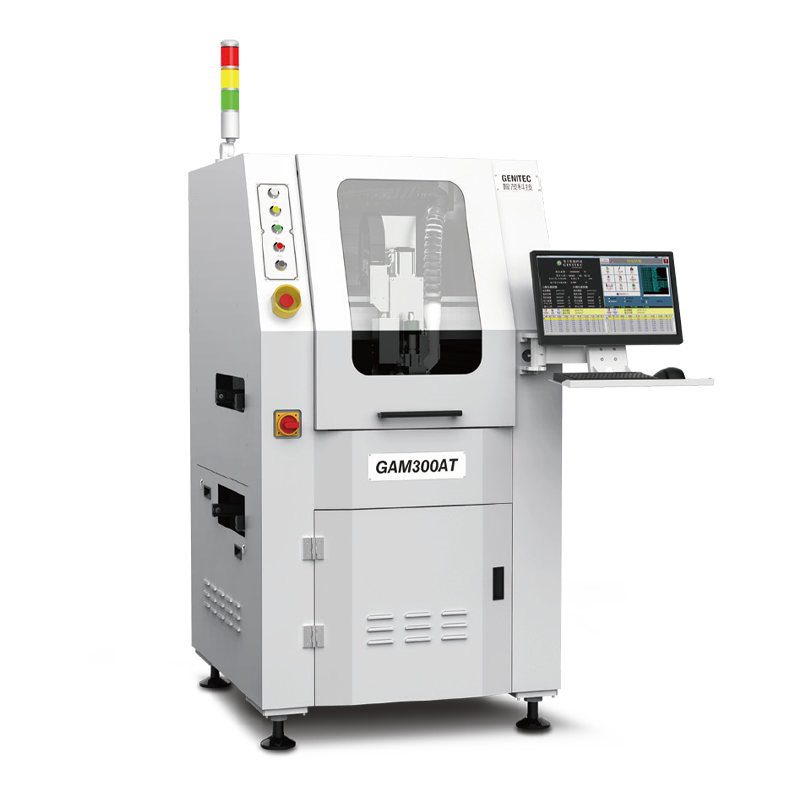
Specification #1: Spindle Speed and Power
Spindle speed dictates cut quality and bit life. Look for a minimum of 40,000 RPM, with 60,000–80,000 RPM available for higher-quality FR-4 cuts. Power is equally important: a 1.5 kW spindle handles ceramic-filled PTFE; a 0.5 kW spindle stalls on thick stack-ups.
| Material | Recommended Spindle |
|---|---|
| FR-4 (standard, ≤1.6 mm) | 40–60K RPM, 0.5–1.0 kW |
| High-Tg FR-4 (≥ 1.6 mm) | 50–70K RPM, 1.0–1.5 kW |
| PTFE / RO4003 | 60–80K RPM, 1.5 kW with vacuum dust extraction |
| Ceramic (Al₂O₃ / AlN) | 30–50K RPM, 1.5+ kW, diamond-coated bits |
| Aluminum-backed MCPCB | 20–40K RPM, 1.5 kW, single-flute bit |
Specification #2: Axis Travel and Repeatability
Travel dictates the largest panel the router can handle. Repeatability dictates edge quality across thousands of cycles.
- X/Y axis travel: 400×400 mm minimum for typical phone boards; 600×800 mm for server / EV boards.
- Z axis travel: at least 50 mm to accommodate thick stack-ups.
- Repeatability: ± 0.01 mm or better. Anything looser than ± 0.02 mm drops yield on dense boards.
- Maximum speed: 800–1,200 mm/sec rapid traverse; 50–100 mm/sec cutting traverse.
Specification #3: Bit-Wear Monitoring
This is the single biggest predictor of long-term edge quality. Without it, you are running blind.
- Force-monitored feed — slows the spindle when cut force rises above a threshold.
- Vibration-monitored bit wear — detects dulling via accelerometer; pauses the cycle.
- Auto-replacement at threshold — counts cuts and prompts the operator before bit exhaustion.
A PCB router machine without these features costs you 1–3% yield through sub-clinical edge damage.
Specification #4: Vision and Alignment
A CCD vision system with fiducial alignment handles:
- Multi-up panels with ± 0.2 mm tolerance on panel position.
- Compensation for panel shrinkage or warp on ceramic substrates.
- Automatic CAD-to-panel offset mapping.
Look for at least 2 cameras (one upward for the panel, one downward for the spindle reference), with 5-megapixel resolution and sub-pixel alignment.
Specification #5: Dust Extraction Integration
Depaneling dust is a yield killer for BGAs and a bioburden risk for medical / aerospace. Specify:
- Under-table extraction at ≥ 2,500 m³/h.
- Spindle-local extraction — captures dust at the source.
- HEPA H13 final filtration if you produce aerospace or medical boards.
- Automatic filter monitoring with pressure-differential alarm.
Specification #6: Software & Connectivity
The router’s controller should integrate with your MES / QMS without custom code. Look for:
- Standard CAM import — Gerber RS-274X, ODB++, DXF.
- Direct CAD import (Altium, KiCad, Mentor) — cuts fixture-design time by 80%.
- OPC-UA / MQTT / REST integration — for MES data export.
- Production reporting — cycle time, defect log, bit usage.
- Multi-language UI — useful for global deployments.
Specification #7: Compliance & Service Network
Check that the OEM has the certifications your customer will ask for:
- ISO 9001 (baseline quality system).
- CE / UL (machine safety).
- Regional service network — critical for high-volume lines where downtime = lost revenue.
Seprays, with 9 service centers across China and clients in 31 countries, is a useful reference: ask any supplier for the same level of coverage.
Bonus: A 60-Second Decision Matrix
| If your priority is… | Prioritize Spec |
|---|---|
| High edge quality (auto/medical/aero) | #3 Bit-wear monitoring |
| High throughput | #1 Spindle power + #2 axis travel |
| Low operator count | #4 Vision + #6 Software |
| Lowest TCO | #3 Bit-wear monitoring + #5 Dust extraction |
| Easy integration with existing line | #6 Software & connectivity |
| Long service life | #1 Spindle + #7 Compliance |
Capital Cost vs Operating Cost
The mistake most buyers make is to optimize on sticker price. Over a 5-year horizon, the typical TCO split is:
- Capital (~30%) — machine + installation + fixture.
- Bits (~8%) — consumable.
- Energy (~12%) — electricity + extraction.
- Labor (~40%) — operator hours.
- Maintenance (~10%) — scheduled service + spindle bearings.
A slightly more expensive router with vibration-monitored bit wear reduces labor by 30%+ and bits by 40%+, easily repaying the capex premium inside 12 months.
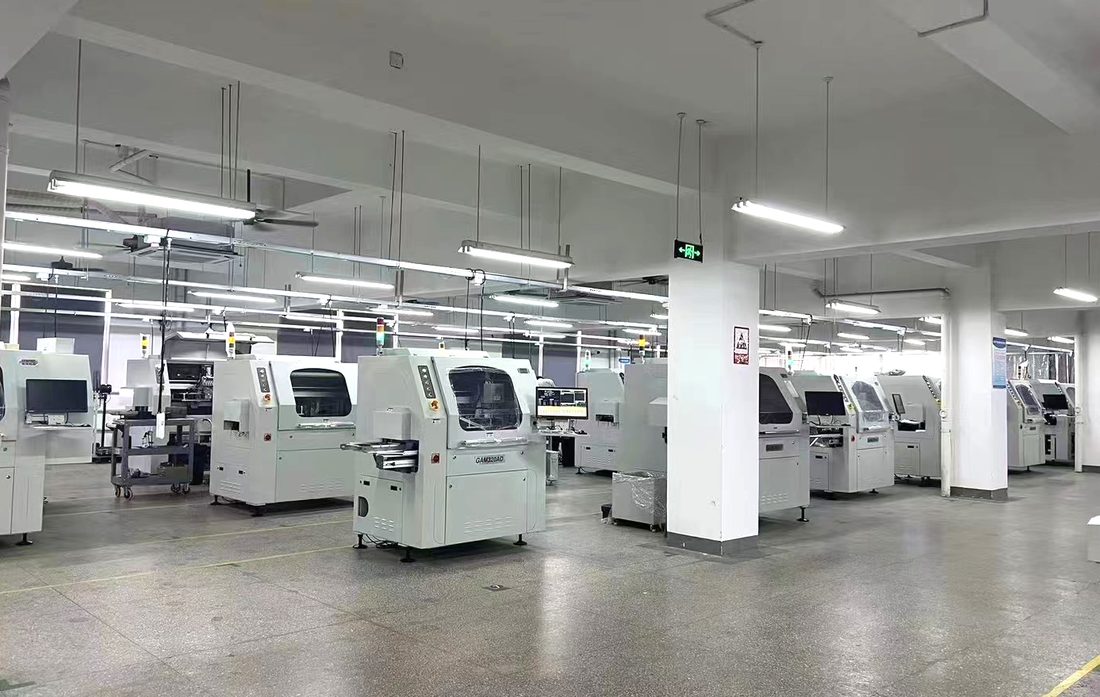
How to Compare Suppliers
Shortlist 3 suppliers and ask each for:
- A demonstration on your actual panel (most suppliers will offer a free sample depaneling run at their facility).
- A capex quote including installation, training, and the first year of service.
- A 24-month ROI projection based on your volume and current defect rate.
- Customer references in your industry.
- Service response-time SLA in your region.
For a free sample depaneling trial in your facility, see the Seprays PCB router machine family.
Conclusion
Choosing a PCB router machine is less about brand and more about matching specs to your application. Start with spindle speed and power, then work through axis travel, bit-wear monitoring, vision, dust extraction, software, and finally compliance. A well-specified router pays back in under 12 months and runs reliably for 8+ years.
Frequently Asked Questions
1. What is the most important spec on a PCB router?
Bit-wear monitoring. Without it, defects accumulate silently. With it, the machine maintains a consistent edge and stops before producing scrap. It’s the single feature that delivers the largest ROI on most lines.
2. Should I buy offline or inline PCB router machine?
For under 50K boards/month and rapid part-number changes, offline is more flexible. Above 50K boards/month, inline delivers lower labor cost and integrated SPC. For mixed production, an inline router with offline docking station covers both.
3. What spindle speed do I need for thick FR-4?
For 2–3 mm thick FR-4, 50–60K RPM with 1.0–1.5 kW spindle and feed rate 1.5–3 mm/sec is the safe starting range. Validate with a feed-rate DOE on your actual stack-up.
4. Can I retrofit vision alignment to an existing PCB router?
Some suppliers offer field retrofits; others don’t. Retrofitting typically costs 40–60% of a new machine and rarely matches the integration quality of a factory-fitted system. For most users, upgrading to a newer router is more cost-effective.
5. What warranty should I expect on a PCB router machine?
Industry standard is 12 months parts and labor, with extended warranty options of 24–36 months. Spindle bearings and vacuum pumps typically have shorter warranties (6 months) because they are consumables.
About Seprays Precision Machinery
Founded in 1993, Seprays Precision Machinery has over 30 years of expertise in PCB depaneling solutions. With two manufacturing facilities totaling 26,000 m², 9 service centers across China, and clients in 31 countries — including Foxconn, Flex, Luxshare, Bosch, and CRRC — Seprays delivers equipment that consistently meets the demanding tolerances of automotive, medical, aerospace, and consumer electronics production lines.
Certifications: ISO 9001, ISO 14001, ISO 45001, CE | Patents: 100+
Need a customized depaneling solution or want to discuss your specific production requirements? Our technical team is ready to help.
jimmy@seprays.com · PCB Router Machine · PCB Laser Depaneling