
PCB Router for Automotive Electronics: IATF-Compliant Depaneling Explained
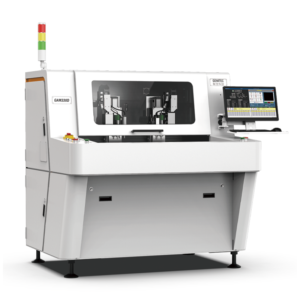
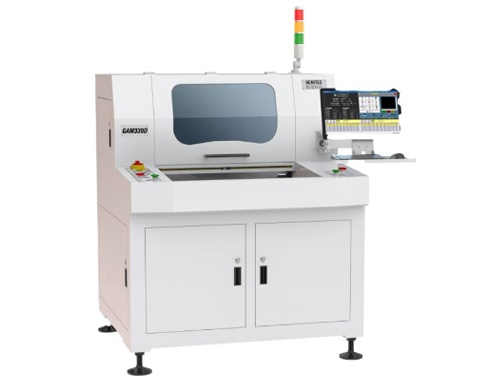
Automotive electronics are held to standards no consumer device ever sees. A modern vehicle carries 70–150 ECUs, each one a printed circuit board depaneled at the end of an SMT line. Tolerances for cut-edge stress, solder-joint fatigue, and long-term thermal cycling are non-negotiable. Tier-1 suppliers — Bosch, Continental, ZF, Aptiv, Denso — and contract manufacturers like Foxconn and Luxshare all rely on a class of equipment built specifically for that environment: the PCB router machine for automotive production.
This guide explains what automotive-grade depaneling actually means, which certifications matter, which process parameters separate a compliant line from an unsafe one, and how to specify a PCB router that survives IATF 16949, VDA 6.3, and the rigors of high-mix EMS production.
Why Automotive Depaneling is a Different Beast
Compared with consumer or mobile-phone board depaneling, automotive depaneling carries three compounding challenges:
- Edge strength must survive 100+ g of vibration — engine-mount ECUs, transmission controllers, ADAS radars.
- Component-to-edge clearances are extremely tight — 0.4–0.8 mm on densely packed ECU boards.
- Operating temperature swing from -40 °C to +125 °C — CTE mismatch at the cut edge becomes a long-term reliability risk.
V-cut scoring, while cheaper, tends to crack under those conditions. Most Tier-1s mandate tab-routing with a PCB router machine — or laser depaneling for the most demanding applications.
What IATF 16949 Means for Your Depaneling Process
IATF 16949 (replacing ISO/TS 16949) is the automotive QMS standard. It does not dictate a depaneling method, but it requires:
- Process FMEA covering every cutting parameter (feed, RPM, depth-of-cut).
- Control plans with documented reaction plans for bit wear, broken-bit detection, and spindle-vibration thresholds.
- PPAP / VDA 2 part submission for new part numbers, with cut-edge Cpk data.
- Traceability — every depaneled batch must link back to spindle, bit, fixture, and operator.
A modern PCB router machine captures all of this automatically through its controller and exports the records to MES/MII systems. Manual V-cut snap operations cannot.
Process Specification: The Numbers That Matter
| Parameter | Typical Automotive Spec | Why |
|---|---|---|
| Spindle speed | 40,000–60,000 RPM | Balance cut-edge finish and bit life |
| Feed rate | 1–5 mm/sec depending on stack-up | Avoids burr and thermal damage |
| Edge clearance to components | ≥ 0.5 mm | Prevents micro-crack propagation |
| Cut-edge Cpk | ≥ 1.33 | Statistical process control on cut tolerance |
| Bit wear monitoring | Force + vibration sensors | Detects dulling before it cracks a board |
| Vacuum fixture | Negative-pressure + ESD-safe | Holds board flat without flexing |
| Bit replacement trigger | Auto-stop at pre-set cut count | Avoids production drift |
| Cut edge roughness Ra | ≤ 6.3 µm | IPC-A-600 / IPC-A-610 acceptance |
Three Sub-Categories of Automotive PCBs, Three Process Variants
1. Powertrain & chassis ECUs (engine, transmission, ABS)
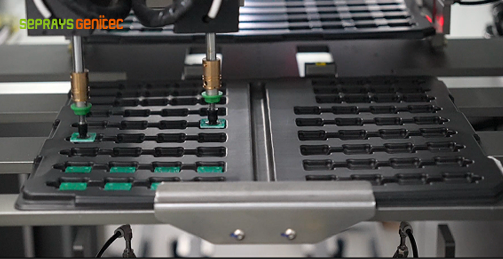
These boards run hot (up to 125 °C junction) and endure constant vibration. Process variant: tab-routing with a 0.8 mm bit, dual-spindle PCB router machine, edge clearance 0.6 mm, fully automated inline. Bit replacement every 50,000 cycles.
2. ADAS sensors (radar, lidar, vision)
These boards have high-frequency laminate (RO4350, RO4003) and tight edge-component clearances. Process variant: laser depaneling for sub-100 µm tolerances on the cut path, with a router station for the rectangular portions of the outline.
3. Infotainment & telematics
These are larger multilayer boards with mixed components. Process variant: high-throughput inline router with multi-board fixtures. Throughput target ≥ 18 sec/board.
Common Defects and How a Good Router Prevents Them
Edge cracking
The single most common automotive depaneling defect. Caused by dull bits, excessive feed rate, or V-cut stress concentration. Mitigation: use a PCB router machine with vibration-monitored bit wear, force-controlled feed, and tab-routing instead of V-cut.
Burr & dust
Burrs appear on entry/exit points when bit geometry is mismatched to material. Dust can short fine-pitch components. Mitigation: choose bit specifically designed for FR-4 / high-Tg laminate; pair router with under-table vacuum extraction at ≥ 2,500 m³/h.
Solder-joint fracture near the cut edge
Caused by lateral spindle force on components less than 0.5 mm from the cut. Mitigation: increase clearance, reduce feed rate by 30%, or switch to laser depaneling for those particular edges.
Inline vs Offline: Which Fits Your Line?
| Use Case | Recommended Form Factor |
|---|---|
| High-mix, low-volume prototyping | Offline / desktop PCB router |
| Medium volume (50K–200K boards/mo) on multiple SKUs | Inline single-spindle router with auto-fixture |
| High volume (200K+ boards/mo) on a few SKUs | Dual-spindle inline router with conveyor |
| Mixed FR-4 + flex / ceramic | Hybrid cell: router + laser depaneling station |
For an inline, IATF-compatible solution with conveyor integration and MES export, see the Seprays PCB router machine series.
ROI Example: A Tier-2 Automotive Supplier
A second-tier automotive electronics supplier running 90,000 boards/month on 6 part numbers replaced its manual V-cut snap station with an inline PCB router machine. Over 12 months:
- Edge-crack defect rate: 2.1% → 0.18% (-91%)
- Operator count: 2 → 0.5 (FTE)
- Bit consumables: $1,840/mo
- Payback period: 9.4 months
Conclusion
Automotive depaneling is one of the most demanding applications in SMT manufacturing. A PCB router machine — properly specified, with vibration-monitored bit wear, SPC-exportable control plans, and IATF-compatible traceability — is the foundation of a compliant, high-yield line. For mixed flex or ceramic, pair it with a laser depaneling station to cover the full material range without compromising edge integrity. Seprays supplies and integrates both technologies and supports globally.

Frequently Asked Questions
1. Why not just use V-cut for automotive PCBs?
V-cut pre-scoring creates a stress riser along the cut. In automotive applications — where ECUs experience continuous vibration and thermal cycling — V-cut edges show 1.9× more crack propagation than tab-routed edges. Most Tier-1 suppliers have moved to PCB router machines for that reason.
2. Is an inline PCB router compatible with IATF 16949 requirements?
Yes. Modern routers log every cutting parameter, spindle ID, bit ID, fixture ID, and operator ID to MES — satisfying PPAP, control plan, and traceability requirements far more cleanly than manual V-cut snap stations.
3. What spindle speed should I use for high-Tg FR-4?
For 0.8–1.6 mm thick high-Tg FR-4 (Tg ≥ 170 °C), 40,000–60,000 RPM with 2–4 mm/sec feed rate is a safe starting range. Always validate with cut-edge Cpk on your specific stack-up. Vibration-monitored force-feedback routers will self-adjust for bit wear.
4. Do I need a laser depaneling machine for automotive boards?
Not for FR-4 ECUs — a PCB router machine handles them well. You do want a laser depaneling station if you have ADAS radar boards with PTFE laminate, flex / rigid-flex tail connectors, or ceramic thermal-management substrates.
5. What does a complete automotive depaneling cell cost?
An offline router alone: $15,000–$30,000. An inline single-spindle router with conveyor: $45,000–$90,000. A dual-spindle IATF-traceable cell with auto-fixture and MES export: $120,000–$200,000. A hybrid router + laser cell: $250,000–$400,000.
About Seprays Precision Machinery
Founded in 1993, Seprays Precision Machinery has over 30 years of expertise in PCB depaneling solutions. With two manufacturing facilities totaling 26,000 m², 9 service centers across China, and clients in 31 countries — including Foxconn, Flex, Luxshare, Bosch, and CRRC — Seprays delivers equipment that consistently meets the demanding tolerances of automotive, medical, aerospace, and consumer electronics production lines.
Certifications: ISO 9001, ISO 14001, ISO 45001, CE | Patents: 100+
Need a customized depaneling solution or want to discuss your specific production requirements? Our technical team is ready to help.
jimmy@seprays.com · PCB Router Machine · PCB Laser Depaneling