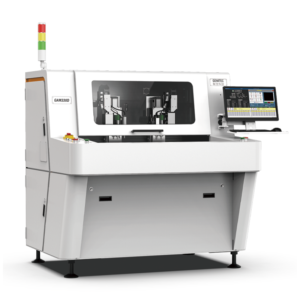

PCB Router for Medical Devices: ISO 13485 & FDA-Compliant Depaneling
Medical devices — patient monitors, infusion pumps, imaging systems, surgical tools, implants — are unforgiving. A single depaneling defect that introduces a 50 µm crack in the laminate can become, in service, a crack that propagates under thermal cycling and ultimately triggers a Class-I recall. That is why medical-grade electronics manufacturers rely on tightly controlled PCB router machines backed by ISO 13485 quality systems and documented process validations (IQ, OQ, PQ).
This guide explains how medical-device depaneling differs from commercial electronics, what process specs your PCB router must meet, and how to validate the depaneling step to satisfy FDA 21 CFR Part 820 and EU MDR.
Why Medical Depaneling Demands a Tighter Process
Three constraints dominate:
- Patient safety. A failed depaneled board inside a Class III device can directly injure or kill. Every cut edge must be repeatable and traceable.
- Regulatory audit trail. ISO 13485, FDA 21 CFR Part 820, EU MDR — each requires documented validation that the process consistently produces the intended result.
- Bioburden and particulate. Especially for implants and surgical tools, depaneling dust and burrs must not contaminate downstream assembly.
ISO 13485 and FDA: What the Auditor Actually Looks At
An ISO 13485 / FDA audit on your depaneling process will examine:
- Design controls (820.30) — design input/output records should reference depaneling as a documented process step.
- Process validation (820.75) — IQ/OQ/PQ records must exist for the depaneling equipment, including cut-edge measurement protocols.
- Document controls (820.35) — work instructions for bit replacement, spindle-vibration limits, and operator training.
- Corrective and preventive actions (820.100) — CAPA records for any cut-edge deviation.
- Production controls (820.70) — control plan with Cpk ≥ 1.33 for cut-edge position and roughness.
A modern PCB router machine automatically captures the data — spindle speed, feed rate, vibration signature, bit ID, fixture ID, operator ID — and exports it to a Quality Management System (QMS) or MES. Manual depaneling cannot produce this evidence at audit-grade.
Process Specification for Medical-Grade Depaneling
| Parameter | Typical Medical Spec | Rationale |
|---|---|---|
| Cut-edge position tolerance | ± 0.05 mm | Adjacent component clearance |
| Edge roughness Ra | ≤ 3.2 µm (Class II) / ≤ 1.6 µm (Class III) | Prevents micro-crack initiation |
| Bit material | Solid carbide, diamond-coated | Reduced particle generation |
| Dust extraction | HEPA H13 + local exhaust at spindle | Bioburden and ESD control |
| Cleanroom compatibility | ISO Class 7 or better | For implants and surgical tools |
| Edge clearance to components | ≥ 0.5 mm for Class II; 0.6 mm for Class III | Cuts lateral vibration transmission |
| Process Cpk | ≥ 1.50 (Class III) | Tighter statistical control than automotive |
| Bit replacement cadence | ≤ 30,000 cuts OR vibration threshold | Avoids sub-clinical wear effects |
Three Sub-Categories of Medical PCBs, Three Process Variants
1. Patient monitors / infusion pumps (Class II)
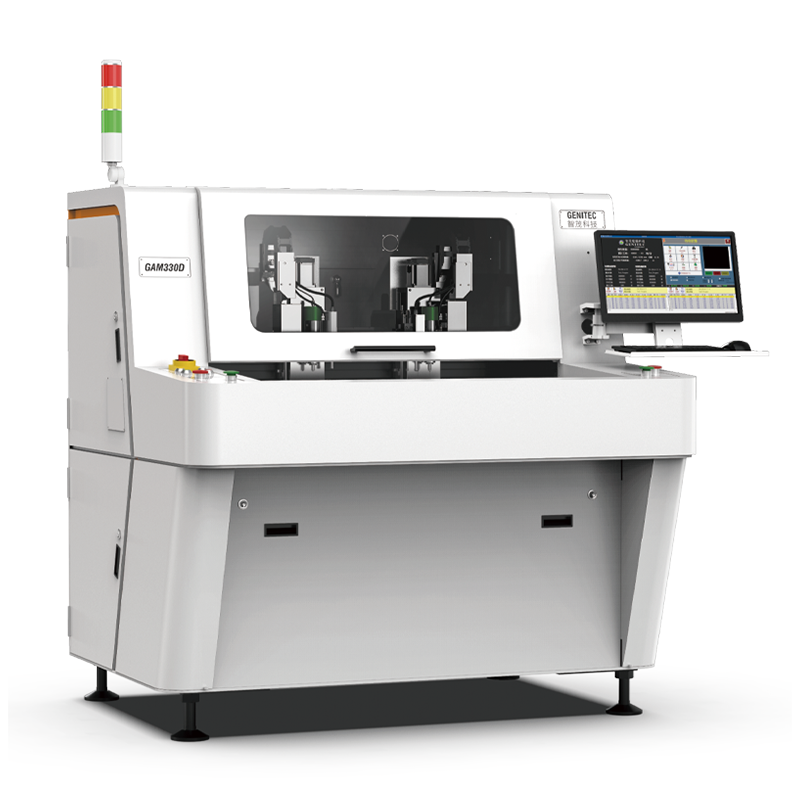
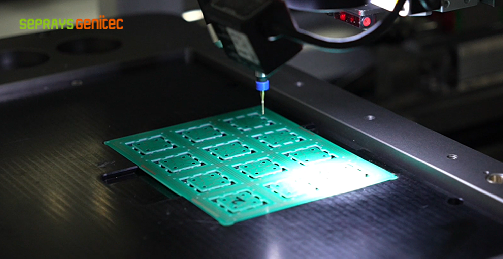
FR-4 multilayer boards, 0.8–1.6 mm, BGAs close to edge. Process variant: tab-routing with a mid-tier inline PCB router machine, 0.6 mm carbide bit, vibration-monitored bit wear, dual HEPA dust collection. Cpk target 1.50.
2. Imaging systems — CT, MRI, ultrasound (Class II)
Larger boards, often 8–12 layers, mixed SMT + through-hole. Process variant: dual-spindle inline router, automatic fixture, real-time SPC. Often paired with conformal coating post-depaneling.
3. Active implants — pacemakers, neuro-stimulators (Class III)
Miniaturized flex + rigid-flex boards, biocompatible substrate. Process variant: laser depaneling for sub-100 µm precision and zero mechanical stress, conducted inside an ISO Class 7 cleanroom.
Validation: The IQ/OQ/PQ Protocol
Process validation of a medical-grade PCB router machine follows three documented phases:
IQ (Installation Qualification)
Verifies that the equipment is installed correctly: utility connections, calibration certificates, ESD ground continuity, dust-extractor airflow. Records filed with the device master record (DMR).
OQ (Operational Qualification)
Confirms the equipment operates within specified tolerances: spindle speed accuracy, axis repeatability, vacuum-fixture pressure, broken-bit detection. Worst-case runs with new and worn bits.
PQ (Performance Qualification)
Three consecutive production runs of the depaneling cell, each 25–50 boards, with cut-edge measurements, Cpk calculation, and visual under 10× magnification. Acceptance: Cpk ≥ 1.50, no edge cracking, no burr > 0.05 mm.
Common Defects in Medical-Device Depaneling
Micro-cracks at the cut edge
Sub-visual defects that propagate over 5–10 years of thermal cycling, causing field failures. Detected only by cross-section microscopy or dye-penetrant tests. Mitigation: tab-routing with a PCB router machine with continuous vibration monitoring, never V-cut.
Solder-joint fracture near edge components
Caused by lateral spindle force. Mitigation: minimum 0.6 mm clearance, OR switch to laser depaneling for the affected edges.
Bioburden from depaneling dust
Particles trapped under BGA packages can host bacteria. Mitigation: HEPA extraction at the spindle plus downstream cleaning (plasma, ultrasonic, or IPA rinse).
Material-Specific Notes
- FR-4 (most common): Standard solid-carbide bits, 40,000–60,000 RPM, 2–4 mm/sec feed.
- High-Tg / lead-free FR-4: Reduce feed by 25%, monitor bit wear more aggressively.
- Polyimide flex: Use a PCB router machine with low-vibration spindle, OR — preferably — laser depaneling.
- Ceramic (Al₂O₃, AlN): Diamond-coated bits OR laser depaneling; standard bits wear out within 200 cycles.
- PTFE (RO4000 series): Tab-routing requires vacuum hold-down at ≥ 0.6 bar; clean chips aggressively to avoid contamination.
ROI: A Real-World Case
A mid-sized medical-device manufacturer producing 30,000 boards/month across 14 SKUs replaced manual V-cut + hand-depaneling with an inline PCB router machine plus HEPA dust extraction. Over 18 months:
- Cut-edge defect rate: 0.8% → 0.04% (-95%)
- Audit-finding frequency: 3 / year → 0 / year (zero non-conformities on depaneling)
- Operator hours: 3 FTE → 0.5 FTE
- Payback period: 11.2 months
For an ISO 13485–compliant inline depaneling solution with full QMS data export, see Seprays’ PCB router machine family.
Conclusion
Depaneling in medical-device manufacturing is not just a process step — it is a documented, validated, and audited element of the QMS. A PCB router machine with vibration-monitored bit wear, HEPA-integrated dust extraction, and full QMS/MES data export is the only credible answer for Class II and most Class III devices. For implants and miniaturized flex assemblies, laser depaneling extends the technology envelope. Seprays supplies and validates both — and supports qualification onsite.

Frequently Asked Questions
1. Why does a PCB router cost less than the alternative in medical-device manufacturing?
It usually does not — but it pays back faster. A medical-grade PCB router machine plus HEPA extraction costs more than a manual depaneling setup, but reduces defect-related rework, audit findings, and field-failure liability. Most medical EMS suppliers see payback within 12 months.
2. Is laser depaneling required for Class III medical devices?
Not strictly required, but laser depaneling is preferred for sub-millimeter flex / rigid-flex and for ceramic substrates where bit wear generates particulate. Many Class III manufacturers combine a PCB router for the rigid portions and laser depaneling for the flex tails.
3. What Cpk value should I target for cut-edge quality?
For Class II devices, Cpk ≥ 1.33 is the typical target. For Class III (implants, life-supporting devices), most manufacturers push to Cpk ≥ 1.50. A PCB router machine with vibration-monitored bit wear and SPC export helps you hit these targets reliably.
4. Can a single PCB router handle all medical part numbers?
Yes — most medical EMS suppliers run 8–30 part numbers through the same machine. CAM-driven changeover takes under 60 seconds. The constraint is fixture complexity: keep fixture design modular, ideally vacuum + magnetic-back so you can mix board sizes.
5. How do I validate a new PCB router before production release?
Run a full IQ/OQ/PQ: IQ verifies installation and utilities; OQ tests spindle and axis performance across tolerance limits; PQ runs three consecutive production lots with full cut-edge measurement. Document everything in the device master record (DMR).
About Seprays Precision Machinery
Founded in 1993, Seprays Precision Machinery has over 30 years of expertise in PCB depaneling solutions. With two manufacturing facilities totaling 26,000 m², 9 service centers across China, and clients in 31 countries — including Foxconn, Flex, Luxshare, Bosch, and CRRC — Seprays delivers equipment that consistently meets the demanding tolerances of automotive, medical, aerospace, and consumer electronics production lines.
Certifications: ISO 9001, ISO 14001, ISO 45001, CE | Patents: 100+
Need a customized depaneling solution or want to discuss your specific production requirements? Our technical team is ready to help.
jimmy@seprays.com · PCB Router Machine · PCB Laser Depaneling