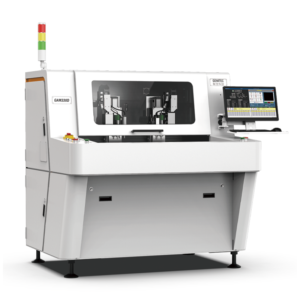

1. What the Spindle Does in a PCB Router
The spindle holds the milling bit and spins it at controlled speed (RPM) while delivering torque for cutting. In a PCB router machine, the spindle is typically air-cooled or water-cooled, with bearings rated for high-cycle operation in a dust-laden environment.
Three parameters define spindle capability for PCB depaneling:
- Maximum RPM — dictates which materials can be cut cleanly
- Power (W or kW) — dictates maximum cut depth and feed rate
- Bearing protection — dictates service life in dusty environment
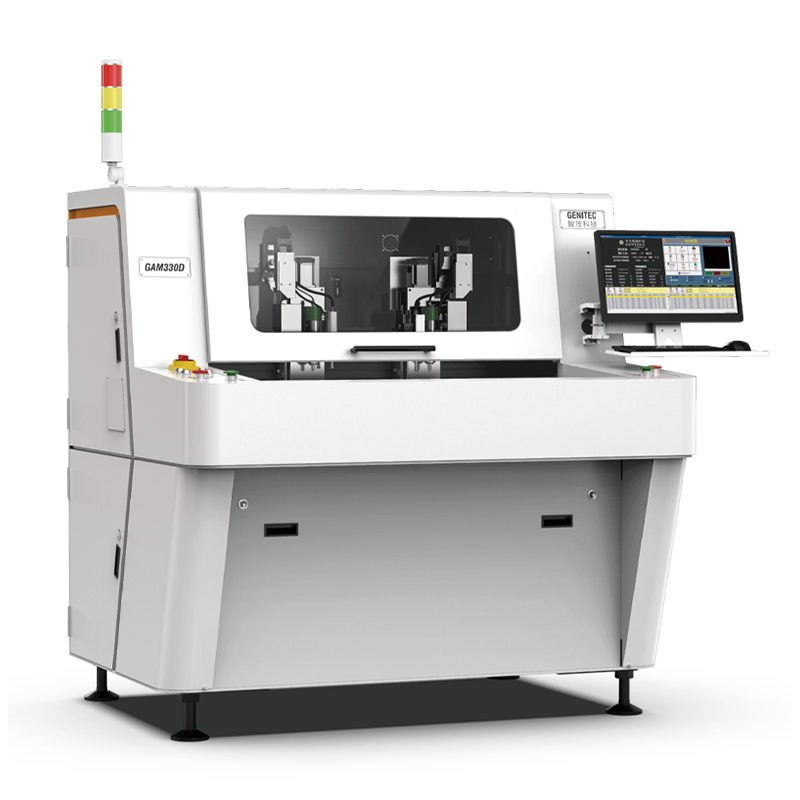
2. Spindle Speed: Why It Matters
RPM sets the surface speed at the cutting edge of the bit. For a 1.0 mm bit, surface speed in m/min = (RPM × π × diameter) / 1000. The recommended surface speed for clean cuts on FR-4 is 80–150 m/min.
That gives:
- 40,000 RPM with a 1.0 mm bit → 125 m/min → sweet spot for FR-4
- 60,000 RPM with a 1.0 mm bit → 188 m/min → cleanest cuts on FR-4; required for high-Tg and high-frequency laminates
- 100,000 RPM with a 0.6 mm bit → 188 m/min → for fine-pitch multilayer with sub-mm cut tolerance
Most entry-level PCB router machines ship with a 40K RPM spindle. For high-frequency PCBs, ceramic-filled FR-4, or sub-1mm cut paths, 60K is the floor. For ultra-fine routing (0402 components within 0.5 mm of the cut), 80K or 100K is required.
3. Spindle Power: How Much You Need
Power dictates how deep you can cut in a single pass and how fast you can feed without stalling. For a 1.6 mm FR-4 stack-up:
- 0.5 kW spindle cuts 1.0 mm per pass at 80 mm/min — adequate for prototypes and low-volume
- 1.0 kW spindle cuts 2.0 mm per pass at 120 mm/min — typical production floor
- 1.5 kW spindle cuts 3.0 mm per pass at 150 mm/min — high-volume multilayers
- 2.5 kW+ spindle — heavy industrial, typically used with water-cooled spindles for continuous duty
The cost of under-powering is feed stalling: the bit dwells in the cut, generating heat that damages the laminate and dulls the bit prematurely. The cost of over-powering is capital expense for capacity you don’t use.
4. Air-Cooled vs Water-Cooled Spindles
Air-cooled spindles are simpler, cheaper, and adequate for most PCB depaneling. The cooling air keeps bearing temperature below 80 °C in normal operation.
Water-cooled spindles are used when:
- The PCB router machine runs continuous duty (above 8 hours/day)
- The spindle is rated above 2.5 kW (air cooling becomes insufficient)
- The work environment is hot (above 30 °C ambient)
- Dust management requires the spindle housing to be sealed (water cooling removes the need for cooling air vents)
For a typical 40–60K RPM PCB router machine running one shift, air-cooled is fine. For 24/7 production, water-cooled reduces bearing temperature by 15–20 °C and doubles bearing life.
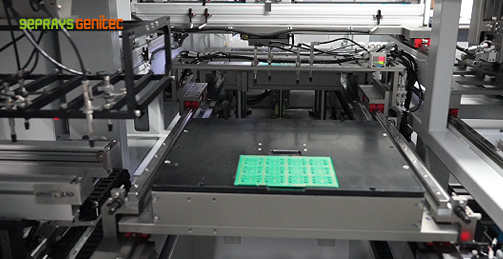
5. Bearing Life: The Dust Problem
A spindle bearing in a clean environment lasts 25,000–40,000 hours. In a dusty FR-4 environment without proper extraction, the same bearing lasts 8,000–12,000 hours. The difference is dust ingestion.
Modern PCB router machines address this with:
- Sealed bearings with ceramic hybrid balls (longer life than steel)
- Positive air pressure inside the spindle housing — clean air flows out, dust doesn’t flow in
- Labyrinth seals at the bit entrance — multi-stage dust deflection
- Integrated extraction at the spindle housing — captures dust before it reaches the bearings
When evaluating a spindle, ask for the bearing life rating AT 30,000 RPM in a dusty environment. Manufacturer specs usually quote clean-environment life, which is 2–3× longer than real-world.
6. Bit Selection and Spindle Compatibility
Bit shank diameter must match the spindle collet. Most PCB router machines ship with a 3.175 mm (1/8″) collet, with optional 3.0 mm or 6.0 mm collets.
Common PCB router bit specifications:
- 0.8 mm tungsten carbide, 2-flute — most common, FR-4
- 1.0 mm tungsten carbide, 2-flute — general purpose
- 1.5 mm tungsten carbide, 2-flute — thick multilayers
- 0.6 mm diamond-coated, 1-flute — high-frequency laminates
- 1.0 mm diamond-coated, 2-flute — ceramic-filled PCBs
Bit grade and spindle RPM must be matched: a diamond-coated bit running below 30,000 RPM wears faster than tungsten at the same speed. Diamond bits need the surface speed that high RPM provides.
7. Total Cost of Ownership
For a PCB router machine running one shift:
- 40K RPM air-cooled spindle: $3,500 replacement, 25,000 hr life → $0.14/spindle-hour
- 60K RPM air-cooled spindle: $5,000 replacement, 22,000 hr life → $0.23/spindle-hour
- 100K RPM water-cooled spindle: $12,000 replacement, 18,000 hr life → $0.67/spindle-hour
For 24/7 operation, multiply by 3 (3 shifts). The dust extraction system is the single biggest factor in extending bearing life — a $2,000 dust collector upgrade can extend spindle life from 12,000 hr to 28,000 hr.
8. When to Replace vs Refurbish
Replace the entire spindle when:
- Bearing noise is audible during operation
- Spindle vibration exceeds 4 mm/s RMS
- Cut quality degrades and bit replacement does not restore it
Refurbishment (factory rebuild) is cost-effective for high-end spindles above 80K RPM. For mid-range 40–60K spindles, replacement is cheaper than factory refurbishment.
Keep a spare spindle on hand for any router in continuous production. A spindle swap takes 4 hours with a spare; without, you’re waiting 2–5 days for shipping.
For the full spindle specifications of the Seprays GAM-series PCB router machine, see the PCB router machine product page technical datasheet.
About Seprays Precision Machinery

Founded in 1993, Seprays Precision Machinery has over 30 years of expertise in PCB depaneling solutions. With two manufacturing facilities totaling 26,000 m², 9 service centers across China, and clients in 31 countries — including Foxconn, Flex, Luxshare, Bosch, and CRRC — Seprays delivers equipment that consistently meets the demanding tolerances of automotive, medical, aerospace, and consumer electronics production lines.
Certifications: ISO 9001, ISO 14001, ISO 45001, CE. Patents: 100+. Need a customized depaneling solution or want to discuss your specific production requirements? Our technical team is ready to help. Contact: jimmy@seprays.com
FAQ
Q1: What spindle speed is right for FR-4 PCB routing?
A: 40,000–60,000 RPM is the standard range for FR-4. Lower speeds cause tearing; higher speeds require diamond-coated bits.
Q2: How often should I replace the spindle on a PCB router machine?
A: Every 25,000 hours in a clean environment, 12,000–15,000 hours with average dust management, 8,000 hours if dust extraction is poor.
Q3: Can a PCB router machine cut ceramic PCBs?
A: Yes, with diamond-coated bits and reduced feed rates (30–60 mm/min). For ultra-thin ceramics, consider laser depaneling instead.
Q4: What is the typical bit life on FR-4?
A: 30–80 m of cut per bit, depending on stack-up thickness and RPM. Plan $0.10–0.30 in bit cost per board.
Q5: How do I know if my spindle bearings are wearing?
A: Audible noise, vibration above 4 mm/s RMS, or degraded cut quality that doesn’t improve with bit replacement. Plan a spindle swap.