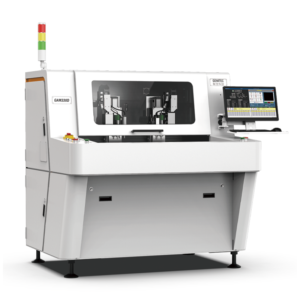

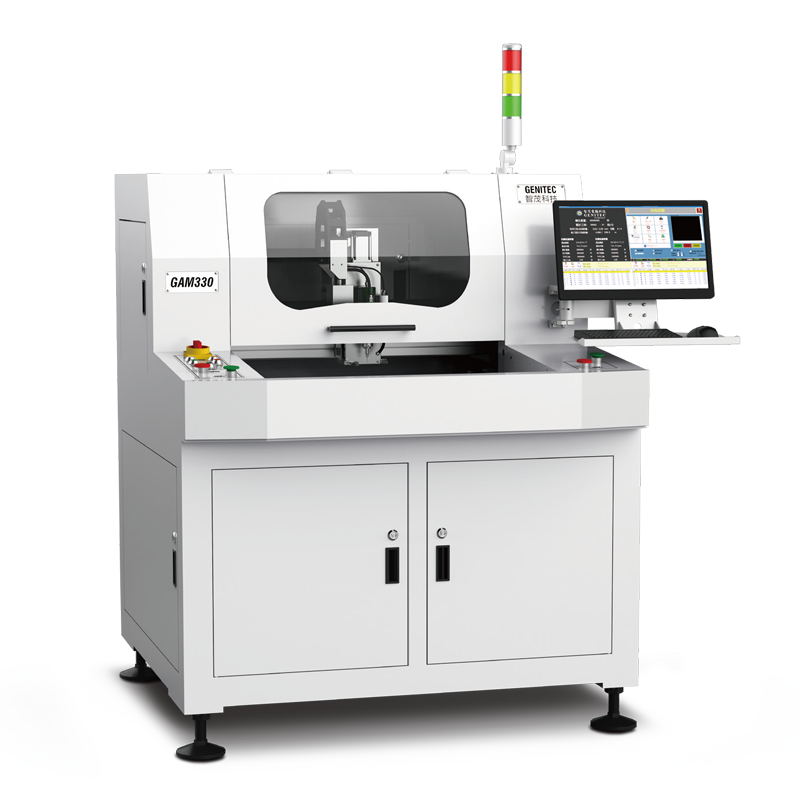
Quick Comparison Table
| Criterion | Offline PCB Router | Inline PCB Router Machine |
|---|---|---|
| Footprint | 1.0–1.5 m² | 4–7 m² (including conveyor) |
| Throughput (typical FR-4 board) | 15–30 sec/board (operator-paced) | 8–15 sec/board (line-paced) |
| Operator hours per shift | 1–2 FTE | 0–0.5 FTE |
| Part-number changeover | Manual, 2–10 min | CAM-driven, < 60 sec |
| SPC and traceability | Optional / add-on | Built-in / native |
| Capital cost | $15K–$45K | $45K–$200K |
| Best for | Low-mid volume, prototype, high-mix | Mid-high volume, single part number, mixed line |
| Floor-space impact | Negligible | Adds 4–7 m of line length |
| Risk if cell fails | Operator workaround | Whole line stops |
How an Offline PCB Router Works
An offline router is a stand-alone bench or floor-mounted machine. The operator:
- Loads a panel into the vacuum fixture by hand.
- Closes the safety door.
- The router cuts, opens the door, the operator unloads the panel.
An offline machine is simple, cheap, and forgiving. It is the right answer for prototyping, low-volume production, and high-mix environments where part numbers change often.
How an Inline PCB Router Machine Works
An inline router is docked into the conveyor. The upstream machine (often the AOI station) signals the conveyor to deliver a panel to the router’s vacuum fixture. The router aligns via vision, cuts, then signals the conveyor to deliver the panel to the next downstream operation. No operator is required at the cell.
Inline routers typically have:
- Automatic fixture change (pallet shuttle).
- Vision alignment for ± 0.2 mm panel-position tolerance.
- MES export via OPC-UA, MQTT, or REST API.
- Bit wear + vibration monitoring.
- Buffer zones to absorb upstream / downstream stoppages.
Cost-Benefit: When Inline Wins
An inline PCB router machine pays back when:
- Volume exceeds 50,000 boards/month on a moderate part-number mix.
- Labor cost is high (US, EU, Japan).
- Defect rate on manual depaneling exceeds 0.5%.
- Compliance requires SPC export (IATF, ISO 13485, AS9100).
- Downstream automation — conformal coating, ICT, or packaging — requires dimensional stability.
ROI Example: A European EMS
A German EMS supplier running 75,000 boards/month on 8 part numbers replaced 2 offline depaneling stations (2 FTE) with 1 inline PCB router machine:
- Labor savings: 2 FTE × €55,000/yr = €110,000/yr.
- Yield improvement: from 0.9% defect → 0.1% = ~€45,000/yr.
- Capex amortized over 5 years: ~€32,000/yr (€160,000 capex).
- Payback: 11 months.
Cost-Benefit: When Offline Wins
An offline PCB router is the better answer when:
- Volume is below 30,000 boards/month.
- Part-number mix exceeds 25 active SKUs.
- R&D or prototype work is the dominant use.
- Floor space is constrained.
- Capital budget is below $50K.
Offline Total Cost of Ownership
A $25,000 offline router running 1 shift, 1 FTE, on 25K boards/month: capex $25K + labor + bits + electricity ≈ $90K–$110K/year. Lower capex, but higher labor share.
Hybrid Layout: Best of Both
Many production lines use a hybrid layout: one inline PCB router machine for the production flow, plus an offline router for prototypes, samples, and small batches. This combination covers everything from 1-board prototype runs to 24/7 production without surrendering flexibility.
What an Inline Router Does That Offline Cannot
- Capture SPC at every board automatically.
- Integrate with traceability systems (each panel scanned via barcode).
- Run unattended for multiple shifts.
- Maintain a controlled change log for audit purposes.
- Dock with conformal coating, robotic handling, and ICT.
What an Offline Router Does That Inline Cannot
- Run a 1-board prototype without conveyor integration.
- Accept arbitrary panel sizes without conveyor reconfiguration.
- Be moved when the line is re-laid-out.
- Cost-effectively depanel small batches of 1–20 boards.
Decision Rule: Pick in 60 Seconds
| Question | If yes | If no |
|---|---|---|
| Do you run more than 50K boards/month? | Inline | Continue ↓ |
| Do you run more than 3 active part numbers? | Inline w/ fast changeover | Offline |
| Are most boards simple rectangles? | Inline single-spindle | Inline dual-spindle |
| Is floor space under pressure? | Offline / mini-inline | Inline |
| Do you need SPC for compliance? | Inline | Offline + manual log |
| Is capital under $50K? | Offline | Inline / hybrid |
Inline Installation: What to Plan For
An inline PCB router machine typically needs:
- Compressed air at 6 bar (clean, dry).
- 3-phase power (400 V or 480 V depending on region).
- Network connection for MES data export.
- Under-table or roof-mounted dust extraction.
- Conveyor reconfiguration upstream and downstream.
- Buffer zone (1–2 panels) between the router and the next station.
Most installations take 3–5 days including commissioning and operator training.
Bottom Line
For high-volume, mid-to-high mix, compliance-bound SMT lines, an inline PCB router machine delivers ROI in 9–14 months. For prototype, R&D, or very low-volume production, an offline router is the right call. Many production lines operate both — a hybrid layout that covers 1-board prototypes and 24/7 production.
For an inline, MES-integrated solution that drops into your existing SMT conveyor, see the Seprays PCB router machine family.
Frequently Asked Questions
1. Is an inline PCB router machine always faster?
Per-board cycle time is faster (8–15 sec vs 15–30 sec), but the throughput advantage depends on upstream / downstream line balance. If the AOI or reflow oven is the bottleneck, the router does not need to be inline.
2. Can I move an offline router later?
Yes — offline routers are portable. They typically weigh 80–300 kg and roll on casters. Relocation takes a few hours, not days.
3. What is the throughput of a dual-spindle inline router?
A dual-spindle inline PCB router machine typically delivers 12–20 sec per board (1 spindle halves the cycle), with throughput limits in the 180,000–250,000 boards/month range.
4. Can a single PCB router serve both inline and offline roles?
Yes — many mid-tier routers accept both conveyor handoff and manual load. Some users do this; the practical limit is changeover time (typically 5–10 min between modes).
5. What is the footprint of an inline PCB router machine?
Body footprint is 1.5–2 m wide × 2 m deep; with conveyor buffer upstream and downstream, total line impact is 4–7 m. Plan for 200 mm of side clearance for maintenance access.
About Seprays Precision Machinery
Certifications: ISO 9001, ISO 14001, ISO 45001, CE | Patents: 100+
Need a customized depaneling solution or want to discuss your specific production requirements? Our technical team is ready to help.
jimmy@seprays.com · PCB Router Machine · PCB Laser Depaneling