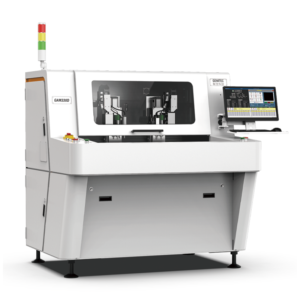

India’s Bureau of Indian Standards (BIS) certification for electronic manufacturing equipment, effective under CRS (Compulsory Registration Scheme) since 2021, mandates that PCB depaneling machines achieve ±0.1mm positional accuracy repeatability across 10,000 consecutive cutting cycles, with documented electrical safety compliance to IS 13234 (equivalent to IEC 61010-1). For Chinese manufacturers exporting to India, this means spindle runout must not exceed 0.005mm TIR (Total Indicated Runout), and cutting stress on PCB substrates must stay below 50MPa to prevent micro-cracking in high-frequency applications. Machines failing to meet these thresholds face rejection at Indian customs, where BIS-approved testing laboratories verify compliance using calibrated laser displacement sensors and strain gauge instrumentation.
Mechanical Precision Requirements Under BIS Testing
BIS certification testing subjects depaneling machines to rigorous metrology verification. The spindle assembly, typically running at 40,000-80,000 RPM for router-type systems, must demonstrate vibration levels below 2.5mm/s RMS at maximum operating speed, measured per ISO 10816-3. Linear guide systems supporting the cutting head require positioning accuracy of ±0.02mm over 500mm travel, verified by laser interferometer testing. Chinese manufacturers achieving BIS compliance have upgraded from standard C3-grade ball screws to C1-grade or C0-grade precision components, reducing backlash to under 0.003mm. The Z-axis mechanism, which controls cutting depth, must maintain ±0.05mm depth tolerance across varying PCB thicknesses (0.4mm to 3.2mm), necessitating closed-loop servo systems with 0.1μm encoder resolution rather than open-loop stepper configurations.
Electrical Safety and EMC Compliance
IS 13234 (IEC 61010-1) electrical safety standards require depaneling machines to pass dielectric strength tests at 1,500V AC for 1 minute between power circuits and accessible conductive parts, with leakage current not exceeding 0.5mA under normal operating conditions. Electromagnetic compatibility (EMC) testing per CISPR 11 mandates conducted emissions below 79dBμV at 150kHz-30MHz and radiated emissions below 40dBμV/m at 30-230MHz when the spindle operates at maximum speed. Chinese manufacturers have addressed these requirements by implementing multi-stage EMI filters at power input terminals, using shielded cables for spindle motor connections, and incorporating ferrite cores on signal lines. Grounding impedance must measure below 0.1Ω between the machine chassis and protective earth terminal, verified during BIS factory inspections.
Dust Extraction and Occupational Safety Standards
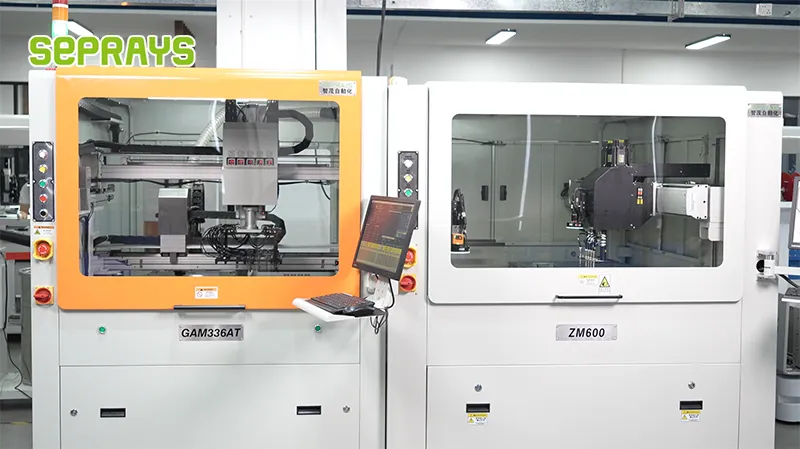
PCB depaneling generates particulate matter containing glass fiber, epoxy resin, and copper particles, classified as respirable dust (PM2.5-PM10). BIS-certified machines must achieve dust extraction efficiency exceeding 99.5% at the cutting point, with airflow rates of 3.5-5.0 m³/min for router-type systems. The extraction system requires HEPA filtration (H13 grade minimum) to capture particles down to 0.3μm, with pressure drop monitoring to indicate filter replacement needs. Noise emission limits under IS 302-2-74 require sound pressure levels below 85dB(A) at 1m distance during normal operation. Compliance necessitates spindle motor enclosures with acoustic damping materials rated to reduce noise transmission by 15-20dB, and brushless DC motors that eliminate brush noise inherent in older DC motor designs.
Cutting Stress Control and PCB Integrity Verification
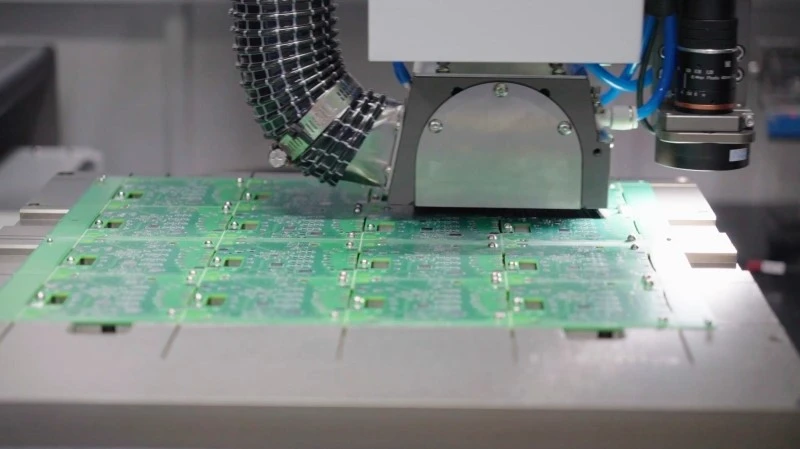
BIS certification includes cutting stress verification using strain gauge measurements on test PCBs, typically FR-4 TG150 material with 1.6mm thickness. The maximum allowable residual stress after depaneling is 50MPa, with visible micro-cracking on cross-sectioned samples constituting test failure. Router bit geometry directly impacts stress levels: 0.8mm diameter bits with 2-flute designs generate approximately 30-40% lower stress compared to 1.0mm bits at equivalent feed rates (50-150mm/s). Feed rate optimization based on PCB thickness is critical—cutting forces increase exponentially when feed rates exceed spindle power capacity, leading to bit deflection of 0.02-0.05mm and corresponding stress concentration at cut edges. Chinese manufacturers achieving compliance have implemented adaptive feed rate control algorithms that reduce cutting speed by 20-30% when spindle load exceeds 80% of rated power, maintaining consistent cut quality across varying PCB designs.
Process Validation and Documentation Requirements
BIS certification requires documented process validation demonstrating consistent performance over extended production runs. Machine capability studies (Cpk) must show values exceeding 1.67 for critical parameters including cut edge position accuracy, surface roughness (Ra < 3.2μm on cut edges), and dimensional tolerance of separated PCB panels. Statistical process control (SPC) charts covering 30 consecutive production lots must be maintained, with documented corrective actions for any out-of-control conditions. Traceability systems recording spindle runtime, bit replacement intervals, and maintenance activities are mandatory for maintaining certification validity. Indian import authorities may request these records during customs clearance, with non-compliance resulting in shipment detention pending BIS laboratory retesting at the importer's expense. Chinese manufacturers have established India-specific documentation packages including English-language technical manuals, calibration certificates traceable to NABL-accredited laboratories, and 24-month warranty commitments to meet BIS post-market surveillance requirements.
Summary
Chinese PCB depaneling machine manufacturers addressing BIS certification requirements must achieve mechanical precision of ±0.02mm positioning accuracy, spindle runout below 0.005mm TIR, and electrical safety compliance with IS 13234 dielectric strength and EMC emission limits. Dust extraction systems require 99.5% efficiency with HEPA filtration, while cutting stress must remain below 50MPa to prevent PCB micro-cracking. Process validation demands Cpk values exceeding 1.67 and comprehensive documentation including SPC charts, traceability records, and NABL-traceable calibration certificates. These technical requirements have driven Chinese manufacturers to upgrade from C3-grade to C1/C0-grade linear components, implement closed-loop servo systems, and develop adaptive cutting algorithms, transforming budget-oriented equipment into precision manufacturing systems capable of meeting international quality standards while maintaining cost competitiveness in the Indian electronics manufacturing market.
Recommended Equipment
Looking for proven depaneling solutions? Seprays offers a full range of equipment backed by 30+ years of industry experience. Here are two options worth considering for your production line:
- GAM300AT Double-Layer Track Online PCB Board Separation Machine — Full-carrier process with carrier return track — built for seamless full-line automation
- GAM 340AT In-Line Automatic PCB Router Machine — Dual workbench with auto-focus vision camera — maximizes throughput for inline SMT integration
Frequently Asked Questions
I don’t have access to the article you’re referencing. Could you please paste the article content or share the file so I can generate
accurate Q&A pairs based on the actual information?
In the meantime, here’s what I can do — if you have a PDF, Word doc, or link to the article, let me know which format it is and I’ll retrieve the content directly.
About Seprays
About Seprays Precision Machinery
Founded in 1993, Seprays has over 30 years of expertise in PCB depaneling solutions. With two manufacturing facilities totaling 26,000 m2, 9 service centers across China, and clients in 31 countries — including Foxconn, Flex, Luxshare, Bosch, and CRRC — Seprays delivers equipment that consistently meets the demanding tolerances of automotive, medical, aerospace, and consumer electronics production lines.
Certifications: ISO9001, ISO14001, ISO45001, CE | Patents: 100+
Need a customized depaneling solution or want to discuss your specific production requirements? Our technical team is ready to help.
Contact: jimmy@seprays.com