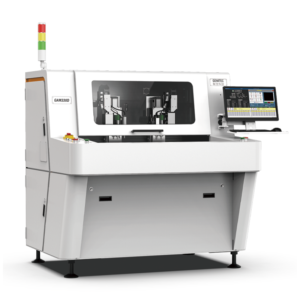

When a routed PCB panel exits a 6-axis CNC depaneling cell at a feed rate of 800mm/min, the kerf width generated by a 2.0mm carbide bit spinning at 60,000 RPM typically measures 2.1±0.05mm — a parameter that directly determines how much product-worthy rail material remains between adjacent boards. If that rail falls below 1.2mm after depaneling, flexural stress concentrations during final assembly can exceed 15 N/mm² on FR-4 substrates, causing micro-cracks in populated boards that may not manifest until field use. This is the mechanical reality that Chinese manufacturers must engineer around — and it is the same reality that European regulatory frameworks test for under CE certification protocols.
Mechanical Precision and Process Capability
Routed depaneling on a precision CNC machine achieves a positional repeatability of ±0.03mm (2σ) when the spindle runout is controlled below 3μm and the XY table uses linear encoders with 1μm resolution. In practice, many mid-tier Chinese machines in the USD 8,000–25,000 price band specify ±0.05mm positional tolerance, which falls short of the ±0.03mm capability that European EMS companies increasingly demand for high-density boards with component keepout zones extending to within 0.3mm of the V-score or routing path. The process capability index (Cpk) for routing operations should reach 1.33 minimum, meaning that 99.97% of routed edges fall within specification — this is the performance level required by automotive and medicalelectronics customers who are the primary CE-certified end-market segment. A Cpk of 1.33 translates to a total tolerance band of 0.12mm for a centered 0.1mm tolerance target, a value that demands active spindle compensation, rigid machine construction with cast iron or polymer concrete beds, and temperature-controlled environments maintaining ±0.5°C within the working volume.
CE Certification Framework and Applicable Directives
CE marking for depaneling machinery sold within the European Economic Area falls primarily under the Machinery Directive 2006/42/EC, with electromagnetic compatibility governed by EU Directive 2014/30/EU. The Machinery Directive requires a comprehensive risk assessment per EN ISO 12100:2010, covering mechanical hazards from rotating tooling, noise emissions where the action zone exceeds 70 dB(A), and electrical safety under EN 60204-1. For a laser depaneling system, the High-Power Laser Radiation hazard classification under EN 60825-1 becomes additional regulatory surface area — Class 4 laser systems require engineered controls including interlocked enclosures, emergency stop circuits meeting Performance Level d (PLd) per ISO 13849-1, and validated air extraction systems to control airborne particulate from ablating substrate material. Chinese manufacturers submitting machinery to a Notified Body for EC Type Examination must provide full technical construction documentation in Mandarin or English, with all circuit diagrams, control system descriptions, and test reports traceable to specific hardware serial numbers.
Technical Documentation and Traceability Requirements
The technical file required under Annex VIII of the Machinery Directive must include design drawings with explicit dimensional tolerances, material specifications for all structural components, calculation notes for safety-related control circuits, and test certificates from ISO 17025-accredited laboratories. A critical gap for many Chinese exporters is the absence of documented FMEA (Failure Mode and Effects Analysis) for the safety control circuit — EN ISO 13849-2 requires validation of safety function performance by analysis, testing, or a combination of both, and this validation must be repeated whenever a sub-supplier changes a critical component such as a safety relay or programmable logic controller. The documentation language requirement is often underestimated: while EU directives do not mandate translation, the instructions for assembly and integration must be written in the official language of the member state where the machinery is placed on the market, which adds localized documentation cost that should be factored into the CE compliance budget.
EMC Performance Specifications
Electromagnetic compatibility testing under EU Directive 2014/30/EU requires compliance with EN 55011:2016 for radiated and conducted emissions from the motor drives and spindle inverter, plus EN 61000-4-2 through EN 61000-4-6 for immunity against electrostatic discharge, radiated RF fields, electrical fast transients, and surge events. A depaneling machine with a 3kW spindle inverter switching at 20kHz will typically produce conducted emissions in the 150kHz–30MHz range that can exceed Class A limits without proper input filtering — this requires a minimum of a IEC 60939-3-rated X/Y capacitors on the mains input, common-mode chokes on motor output cables, and shielded motor cable with shield bonded at both ends. Immunity testing at 10V/m RF field strength per EN 61000-4-3 is particularly relevant for machines deployed in shared manufacturing floors where welding equipment or RF heaters are present — the machine’s PLC and motion controller must maintain position accuracy within specified tolerances under this field stress, which is verified by functional testing during the EMC test house engagement.
Strategic Pathway for Market Entry
Chinese depaneling machine manufacturers have three viable routes to CE compliance. The first is self-declaration under Annex VIII, viable only for machinery that presents no significant hazard under foreseeable misuse conditions and requires no third-party involvement — this route carries the highest technical risk but lowest cost if the manufacturer possesses in-house expertise in EN ISO 13849-1 performance level calculations. The second route is EC Type Examination through a Notified Body such as TÜV Rheinland, Intertek, or SGS, which issues a certificate valid for 5 years and is the de facto requirement when selling to European industrial distributors or directly to Tier-1 EMS companies who conduct supplier audits. The third route involves engaging a European-based authorized representative who can hold the technical file and sign the Declaration of Conformity on behalf of the Chinese manufacturer, simplifying customs clearance and post-market surveillance obligations. Regardless of route, the machine must pass live testing at an ISO 17025-accredited EMC laboratory — typically a 3–5 day test campaign costing between EUR 8,000 and 18,000 depending on spindle power and laser classification — before the CE marking can be legally affixed to the machine nameplate. Building this compliance architecture into the product development cycle at the earliest engineering stage, rather than retrofitting it at the sales-distribution stage, is the decisive factor that separates manufacturers who achieve sustained market penetration in Europe from those who encounter regulatory rejection at the port of entry.
Recommended Equipment
Looking for proven depaneling solutions? Seprays offers a full range of equipment backed by 30+ years of industry experience. Here are two options worth considering for your production line:
- GAM330AT Fully Automatic PCB Depaneling Machine — Self-feeding operation with automatic sorting — ideal for high-volume automated production lines
- GAM300AT Double-Layer Track Online PCB Board Separation Machine — Full-carrier process with carrier return track — built for seamless full-line automation
Frequently Asked Questions
Q1: What is the main challenge discussed in this article?
A1: This article explores practical considerations for PCB depaneling operations in manufacturing environments, covering key factors that affect quality, efficiency, and cost.
Q2: How does this relate to production quality?
A2: Improper depaneling can damage components, introduce stress, and compromise board integrity. Choosing the right method directly impacts your final product quality and yield rate.
Q3: What depaneling methods are available?
A3: Common methods include router depaneling (best for complex shapes), V-cut depaneling (cost-effective for high volume), and laser depaneling (ultra-precise, minimal stress).
About Seprays
About Seprays Precision Machinery
Founded in 1993, Seprays has over 30 years of expertise in PCB depaneling solutions. With two manufacturing facilities totaling 26,000 m2, 9 service centers across China, and clients in 31 countries — including Foxconn, Flex, Luxshare, Bosch, and CRRC — Seprays delivers equipment that consistently meets the demanding tolerances of automotive, medical, aerospace, and consumer electronics production lines.
Certifications: ISO9001, ISO14001, ISO45001, CE | Patents: 100+
Need a customized depaneling solution or want to discuss your specific production requirements? Our technical team is ready to help.
Contact: jimmy@seprays.com