
During the PCB singulation process on a typical 1.6mm thick FR-4 toy
controller board, the mechanical stress transferred to surface-mounted components at the board edge can reach 15-25 N/mm² if depaneling is performed without proper tool compensation — a threshold that routinely causes passive component crack propagation in electrolytic capacitors rated below 100µF. This failure mode alone accounts for an estimated 8-12% field rejection rate in budget toy electronics production lines that rely on manual V-scoring separation or unmodified press-fit tooling.
Mechanical Stress and the Singulation Boundary
Toy electronics PCB assemblies predominantly use panel formats of 3×6 or 4×8 units, with individual board sizes ranging from 25mm × 15mm (simple fidget-toy controllers) to 80mm × 50mm (RC vehicle main boards). The depaneling method selected directly determines the stress envelope experienced by components positioned within 2.0-3.0mm of the routed channel or pre-scored breakaway line. According to IPC-A-600H Acceptability of Printed Boards, board edges must exhibit no substrate delamination, crack propagation into internal layers, or pad lifting beyond 0.25mm — tolerances that are routinely violated when high-volume toy production runs use aggressive feed rates without in-process stress monitoring.
Router-type depaneling systems with spindle speeds in the 40,000-80,000 RPM range generate cutting forces between 0.8N and 2.5N per flute engagement, depending on board thickness and bit diameter. For 1.6mm FR-4 at 60,000 RPM with a 1.2mm carbide bit and a federate of 300mm/min, the peak instantaneous cutting force stabilises at approximately 1.4N, which translates to a bending moment on adjacent components that remains within the ±0.05mm positional tolerance specified in IPC-2221 Generic Standard on Printed Board Design for flex-to-install and static-load scenarios.
Spindle Speed Selection for FR-4 Substrate Panels
The majority of toy electronics production runs use phenolic paper-phenolic (CEM-1) or standard FR-4 substrates, both of which present distinct abrasiveness profiles during router singulation. At spindle speeds below 40,000 RPM, the cutting edge generates sufficient heat to cause resin smear on exposed copper traces within the 0.3mm minimum annular ring geometries common in toy PCB layouts. Speeds exceeding 80,000 RPM introduce chatter marks and microfractures along the cut edge, measurable by cross-sectional analysis as crack propagation depths of 0.02-0.08mm into the laminate — well within the rejection threshold defined in IPC-TM-650 Method 2.4.28 for dielectric breakdown resistance.
For a Shantou-sourced 60,000-RPM brushless DC spindle system rated for continuous operation at 2.4kW, the runtime thermal drift during a 10-hour production shift at 25°C ambient can introduce a positional error of ±0.08mm after spindle warm-up, if the tool length compensation is not recalibrated at intervals of 180 minutes or 12,000 cutting cycles. Production managers targeting first-pass yields above 98.5% in toy electronics depaneling must therefore enforce a recalibration protocol that accounts for thermal expansion coefficients of 14-18 ppm/°C for the aluminium tooling plate and 12-16 ppm/°C for the FR-4 laminate.
Feed Rate Optimisation and Throughput Economics
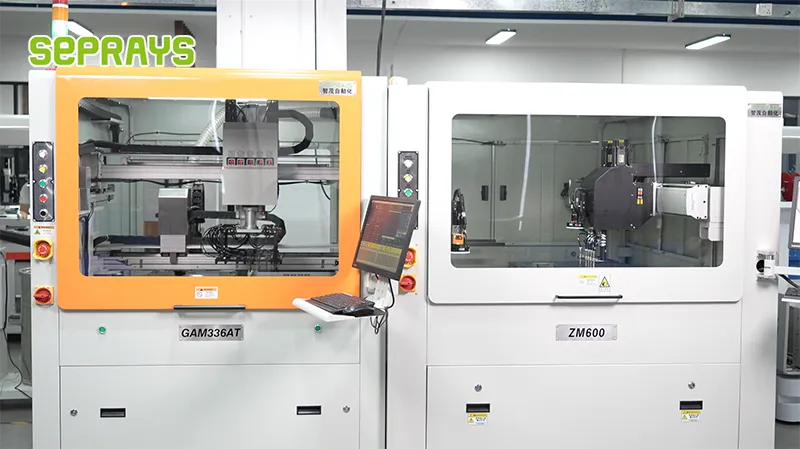
In cost-sensitive toy electronics manufacturing, the throughput-versus-quality trade-off is governed by feed rate selection. A single-head router depaneling machine processing 4×8 panels of 1.6mm FR-4 achieves a balanced feed rate of 280-350mm/min at 60,000 RPM, yielding a cycle time of 18-24 seconds per panel — equivalent to 150-200 boards per hour per head. Doubling to a dual-head configuration increases theoretical throughput to 300-400 boards per hour but introduces a positional inter-axis error risk of ±0.12mm if the machine’s linear guide parallelism exceeds 0.01mm/100mm, a specification that requires verification against the machine’s factory acceptance test protocol.
For toy electronics applications where the per-board material cost is sub-USD 0.15 and labour constitutes the dominant cost centre, the economic case for automated depaneling over manual breakaway separation hinges on defect-rate reduction. Each percentage point improvement in first-pass yield on a production run of 500,000 boards translates to 5,000 fewer reworks or discards — at a typical rework cost of USD 0.25-0.40 per unit, this represents a saving of USD 1,250-2,000 per production run, sufficient to amortise a mid-specification depaneling machine investment within 8-14 months at standard toy manufacturing utilisation rates of 2,000-2,500 machine hours per year.
Fixture Design and Panel Support for High-Yield Singulation
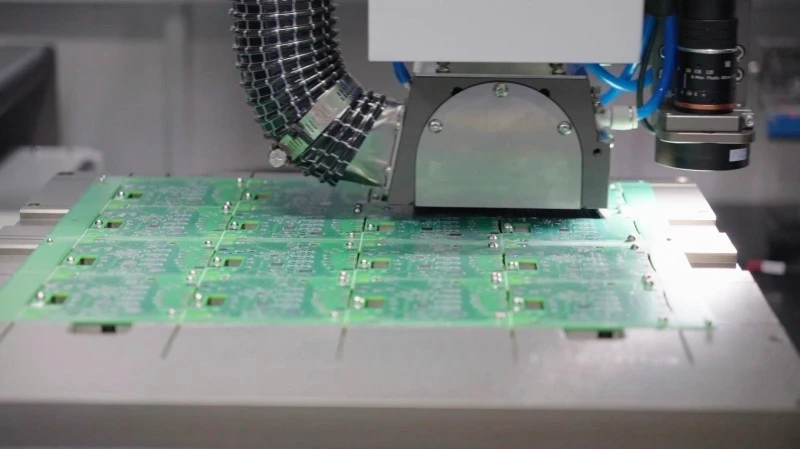
The fixture interface between the production panel and the depaneling machine’s aluminium workholding plate determines the effective working tolerance of the entire system. Vacuum fixture systems operating at -85 kPa to -90 kPa with aerostaticporous ceramic chuck platens provide uniform panel support across 300mm × 400mm panel formats, reducing panel bow below 0.05mm under full vacuum hold — a critical parameter when routing 0.8mm depth cuts across panels with local thickness variations of ±0.08mm due to panel pressing tolerances. Panel bow exceeding 0.08mm during cutting introduces a Z-axis deflection that compounds X-Y positional error, pushing the effective tolerance beyond the ±0.05mm target for boards with QFN or SOT-23 components near the singulation edge.
Technical Summary
Shantou-manufactured depaneling equipment offers a compelling cost-performance proposition for toy electronics PCB assembly operations, provided that procurement specifications include spindle speed range (40,000-80,000 RPM), thermal drift recalibration intervals, and fixture flatness tolerances (≤0.05mm/300mm) as mandatory acceptance criteria. The dominant failure modes — component cracking from excess singulation stress and resin smear from insufficient spindle speed — are both controllable through parameter optimisation aligned with IPC-A-600 and IPC-2221 requirements. At production volumes exceeding 1 million boards annually, the defect-rate reduction achieved by automated router depaneling over manual separation methods generates sufficient yield savings to justify machine ROI within 12-18 months, making this class of equipment a baseline requirement for competitive toy electronics manufacturing rather than a discretionary capital investment.
Recommended Equipment
Looking for proven depaneling solutions? Seprays offers a full range of equipment backed by 30+ years of industry experience. Here are two options worth considering for your production line:
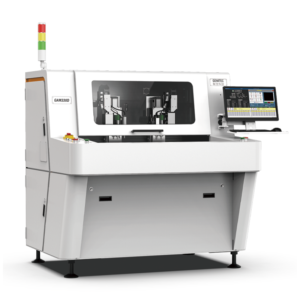
- GAM300AT Double-Layer Track Online PCB Board Separation Machine — Full-carrier process with carrier return track — built for seamless full-line automation
- ZM30-D Multi-Tool Multi-Group PCB Depaneling Machine — One-time full LED board cutting — daily output exceeding 100,000 pieces with custom configurations
Frequently Asked Questions
Q1: What is the typical throughput range for Shantou-manufactured PCB depaneling machines used in toy electronics production lines, and how does this compare to higher-end alternatives?
A1: Shantou depaneling machines typically deliver 300–600 boards/hour for standard single-layer toy PCBs, with mid-tier rotary models reaching up to 800 boards/hour in optimized conditions. Against Japanese or German brands, this represents 60–75% of their throughput, but with 40–50% lower acquisition cost and significantly cheaper spare parts and consumables.
Q2: What are the most common depaneling methods used in Shantou machines suited for toy electronics PCBs, and which offers the best cost-performance balance for high-volume toy production?
A2: The primary methods are v-score depaneling (lowest cost, ~¥15,000–25,000 machine investment), router-bit milling (versatile for complex shapes, ~¥25,000–40,000), and laser depaneling (highest precision for fine-pitch boards, ~¥80,000+). For high-volume toy electronics where unit margins are tight, v-score depaneling provides the best cost-performance ratio; router-bit milling is preferred when boards contain non-linear cut paths or sensitive SMD components.
Q3: What maintenance requirements and cost factors should toy electronics manufacturers budget for when operating Shantou depaneling equipment in a production environment?
A3: Shantou depaneling machines require routine maintenance every 500–1,000 operating hours, with typical consumables being v-blade replacements (¥200–500 each, lasting 50,000–100,000 cuts) and router bits (¥50–150 each, depending on material). Annual maintenance costs average 8–12% of the original machine purchase price, substantially lower than the 15–20% typical for European branded equipment. Operators should budget for blade wear monitoring, linear guide lubrication every shift, and periodic calibration of positioning accuracy to within ±0.05mm per IPC-2221A standards.
About Seprays
About Seprays Precision Machinery
Founded in 1993, Seprays has over 30 years of expertise in PCB depaneling solutions. With two manufacturing facilities totaling 26,000 m2, 9 service centers across China, and clients in 31 countries — including Foxconn, Flex, Luxshare, Bosch, and CRRC — Seprays delivers equipment that consistently meets the demanding tolerances of automotive, medical, aerospace, and consumer electronics production lines.
Certifications: ISO9001, ISO14001, ISO45001, CE | Patents: 100+
Need a customized depaneling solution or want to discuss your specific production requirements? Our technical team is ready to help.
Contact: jimmy@seprays.com