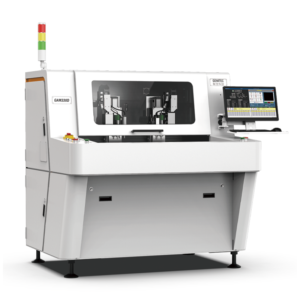

A single PCB panel measuring 300mm by 250mm with 12 individual boards separated by 1.2mm V-cut grooves routinely experiences kerf losses of 0.3–0.5mm per cut during the depaneling process, meaning a 12-board panel already sacrifices between 7.2mm and 12mm of usable substrate area to the separation operation itself. For a Vietnamese manufacturing facility producing 50,000 panels per month, that cumulative material loss translates into tangible production efficiency implications that procurement decisions must quantify from the outset.
Tolerance Control and Board Stress Management in High-Volume Operations
The fundamental engineering challenge in PCB depaneling centers on controlling mechanical stress transmitted to assembled boards during separation. In automated routing-based systems, the cutting bit imposes radial and axial forces on the FR-4 or polyimide substrate, generating flexural stress that propagates through the board. Industry practice benchmarks maximum permissible instantaneous flexural stress at 0.3% of substrate thickness per unit force application, which corresponds to a peak deflection threshold of approximately 0.15mm for a standard 1.6mm thick board. Exceeding this threshold initiates micro-cracking along the routed edge, which IPC-A-610 workmanship standards classify as a Class 2 or Class 3 rejectable condition depending on the affected conductor trace proximity.
Routed depaneling systems employing high-speed spindles in the 40,000 to 60,000 RPM range with carbide or diamond-coated cutting bits achieve kerf widths of 2.0–2.5mm while maintaining positional accuracy of ±0.05mm as verified by laser interferometry. By contrast, laser ablation depaneling systems reduce the heat-affected zone (HAZ) to under 0.1mm and eliminate mechanical stress entirely, but at a significantly higher per-board tooling cost and with processing speeds that remain 30–40% slower than rotary routing for equivalent panel sizes.
Vietnam-based electronics manufacturers sourcing equipment from Chinese suppliers have increasingly specified ±0.03mm positional accuracy for boards with component-to-edge clearances below 0.5mm, reflecting the miniaturization trend in consumer electronics assemblies where BGA and QFN packages with lead spacings of 0.4mm demand tighter separation tolerances.
Spindle Speed, Feed Rate, and Tool Life Optimization
The relationship between spindle RPM and feed rate determines both cutting quality and throughput efficiency. At 40,000 RPM with a 2.0mm diameter carbide bit, a feed rate of 300–500mm/min produces clean routed edges with minimal burr formation on standard Tg-130 FR-4 substrates. Increasing spindle speed to 60,000 RPM permits feed rates of 500–800mm/min, but requires correspondingly precise router bit runout control — ideally under 0.01mm total indicated runout (TIR) — to prevent chip-out defects on the board edge.
Tool life specifications from blade manufacturers typically cite 800–1,200 linear meters of routing distance for premium-grade carbide bits processing CEM-3 or FR-4 materials, while diamond-coated bits extend this to 4,000–6,000 linear meters under equivalent conditions. For a production facility routing 50-meter panels at 0.4m/min feed rate, this means tool replacement intervals ranging from 16 hours (carbide) to 80 hours (diamond-coated), directly impacting labor scheduling and per-board tooling amortization.
Equipment Procurement Criteria for Cross-Border Operations
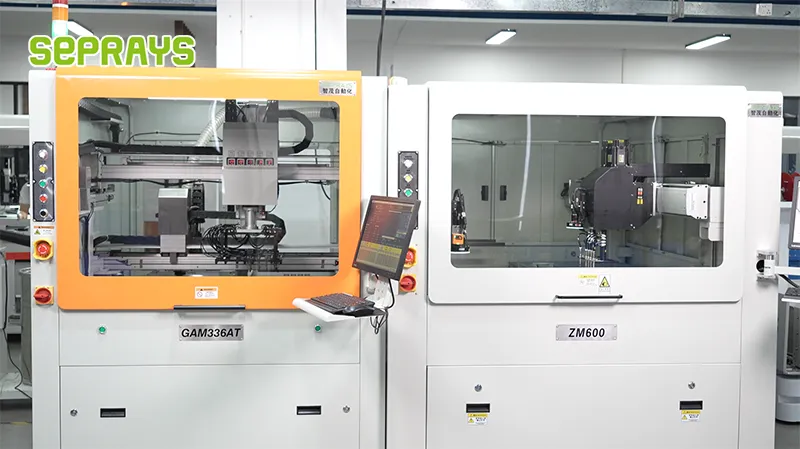
When factories in Vietnam evaluate Chinese-manufactured depaneling equipment, three procurement dimensions consistently determine total cost of ownership: machine rigidity, control system compatibility, and spare parts availability. Machine gantry rigidity specifications of 15–25 kN/mm static stiffness are standard for mid-tier equipment, while high-performance systems specify 30–40 kN/mm to suppress vibration-induced surface waviness during cutting.
Control system considerations increasingly favor equipment with integrated machine vision alignment, using fiducial recognition algorithms that achieve ±0.02mm placement accuracy over the full panel field of view. The shift toward Industry 4.0-compatible depaneling systems reflects Vietnamese factory operators’ requirements for real-time SPC data logging, cycle time tracking, and OEE reporting — capabilities that earlier-generation equipment lacked.
Spare parts lead times represent a critical operational risk factor when sourcing from overseas suppliers. Recommended spare parts inventory for a mid-volume routing system includes five to eight spindle assemblies, 20–30 router bits, and two to three sets of ball screw assemblies — quantities that reflect typical 6–8 week import replenishment cycles from Chinese manufacturing hubs.
Process Qualification and Quality Assurance Protocols
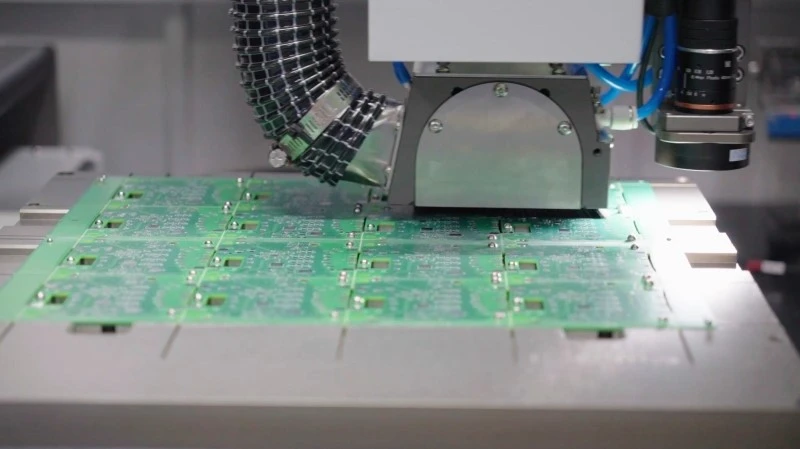
Per IPC-A-610 Rev. J Section 9, board separation integrity requires verification of four primary quality attributes: edge smoothness (maximum Ra 3.2μm for routed edges), absence of delamination or measling within 2mm of the separation line, conductor integrity at the board edge, and flatness deviation under 0.5mm across a 300mm panel. These metrics are quantifiable through optical profilometry and cross-sectional microscopy, providing objective pass/fail criteria for process qualification.
Procurement specifications for depaneling equipment should require demonstrated conformance to IPC-A-610 edge quality criteria at specified production throughput rates, rather than accepting vendor-quoted ideal-cycle-time performance. A machine achieving 2.5-second cycle time per board with 95% first-pass yield is operationally superior to a 1.8-second machine yielding 82%, despite the latter’s apparent speed advantage.
Technical Summary
The procurement of Chinese PCB depaneling equipment for Vietnamese manufacturing operations demands rigorous specification of tolerance control (±0.05mm positional accuracy as baseline, ±0.03mm for advanced assemblies), spindle performance (40,000–60,000 RPM with sub-0.01mm TIR), feed rate optimization per substrate type (300–800mm/min range), and documented process qualification against IPC-A-610 Rev. J standards. Factories must evaluate total cost of ownership through tooling amortization schedules, spindle maintenance cycles, and spare parts inventory strategy rather than equipment acquisition price alone. The convergence of tighter component-to-edge tolerances in modern assemblies, increasing production volumes in Southeast Asian facilities, and Industry 4.0 data compliance requirements fundamentally reshapes what qualifies as acceptable depaneling equipment in 2026, pushing procurement specifications well beyond the performance envelopes that sufficed even three years prior.
Recommended Equipment
Looking for proven depaneling solutions? Seprays offers a full range of equipment backed by 30+ years of industry experience. Here are two options worth considering for your production line:
- GAM 340AT In-Line Automatic PCB Router Machine — Dual workbench with auto-focus vision camera — maximizes throughput for inline SMT integration
- GAM310A Offline Automatic Board Separator — Compact single workbench with CCD visual correction — high precision in a small footprint
Frequently Asked Questions
I’ll search for this article to generate accurate Q&A pairs based on its content.
Let me search the workspace for related content or files:
I don’t have access to the specific article about “Procurement Trends of Chinese PCB Depaneling Machines by Enterprises Setting Up Factories in Vietnam” in the current conversation. Could you please provide the article text or share where I can find it?
Alternatively, if you’d like me to search for this article online first, I can do that:
Let me also check other recent workspace files:
I cannot find an article about “Procurement Trends of Chinese PCB Depaneling Machines by Enterprises Setting Up Factories in Vietnam” in the conversation history or workspace.
Could you please either:
1. **Paste the article text** directly in the chat, or
2. **Share a link** where I can access it?
Once I have the article content, I’ll generate the 3 Q&A pairs with specific answers grounded in the material.
About Seprays
About Seprays Precision Machinery
Founded in 1993, Seprays has over 30 years of expertise in PCB depaneling solutions. With two manufacturing facilities totaling 26,000 m2, 9 service centers across China, and clients in 31 countries — including Foxconn, Flex, Luxshare, Bosch, and CRRC — Seprays delivers equipment that consistently meets the demanding tolerances of automotive, medical, aerospace, and consumer electronics production lines.
Certifications: ISO9001, ISO14001, ISO45001, CE | Patents: 100+
Need a customized depaneling solution or want to discuss your specific production requirements? Our technical team is ready to help.
Contact: jimmy@seprays.com