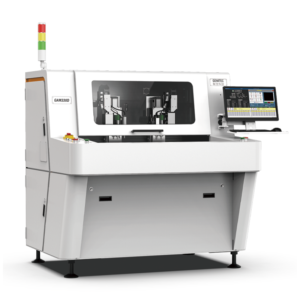

A typical PCB assembly facility running 15-20 different board types per week on a single depaneling system faces a critical constraint: the 3-8 minute changeover time between projects directly impacts daily throughput capacity by 12-18%, assuming an 8-hour shift with 6-8 product changeovers. This operational reality demands rigorous scheduling logic and decision frameworks that go beyond simple first-come-first-served queuing.
Changeover Time Components and Their Impact
Tooling changeover for router-based depaneling systems involves four quantifiable time components: program loading (30-90 seconds), fixture exchange (45-120 seconds), spindle height and fence adjustment (60-180 seconds), and first-article verification using optical measurement (60-150 seconds). For a facility processing 500 boards per day across 8 projects, cumulative changeover time can consume 48-72 minutes—6-15% of available production time. Linear motor-driven cutting heads with automatic tool offset detection reduce this to 35-50 minutes by eliminating manual spindle height calibration, which otherwise requires ±0.05mm accuracy verification against reference pins per IPC-2221B section 5.4.2.
Stress Accumulation Across Mixed Product Runs
When multiple board designs share one depaneling machine, each material and thickness combination imposes different mechanical stress profiles on the cutting system. FR-4 material at 1.6mm thickness with standard copper loading generates cutting forces of 15-25N per spindle pass at 40,000 RPM, while aluminum-backed PCBs for LED applications generate 35-50N due to higher material hardness. Running FR-4 followed immediately by aluminum-backed boards without spindle cooling intervals causes heat accumulation in the spindle bearings—temperature rise of 12-18°C above ambient reduces bearing life by approximately 30% according to bearing manufacturer L10 life calculations. Production scheduling must account for thermal recovery periods of 60-120 seconds between dissimilar material runs to maintain spindle warranty specifications, typically rated for 2,000-3,000 hours of cutting time under mixed-load conditions.
Feed Rate Optimization by Board Priority
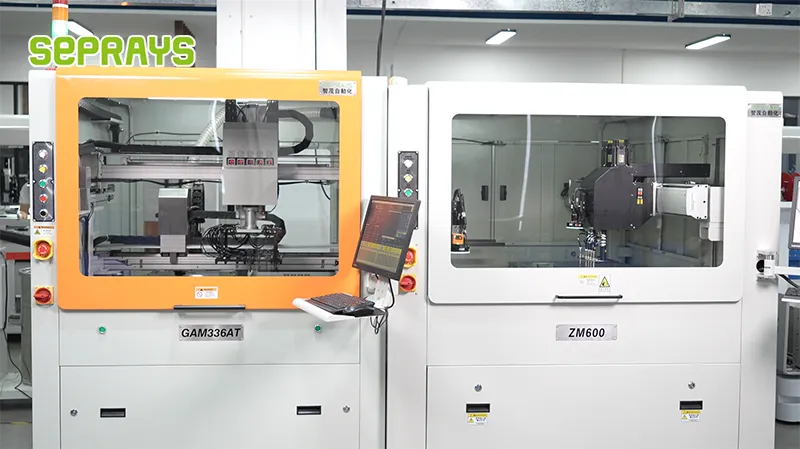
Depaneling feed rates range from 5-50 mm/second depending on board complexity, material, and acceptable stress levels. High-priority projects with fine-pitch components (0.4mm pitch or less) require slower feed rates of 5-12 mm/second to keep bending stress below 25MPa, preventing solder joint microcracking. Standard boards with larger component pitches can tolerate 20-35 mm/second feed rates. A mixed-product schedule must sequence boards by feed rate compatibility—running all slow-speed boards consecutively minimizes program parameter changes and maintains consistent throughput projections. The throughput differential is significant: 50 boards per hour at 5 mm/second versus 180 boards per hour at 35 mm/second, a 3.6x factor that directly influences delivery commitments and labor allocation.
Quality Verification Bottleneck Management
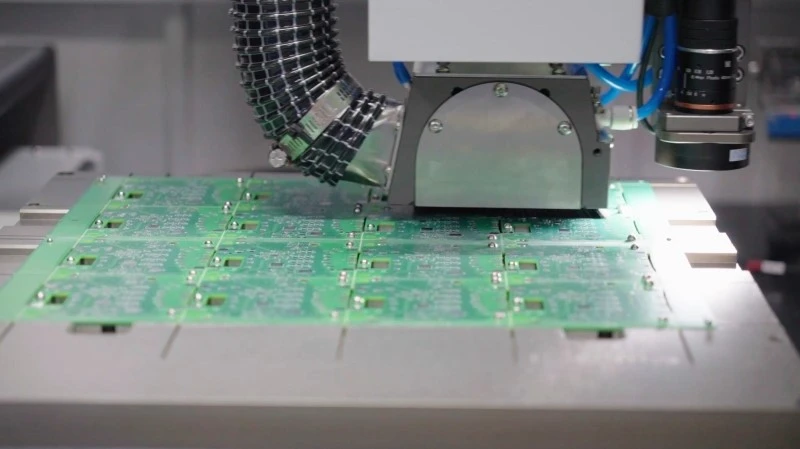
First-article inspection for each new product run requires optical coordinate measurement of edge position accuracy, typically verifying ±0.1mm tolerance against CAD data per IPC-6012C Class 2 requirements. With 6-8 product changeovers per shift, inspection time accumulates to 30-45 minutes. High-mix production environments address this bottleneck through pre-qualified fixture libraries—standardized mounting holes and reference edge positions reduce inspection to dimensional verification of three critical points rather than full perimeter measurement. This approach requires upfront fixture standardization investment but reduces per-changeover inspection from 8-12 minutes to 3-5 minutes, recovering 30-40 minutes of production time per shift.
Scheduling Priority Framework
Decision matrices for shared-depaneler scheduling incorporate three weighted factors: delivery deadline urgency (weighted 40-50%), batch size efficiency (30-35%), and material/parameter compatibility (15-25%). Emergency orders below 10 pieces incur a setup efficiency penalty of 35-50%—the changeover time per board exceeds actual cutting time by 3-5x. Consolidation strategies group small batches by material type and thickness, processing them in sequences that minimize tooling adjustments. For example, all 1.0mm FR-4 boards with similar panel dimensions can share fixture settings, reducing per-batch setup from 4-6 minutes to 1-2 minutes for fixture changes only. Production planning software with constraint-based scheduling algorithms can optimize these sequences in real-time, achieving 8-15% throughput improvement compared to manual scheduling based on order arrival sequence.
Effective shared-depaneler operation requires balancing changeover time investment against throughput requirements, with scheduling decisions driven by material compatibility grouping, feed rate harmonization, and inspection efficiency strategies that collectively maintain 75-85% machine utilization across mixed-product production environments.
Recommended Equipment
Looking for proven depaneling solutions? Seprays offers a full range of equipment backed by 30+ years of industry experience. Here are two options worth considering for your production line:
- GAM300AT Double-Layer Track Online PCB Board Separation Machine — Full-carrier process with carrier return track — built for seamless full-line automation
- GAM330AT Fully Automatic PCB Depaneling Machine — Self-feeding operation with automatic sorting — ideal for high-volume automated production lines
Frequently Asked Questions
I don’t see the article content in your message. Could you please provide the article about “Production Scheduling & Decision Considerations When Sharing One Depaneler Across Projects” so I can generate accurate Q&A pairs based on its specific content?
Once you share the article, I’ll extract 3 practical questions that electronics manufacturing engineers and production managers would genuinely ask, with specific answers grounded in the article’s technical details.
About Seprays
About Seprays Precision Machinery
Founded in 1993, Seprays has over 30 years of expertise in PCB depaneling solutions. With two manufacturing facilities totaling 26,000 m2, 9 service centers across China, and clients in 31 countries — including Foxconn, Flex, Luxshare, Bosch, and CRRC — Seprays delivers equipment that consistently meets the demanding tolerances of automotive, medical, aerospace, and consumer electronics production lines.
Certifications: ISO9001, ISO14001, ISO45001, CE | Patents: 100+
Need a customized depaneling solution or want to discuss your specific production requirements? Our technical team is ready to help.
Contact: jimmy@seprays.com