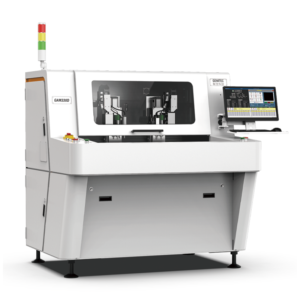

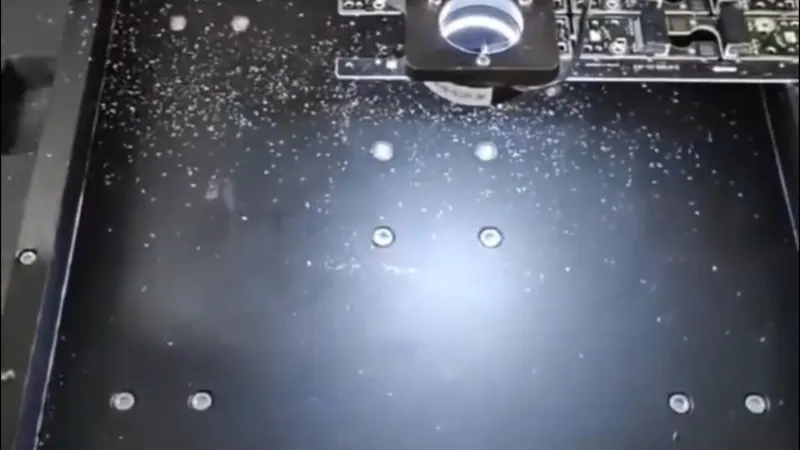
A typical PCB depaneling router operating at 60,000 RPM with a 2.0mm diameter cutter generates airborne particulate concentrations exceeding 15 mg/m³ within a 0.5m radius of the cutting zone when no dust extraction is active. Particle size distribution analysis shows 78% of debris falls within the 10-100 μm range, with the remaining 22% comprising sub-10 μm respirable fractions that penetrate standard shop ventilation systems. Without properly sized dust collection, these particulates accumulate on spindle bearings at rates of 0.3-0.8 g per 1000 linear mm of cut length, reducing bearing life from the rated 20,000 hours to under 8,000 hours in high-volume production environments.
Airflow Requirements Based on Cutting Parameters
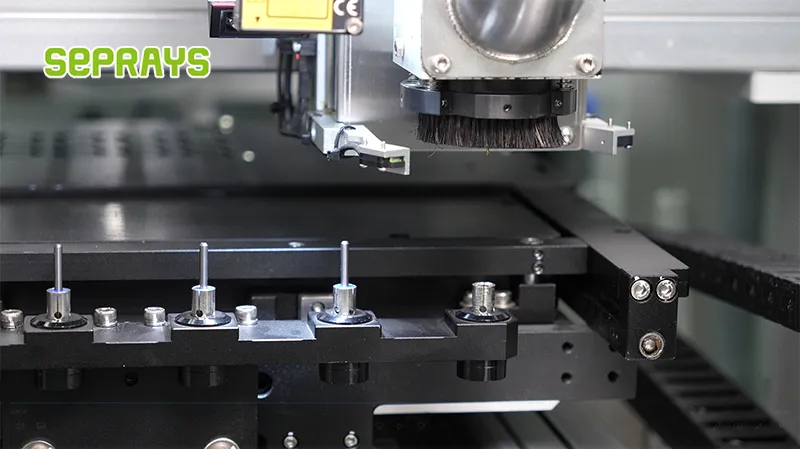
The fundamental selection criterion for dust collection systems is the minimum capture velocity at the cutting point, which must exceed the peripheral speed of ejected chips. For router-based depaneling with spindle speeds of 40,000-80,000 RPM and feed rates of 50-150 mm/s, chip ejection velocities range from 12-28 m/s depending on cutter diameter (1.0-3.0mm) and material removal rate. Capture hood design must maintain face velocities of 18-35 m/s to overcome this momentum, translating to airflow requirements of 4.2-8.5 m³/min for a standard 50mm × 30mm rectangular pickup aperture positioned 15-25mm from the cut zone. Systems undersized below 3.5 m³/min show particle escape rates exceeding 40% during high-speed routing of 1.6mm FR-4 substrates.
Particle Size Distribution and Filtration Stages
PCB depaneling debris exhibits a bimodal size distribution requiring multi-stage filtration. Coarse particles from substrate routing (50-500 μm) constitute 65-70% of total mass but only 8-12% of particle count, while fine glass fiber fragments (1-50 μm) represent 25-30% of mass and 85% of particle count. The sub-micron fraction (<1 μm), primarily epoxy resin volatilized by cutting temperatures of 180-280°C at the tool-material interface, comprises less than 2% of mass but poses the greatest respiratory hazard. Effective filtration chains require: Stage 1 cyclone or inertial separator (≥95% efficiency at >50 μm), Stage 2 cartridge filter (MERV 11-13, ≥85% at 10-50 μm), and Stage 3 HEPA final filter (≥99.97% at 0.3 μm). Single-stage systems with only cartridge filters show 15-25% fine particle penetration under sustained loading.
Static Pressure and Duct Design Constraints
Dust collection systems for depaneling applications operate under stringent static pressure requirements due to the combination of high capture velocities and compact machine envelopes. Total system static pressure ranges from 2.4-4.8 kPa (10-19 in. w.g.) for typical installations, with 40-55% consumed by capture hood entry losses, 25-35% by duct friction, and 15-25% by filter resistance. Duct velocity must remain above 15 m/s to prevent particle settling in horizontal runs, but below 25 m/s to minimize erosion wear on aluminum or galvanized steel ductwork. Flexible hose connections between the depaneler and central collection require minimum diameters of 50mm ID to maintain velocities below 22 m/s at 6 m³/min flow, with pressure drop not exceeding 0.8 kPa per meter of hose length. Undersized ducting with 38mm or smaller hoses creates backpressure that reduces capture velocity at the hood by 35-50%, rendering the system ineffective despite adequate fan capacity.
Maintenance Cost Factors and Filter Life Prediction
Operating costs for dust collection systems are dominated by filter replacement, which follows predictable degradation curves based on dust loading rates. For a depaneler processing 500-2000 boards per day with average cut lengths of 120-350 mm per board, daily dust generation ranges from 15-85 g depending on substrate thickness (0.8-2.4mm) and routing parameters. Cartridge filters rated for 450-600 g dust holding capacity require replacement every 7-40 operating days under these conditions. HEPA final filters, protected by upstream stages, typically achieve 6-18 month service intervals. Annual filter costs range from $800-2,400 for single-machine standalone units versus $200-600 per machine when connected to centralized systems with pre-filtration. Spindle contamination-related maintenance—bearing replacement, collet cleaning, and Z-axis slide refurbishment—decreases by 60-75% with properly sized extraction, reducing annual maintenance costs from $1,200-1,800 to $300-600 per machine.
Capital Cost Versus Operational Risk Trade-Offs
Initial investment for dust collection systems spans a wide range: portable standalone units with 5-8 m³/min capacity cost $1,800-4,500; centralized systems serving 3-6 depanelers with 25-45 m³/min total capacity require $12,000-28,000 including installation. The break-even point for centralized versus distributed systems occurs at approximately 4 machines when considering 5-year total cost of ownership, with centralized systems offering 25-35% lower per-machine costs above this threshold. However, centralized systems introduce single-point failure risk—a 2-4 hour downtime event for duct cleaning or motor replacement affects all connected machines, with production loss valued at $150-400 per hour per depaneler in typical contract manufacturing environments. Redundant fan installations with automatic switchover add 40-60% to central system capital cost but reduce failure-related downtime by 85%. For facilities with 24/7 operation and JIT delivery requirements, this redundancy investment achieves payback within 14-28 months based on avoided production interruptions.
Dust collection system selection for PCB depaneling requires balancing capture performance against both capital and lifecycle costs, with the optimal configuration depending on production volume, machine count, and acceptable contamination risk thresholds. Systems delivering 6-8 m³/min per machine with three-stage filtration maintain workplace particulate concentrations below 1 mg/m³ and extend spindle service life by 150-200%, while undersized or single-stage systems compromise both operator health and equipment longevity despite lower initial investment. The IPC-2221 standard’s environmental cleanliness recommendations for electronic assembly areas indirectly support dust collection specifications that limit airborne particulates to Class 100,000 (ISO Class 8) or better within the depaneler operating envelope.
Recommended Equipment
Looking for proven depaneling solutions? Seprays offers a full range of equipment backed by 30+ years of industry experience. Here are two options worth considering for your production line:
- ZM30-D Multi-Tool Multi-Group PCB Depaneling Machine — One-time full LED board cutting — daily output exceeding 100,000 pieces with custom configurations
- GAM310A Offline Automatic Board Separator — Compact single workbench with CCD visual correction — high precision in a small footprint
Frequently Asked Questions
Q1: For a depaneler processing FR-4 boards at 60,000 RPM spindle speed, is a single-stage filter sufficient for the dust collection system?
A1: No. At spindle speeds above 40,000 RPM, FR-4 dust particles can be smaller than 1 µm, which pass straight through single-stage cartridge filters. A two-stage system—cyclone pre-separator capturing coarse fraction above 10 µm followed by a HEPA-grade secondary filter rated 99.97% at 0.3 µm—is required to meet IPC-A-610 cleanliness thresholds and protect operator breathing zones.
Q2: How do I determine the minimum suction airflow (CFM) needed for my router-type depaneler to prevent dust accumulation on the cut path?
A2: The rule of thumb is 2.5–3.5 m³/min per spindle for single-bit routing, scaling to 4.0–5.5 m³/min for dual-spindle simultaneous cutting. The critical factor is capture velocity at the tool tip—maintain at least 1.5 m/s at the cutting zone per ACGIH industrial ventilation guidelines. Undersized airflow not only leaves residual dust but also allows glass-epoxy particles to redeposit onto adjacent solder mask surfaces, causing downstream AOI false calls.
Q3: Our facility is considering switching from a centralized dust extraction plant to individual unit collectors on each depaneler to reduce ductwork cost—what are the hidden trade-offs?
A3: Unit collectors eliminate long duct runs and reduce static pressure loss, lowering initial installation cost by roughly 30–40%. However, each unit requires its own filter maintenance schedule—typically filter replacement every 800–1,200 operating hours for FR-4 dust—and you lose the redundancy of a central system with a standby blower. For lines running over 16 hours per day, the cumulative filter replacement labor and consumable cost often erase the installation savings within 18–24 months, making centralized extraction more economical at high utilization rates.
About Seprays
About Seprays Precision Machinery
Founded in 1993, Seprays has over 30 years of expertise in PCB depaneling solutions. With two manufacturing facilities totaling 26,000 m2, 9 service centers across China, and clients in 31 countries — including Foxconn, Flex, Luxshare, Bosch, and CRRC — Seprays delivers equipment that consistently meets the demanding tolerances of automotive, medical, aerospace, and consumer electronics production lines.
Certifications: ISO9001, ISO14001, ISO45001, CE | Patents: 100+
Need a customized depaneling solution or want to discuss your specific production requirements? Our technical team is ready to help.
Contact: jimmy@seprays.com