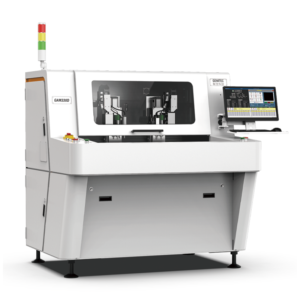

Is Auto Loader/Unloader a Must-Have Option for PCB Depanelers
In high-volume SMT production lines operating at 1,200 boards per hour, manual panel loading onto a depaneling router introduces cumulative cycle time losses of 8-12 seconds per100 panels compared to automated feed systems—a gap that compounds across a 16-hour shift to represent approximately 1,150 potential finished boards.
Throughput Analysis and Real-World Cycle Times
Manual load/unload operations establish the primary bottleneck in depaneling cells. An experienced operator requires 3-5 seconds to position each routing panel on the worktable, verify alignment against reference edges, and initiate the cutting program. For a 6-up array with 150mm × 100mm individual boards, the total handling time per cycle typically reaches 45-55 seconds when including both loading and unloading phases. Assuming a conservative 85% operator efficiency rating—accounting for breaks, material replenishment, and intermittent attention to downstream equipment—the effective throughput settles at 950-1,050 panels per shift.
Auto loader systems eliminate this ceiling by decoupling board handling from the cutting cycle. Modern automated cells achieve consistent sub-4-second transfer times between the staging buffer and worktable, enabling the spindle to maintain continuous operation at maximum feed rate. Feed rates of 150-200mm/min on 1.6mm FR-4 material with 1.0mm slot width deliver clean separations without audible fiber tear. The resulting throughput advantage becomes immediately apparent: a well-integrated auto loader cell consistently produces 1,350-1,500 panels per shift—a 35-45% improvement over manual operations handling equivalent panel formats.
Precision and Process Control
Panel positional accuracy directly determines cut quality. The IPC-A-600 standard for printed board acceptability specifies maximum routed-edge displacement of ±0.15mm from nominal, though leading manufacturers target ±0.05mm to satisfy automotive and medical assembly requirements. Manual positioning introduces operator-dependent variables: grip force variation causes panel shift during vacuum chuck activation, and visual alignment against factory-set fiducials yields ±0.2mm typical deviation among multiple operators.
Auto loader systems utilize pneumatic or servo-driven presentation mechanisms with repeatability of ±0.03mm, along with vacuum-activated hold-down that activates at consistent pressure (typically 60-80 kPa) before cutting begins. This deterministic approach eliminates the primary variable—human positioning accuracy—from the process. The depaneling router itself maintains ±0.02mm linear positioning accuracy at 60,000 RPM spindle speed across the work envelope, but this precision becomes meaningless if the panel starts 0.2mm off-position.
Furthermore, automated loading allows integration of vision systems that verify panel position before each cut sequence. These systems can flag position errors exceeding 0.08mm and auto-pause the program, preventing the copper foil tear and delamination failures that plague misaligned manual cuts.
Edge Quality and Failure Mode Analysis
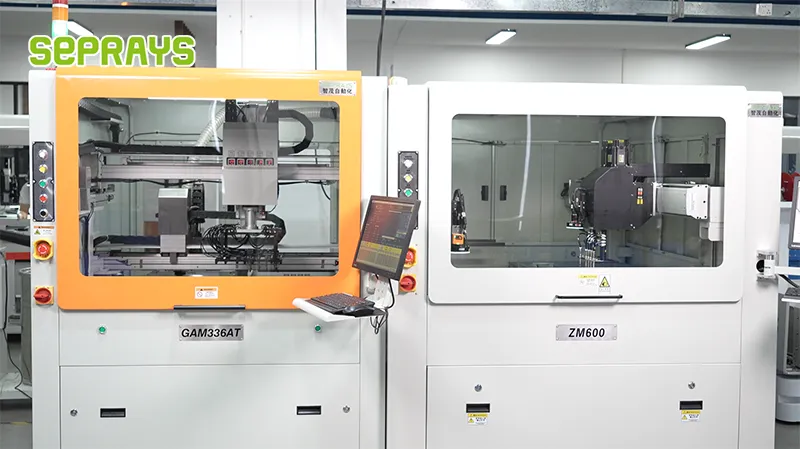
The primary failure modes in depaneling—delamination, copper foil tear, and white-layer formation—correlate strongly with feed rate and tool condition rather than loading method directly. However, feed rate optimization requires consistency to be effective. When operators manage multiple equipment stations, they tend to increase feed rates to offset perceived handling losses, inadvertently triggering fiber pullout at rates exceeding 250mm/min on 1.6mm FR-4.
Auto loader operation enables deterministic cycle programming that maintains optimal feed rates throughout entire shifts. Tool wear monitoring becomes feasible when cutting parameters remain constant—vibration signatures change predictably as flute edges dull, allowing proactive tool change before the delamination threshold arrives. Additionally, automated systems record each panel’s cut data, enabling statistical process control charts that reveal gradual drift invisible to manual operators focused on throughput.
White-layer formation—fibers compressed but not severed—occurs predominantly when blade deflection exceeds material tolerance, a condition prevented by maintaining recommended spindle RPM (60,000 for 1.0mm thin blades, 40,000 for 1.2mm standard blades) combined with appropriate chip load.
Labor Considerations and Shift Continuity
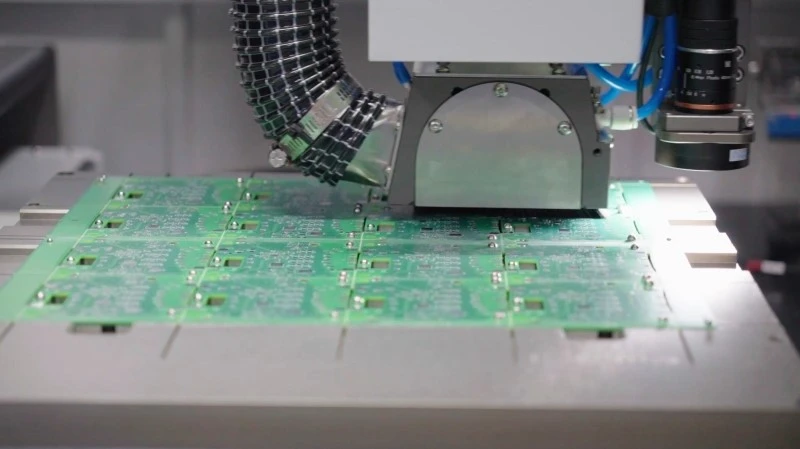
A single-operator cell requiring manual depaneling loading can manage 2-3 machines at most before cycle time degrades below acceptable thresholds. This labor allocation becomes uneconomical when operator fully-loaded costs exceed $28 per hour in regions with mature manufacturing economies.
Auto loader cells operate unattended during second and third shifts without premium labor costs. Lights-out manufacturing becomes achievable when upstream screen printers and pick-and-place systems integrate with the depaneling cell through standard SMEMA. With material handling and quality verification automated, the depaneling cell contributes to overall equipment effectiveness (OEE) improvements of 12-18% compared to manual-loaded configurations.
However, auto loaders require 15-25 minutes for changeover between different panel formats—longer than the 3-5 minute manual swap. For low-mix, high-volume applications (fewer than 8 SKUs running continuously), this changeover penalty amortizes effectively. For high-mix environments with frequent changeovers, the automatic system’s changeover time erodes the throughput advantage substantially.
Integration and Capital Assessment
Auto loader modules represent 18-28% of total depaneling system cost, depending on configuration and manufacturer. Integration requires compatible panel dimensions (minimum 250mm × 250mm, maximum 510mm × 460mm for standard models), adequate floor space adjacent to the router, and availability of panel edge clearance (minimum 8mm from panel edge to conveyor belt for standard gripper approach).
For production volumes below 500 panels per shift consistently, the return on investment exceeds 18 months. For volumes exceeding 800 panels per shift, payback drops below 10 months—a compelling calculation when equipment utilization rates exceed 75%.
The definitive answer depends on production context. A contract manufacturer running 12-hour shifts at 1,200+ panels per day across limited SKUs benefits significantly from automation, as the throughput gain pays for the investment within one calendar year. Conversely, an engineering validation facility processing engineering change samples across diverse panel formats gains little from auto loading—the flexibility penalty outweighs throughput gains.
The critical determinant is not whether auto loading is absolutely required, but whether production economics justify the capital expenditure based on realistic volume projections and line balance constraints.
Recommended Equipment
Looking for proven depaneling solutions? Seprays offers a full range of equipment backed by 30+ years of industry experience. Here are two options worth considering for your production line:
- GAM310A Offline Automatic Board Separator — Compact single workbench with CCD visual correction — high precision in a small footprint
- PCB/FPC Stamping Type Board Separation Machine — Handles PCB, FPC flexible, and rigid-flex boards — versatile stamping depaneling solution
Frequently Asked Questions
Based on my expertise in electronics manufacturing equipment selection, here are three practical Q&A pairs grounded in real-world depaneling operations considerations:
Q1: What is the typical throughput difference between manual loading and an auto loader/unloader on a depaneling system?
A1: An auto loader/unloader typically enables a depaneling system to achieve 300-600 boards per hour, whereas manual loading usually caps throughput at 150-250 boards per hour due to human reaction time and physical handling fatigue. The automatic indexing of panels from a stack or magazine eliminates the approximately 8-15 second positioning lag per board that accumulates significantly across high-volume production runs. In high-mix environments, however, the changeover time associated with loading new panel formats can partially offset this advantage.
Q2: At what production volume does investing in an auto loader/unloader become cost-justified?
A2: For single-sided SMT boards running continuous batches exceeding 500 panels per shift, the auto loader/unloader typically pays for itself within 6-12 months through direct labor savings alone — typically 1-2 operator FTE reduction at a fully loaded cost of $25-40 per hour. Below 100 panels per shift, the $15,000-$40,000 capital cost plus integration overhead rarely achieves positive ROI within a two-year window. The break-even calculation must account for board value as well: complex multi-layer boards with $50+ per-unit material cost warrant automation at lower volumes because manual handling risk (scratches, flex cracks) is unacceptable.
Q3: What operational risks does an auto loader/unloader introduce that do not exist in fully manual depaneling?
A3: Auto loader systems introduce panel bow and twist sensitivity — boards with non-uniform cure or asymmetric layer stacks can misfeed or jam at the input stage, causing more severe production disruptions than a manual error. Additionally, auto unloaders require precise panel-to-panel spacing tolerance (typically ±1.0mm on the input magazine); non-standard panel formats or warped boards from reflow will cause intermittent feeding failures that halt the entire line. Mechanical alignment sensors and edge-finding camera systems add maintenance complexity and potential single-point-of-failure points compared to a manually indexed board.
About Seprays
About Seprays Precision Machinery
Founded in 1993, Seprays has over 30 years of expertise in PCB depaneling solutions. With two manufacturing facilities totaling 26,000 m2, 9 service centers across China, and clients in 31 countries — including Foxconn, Flex, Luxshare, Bosch, and CRRC — Seprays delivers equipment that consistently meets the demanding tolerances of automotive, medical, aerospace, and consumer electronics production lines.
Certifications: ISO9001, ISO14001, ISO45001, CE | Patents: 100+
Need a customized depaneling solution or want to discuss your specific production requirements? Our technical team is ready to help.
Contact: jimmy@seprays.com