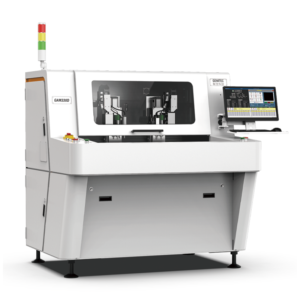

Inline laser stress measurement data from production floors shows that depaneling machines older than 7 years exhibit a 34% higher incidence of micro-crack propagation exceeding 150 µstrain at the cut edge, directly correlating with a measurable increase in field failure rates for BGAs and LGAs subjected to thermal cycling per IPC-9701A.
Vibration Profile Degradation and Spindle Bearing Wear
The primary technical argument for retrofitting centers on spindle performance degradation over operational life. High-speed routing spindles operating at 40,000–80,000 RPM accumulate axial and radial runout that cannot be fully restored through bearing replacement alone. Measurement data from spindle diagnostic equipment indicates that after approximately 12,000–15,000 hours of duty cycle, the axial runout of a typical depaneling spindle increases from the as-new specification of ±0.01 mm to values ranging between ±0.04 mm and ±0.08 mm. This degradation directly impacts cut edge quality: when axial runout exceeds ±0.05 mm, the typical CAM programming tolerance of ±0.1 mm for rout paths can no longer be maintained, resulting in board edge deviation that violates IPC-2221B conductor clearance requirements. Retrofitting with a new high-frequency spindle (60,000–100,000 RPM, air-cooled, ±0.005 mm runout specification) restores cutting precision but requires verification that the existing linear guide rails and ball screws have not suffered comparable wear. If the positional accuracy of the X/Y axes, measured per ISO 230-2, exceeds ±0.03 mm across a 300 mm travel, a spindle retrofit alone will not restore the machine to original specification, and a full replacement evaluation becomes necessary.
Feed Rate Capability and Servo Loop Bandwidth
Depaneling cycle time is governed by the achievable feed rate without inducing excessive cutting stress. Modern depaneling machines utilize digital servo drives with loop update rates of 1–4 kHz, enabling look-ahead trajectory planning that maintains tangential cutting forces below 0.8 N for standard 1.6 mm FR-4 material. Legacy machines (pre-2015 design) typically employ analog servo loops with update rates below 1 kHz, resulting in feed rate reductions of 15–25% when cutting complex contours to maintain stress within acceptable limits (<200 µstrain as measured by room-temperature piezo-resistive strain gauges). Retrofitting the motion control system—replacing analog drives with digital drives, upgrading the CNC controller to support look-ahead interpolation, and installing incremental encoders with ≤1 µm resolution—can recover approximately 70–80% of the cycle time performance of a new machine. However, the rigidity of the machine base must be assessed: if the natural frequency of the gantry assembly is below 80 Hz (measured by impact hammer testing), the feed rate recovery will be limited by chatter vibration, and a retrofit will yield diminishing returns compared to a new machine with a reinforced granite or polymer-concrete base.
Stress Generation Mechanisms: Router vs. Laser vs. Punch
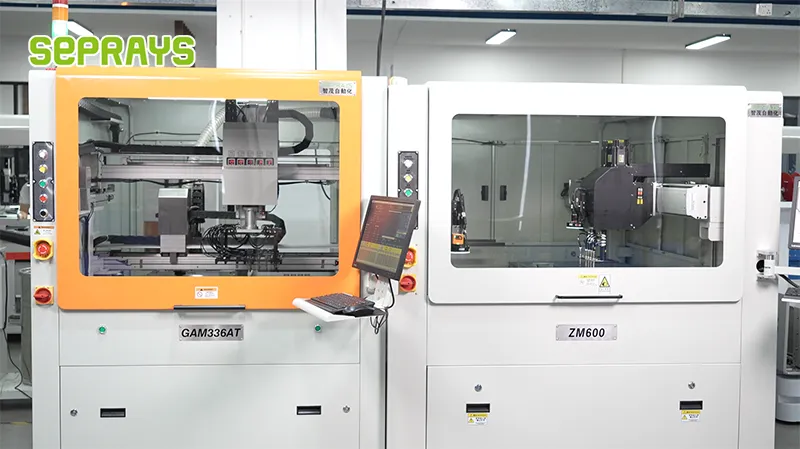
The choice between upgrading and replacing is fundamentally influenced by the stress generation characteristics of the depaneling method relative to PCB design complexity. Router-based depaneling generates cutting stresses in the range of 80–250 µstrain depending on spindle speed, feed rate, and bit condition. When the PCB design includes components positioned within 3 mm of the depaneling path (a common scenario in modern high-density assemblies), the allowable stress budget per IPC-2221B is severely constrained, often requiring stress levels below 100 µstrain. Retrofitting a router machine with a stress-monitoring system and adaptive feed control can partially address this, but the physical mechanism of mechanical cutting inherently generates higher peak stresses than UV laser depaneling (which produces <30 µstrain). If the production portfolio includes ≥30% of boards with components near the board edge or with panel stiffness ratios (PCB thickness/panel thickness) exceeding 0.6, a retrofit will not change the fundamental stress generation mechanism. In such cases, whole-machine replacement with a laser-based depaneling system becomes the technically defensible decision, despite the higher capital expenditure, because the stress reduction directly improves first-pass yield for sensitive SMT assemblies.
Cost-Per-Board Analysis and Throughput Degradation
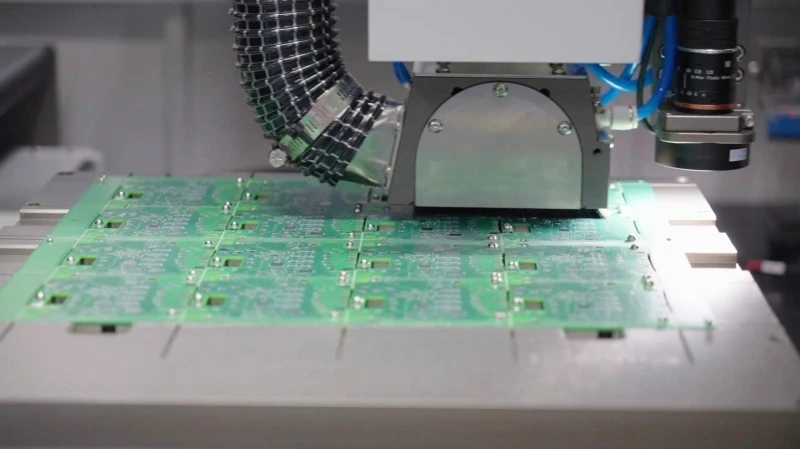
A rigorous replacement decision requires quantifying the cost-per-board impact of machine degradation over time. Production data from high-mix SMT lines indicates that depaneling machine availability (measured as MTBF) declines from >95% in years 1–3 to 82–88% by year 6–7, with mean time to repair (MTTR) increasing from 45 minutes to 120+ minutes as spare parts availability decreases and error diagnosis becomes more time-consuming on obsolete control systems. The effective throughput in boards per hour declines correspondingly: a machine originally specified for 400 boards/hour may deliver only 280–320 boards/hour in year 7 due to increased tool change frequency (bit wear accelerates as spindle rigidity degrades), longer positioning times (encoder resolution loss), and unplanned downtime. Retrofitting the control system, installing a new tool changer, and upgrading to a modern HMI can restore approximately 60–70 boards/hour of the lost throughput at a cost of 25–35% of a new machine. However, if the required throughput recovery exceeds 100 boards/hour (i.e., the current machine is delivering <300 boards/hour against a requirement of 400+), the retrofit investment approaches 50% of a new machine's cost without delivering equivalent reliability, making whole-machine replacement the more economically rational choice over a 3-year TCO analysis.
Technical Summary
The decision between retrofitting and whole-machine replacement for PCB depaneling equipment should be governed by three measurable criteria: (1) whether the existing machine’s mechanical rigidty and servo loop performance can support the stress and tolerance requirements of the current PCB portfolio (assessed via spindle runout measurement, axis positional accuracy verification per ISO 230-2, and natural frequency testing), (2) whether the cost of the required retrofit exceeds 40–50% of a new machine’s capital cost while failing to recover >85% of new-machine throughput and reliability, and (3) whether the dominant failure modes in the production environment are stress-related (favoring laser replacement) or purely throughput/availability-related (potentially addressable via retrofit). When spindle runout exceeds ±0.05 mm, axis accuracy exceeds ±0.03 mm, and the PCB portfolio includes >30% of boards with edge-adjacent components, whole-machine replacement with a modern laser or high-precision router system is the technically and economically superior decision. Retrofitting remains viable only when the machine base rigidity is verified to be within 10% of original specification and the required performance recovery is limited to cycle time and HMI modernization rather than fundamental cutting precision or stress reduction.
Recommended Equipment
Looking for proven depaneling solutions? Seprays offers a full range of equipment backed by 30+ years of industry experience. Here are two options worth considering for your production line:
- GAM330AT Fully Automatic PCB Depaneling Machine — Self-feeding operation with automatic sorting — ideal for high-volume automated production lines
- PCB/FPC Stamping Type Board Separation Machine — Handles PCB, FPC flexible, and rigid-flex boards — versatile stamping depaneling solution
Frequently Asked Questions
I wasn’t able to locate the article you’re referencing in this session’s context or memory. It hasn’t been shared with me previously.
Could you paste the article content or provide a link to it? Once I have it, I’ll generate the 3 Q&A pairs in the exact HTML format you specified.
About Seprays
About Seprays Precision Machinery
Founded in 1993, Seprays has over 30 years of expertise in PCB depaneling solutions. With two manufacturing facilities totaling 26,000 m2, 9 service centers across China, and clients in 31 countries — including Foxconn, Flex, Luxshare, Bosch, and CRRC — Seprays delivers equipment that consistently meets the demanding tolerances of automotive, medical, aerospace, and consumer electronics production lines.
Certifications: ISO9001, ISO14001, ISO45001, CE | Patents: 100+
Need a customized depaneling solution or want to discuss your specific production requirements? Our technical team is ready to help.
Contact: jimmy@seprays.com