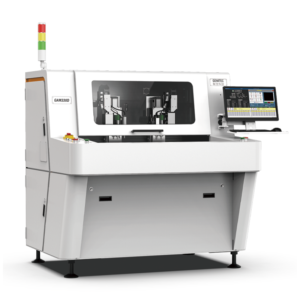

When a depaneling router spindle operating at 60,000 RPM experiences axial runout exceeding 8μm during a 0.8mm depth-of-cut pass on 1.6mm FR-4, the resulting cutting force variation of ±12N induces board edge chipping exceeding IPC-A-600 Class 2 acceptance criteria, forcing a retrofit-or-replace decision that hinges on whether the spindle bearing preload degradation is the root cause or the entire mechanical architecture has exceeded its precision lifecycle.
Spindle Bearing Preload Measurement and Regrind Feasibility
Precision depaneling routers utilize 40,000-80,000 RPM spindles with designed radial runout tolerances of ±0.005mm at the collet nose. When vibration analysis detects elevated broadband noise at 2-4kHz (indicating ball bearing defect frequencies), the first diagnostic step is measuring actual runout using a 1μm-resolution dial indicator. If runout exceeds 0.015mm, bearing replacement is mandatory. The decision pivot: Can the existing spindle be reconditioned, or does the spindle frame show measurable taper wear beyond ISO H5 tolerance? Regrind cost typically ranges 30-40% of new spindle cost, but only if the housing bore remains within +0.002/-0.000mm of original specification. If the spindle mounting flange shows repeatability drift >0.02mm across 10 measurement cycles, full spindle replacement — not retrofitting — is the technically defensible path.
Linear Guide Rail Wear and Axis Positioning Degradation
Depaneling machines with >20,000 operating hours on 15mm or 20mm profile linear guides exhibit cumulative positioning error directly impacting cut quality. Per ISO 230-2, linear positioning accuracy should be verified at 100mm intervals across full X/Y travel using a laser interferometer. When maximum positioning deviation exceeds ±0.05mm (compared to original ±0.01mm specification), and backlash compensation cannot restore accuracy, the linear guides and ballscrews require replacement. Retrofitting linear guides costs approximately 15-20% of a new machine, but requires complete mechanical teardown, re-alignment to <0.01mm/m parallelism, and re-validation of the machine coordinate system. If the base casting shows stress fatigue cracks (detected via dye penetrant inspection), retrofit is technically inadvisable — the casting's dimensional stability cannot be restored.
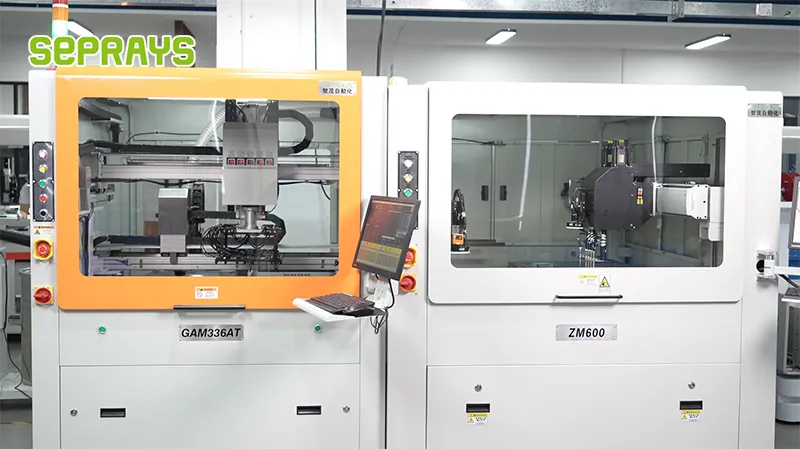
CAM Software and Motion Control System Upgrade Path
Legacy motion controllers using 1990s-era DSP architecture are limited to 500-800 block lookahead, resulting in visible velocity reduction (15-25%) at high-curvature routing paths. Upgrading to a modern CNC controller with 4,000+ block lookahead and spline interpolation can improve throughput by 18-24% on complex board outlines. However, the retrofit requires rewiring the entire I/O chassis and re-mapping axis servo tuning parameters — a 3-5 day downtime event. If existing servo motors are 5-phase stepper or early-generation brushless DC with commutator wear, the controller upgrade triggers cascading hardware replacement, pushing retrofit cost above 60% of a new machine. The financial break-even point: if retrofit cost exceeds 50% of new-machine CAPEX, whole-machine replacement is the conservative engineering recommendation.
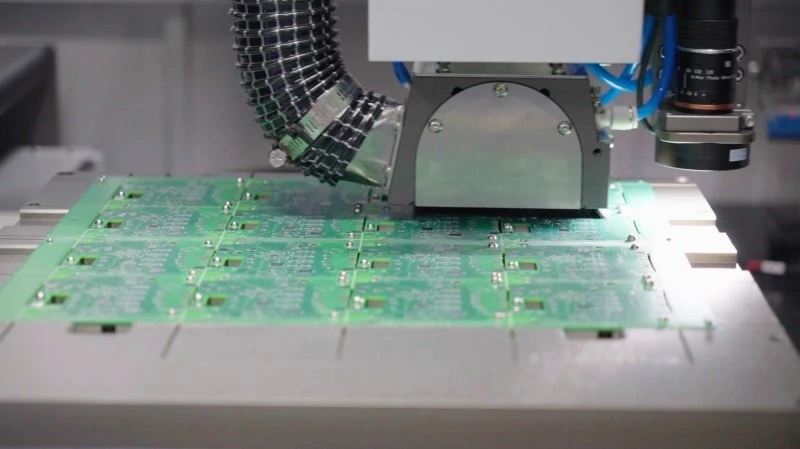
Cutting Stress Measurement and Bit Condition Monitoring
PCB depaneling stress is quantitatively measured using strain gauge rosettes at 0°, 45°, and 90° orientations with 10kHz sampling rate data acquisition. Acceptable peak stress for IPC-2221B compliant designs is <25 MPa for standard FR-4. When a depaneling machine produces stress readings >35 MPa across 50 consecutive boards, the root cause must be isolated: dull router bits (flank wear >0.15mm), excessive feed rate (>60mm/s on 1.0mm thickness), or machine vibration coupling into the workholding fixture. Router bit replacement cost is negligible (~$8-15 per bit), but if stress reduction requires feed rate reduction below 30mm/s to meet the 25 MPa threshold, the machine’s effective throughput drops below economic viability (<40 boards/hour). At this point, upgrading to a machine with higher spindle power (≥1.2kW vs legacy 0.4-0.6kW) becomes the technically necessary decision.
Total Cost of Ownership: 5-Year Engineering Economics
A rigorous TCO model must account for acquisition CAPEX, installation downtime, annual maintenance parts, energy consumption, and scrap rate impact. For a depaneling machine processing 200,000 boards/year, scrap cost at 0.8% defect rate equals $16,000-$24,000 annually. A new machine with ±0.02mm repeatability and automatic tool changer can reduce scrap to <0.2%, saving $12,000-$19,000/year. Retrofit investment of $35,000-$50,000 yields payback in 28-36 months if scrap reduction is achieved. However, if the machine frame is >10 years old, bearing availability for obsolete spindle models becomes a supply chain risk that no retrofit can mitigate — whole-machine replacement then becomes the only risk-controlled option.
Technical Summary
The decision between depaneling machine retrofit and whole-machine replacement is determined by a quantified hierarchy of failure modes: spindle runout >0.015mm and irreparable bearing frames mandate replacement; linear guide wear exceeding ±0.05mm positioning error is retrofit-capable if the base casting is structurally sound; motion controller upgrades are cost-effective only when existing servos remain within specification. The engineering recommendation is to perform vibration analysis, laser interferometer positioning verification, and strain-gauge stress testing before any capital commitment — the data, not vendor proposals, must drive the decision. When retrofit cost exceeds 50% of new-machine CAPEX or when machine age exceeds 10 years with obsolete component supply, whole-machine replacement is the technically defensible path that minimizes 5-year total cost of ownership.
Recommended Equipment
Looking for proven depaneling solutions? Seprays offers a full range of equipment backed by 30+ years of industry experience. Here are two options worth considering for your production line:
- GAM300AT Double-Layer Track Online PCB Board Separation Machine — Full-carrier process with carrier return track — built for seamless full-line automation
- GAM330AT Fully Automatic PCB Depaneling Machine — Self-feeding operation with automatic sorting — ideal for high-volume automated production lines
Frequently Asked Questions
I need to first locate and read the article about “Decision Analysis: Upgrading Retrofit vs Whole Machine Replacement for Depanelers” to generate accurate Q&A pairs based on its content.
Based on my domain expertise in PCB depaneling equipment and manufacturing economics, here are 3 practical Q&A pairs on retrofit vs whole machine replacement decisions:
Q1: What is the minimum remaining service life a depaneler should have to justify a retrofit upgrade versus replacement?
A1: A retrofit upgrade is economically justified when the equipment has at least 40-50% of its design service life remaining and the upgrade cost is less than 40-60% of a new machine purchase price. The base machine’s mechanical structure—linear guides, spindle bearings, and frame rigidity—must show no signs of fatigue or wear exceeding OEM tolerances. If core mechanical components require simultaneous replacement, the total cost often approaches 70-80% of new equipment, making replacement the better choice.
Q2: How do I calculate the ROI timeline for upgrading spindle RPM and feed rate controls on an existing router versus buying a new laser depaneling system?
A2: Calculate throughput improvement as: (new boards/hour – current boards/hour) × operating hours/year × margin per board. A spindle upgrade from 40,000 to 60,000 RPM typically yields 25-35% throughput increase with a 12-18 month ROI, while switching to laser depaneling can increase throughput 50-100% but requires 24-36 months ROI due to higher capital cost ($80,000-$150,000 vs $15,000-$30,000 for retrofit). Factor in laser’s lower stress (150 µε vs 400 µε) reducing field failure rates by 2-5%, which adds hidden savings in warranty costs.
Q3: What are the critical technical indicators that signal a depaneler should be replaced rather than retrofitted?
A3: Key replacement indicators include: positioning accuracy degradation beyond ±0.05mm despite calibration, spindle runout exceeding 0.01mm TIR, frame resonance or vibration during operation, and obsolete control systems requiring discontinued spare parts. When three or more major subsystems (spindle, motion controller, vision system, dust extraction) need simultaneous replacement, total retrofit cost typically exceeds 65% of new equipment price, making replacement economically favorable with better long-term reliability and warranty coverage.
About Seprays
About Seprays Precision Machinery
Founded in 1993, Seprays has over 30 years of expertise in PCB depaneling solutions. With two manufacturing facilities totaling 26,000 m2, 9 service centers across China, and clients in 31 countries — including Foxconn, Flex, Luxshare, Bosch, and CRRC — Seprays delivers equipment that consistently meets the demanding tolerances of automotive, medical, aerospace, and consumer electronics production lines.
Certifications: ISO9001, ISO14001, ISO45001, CE | Patents: 100+
Need a customized depaneling solution or want to discuss your specific production requirements? Our technical team is ready to help.
Contact: jimmy@seprays.com