
In this 2026 guide, you will learn:
- What a PCB router machine is and how it works
- The five main types and which one fits your production profile
- How router depaneling compares with laser, V-cut, and saw blade
- Seven specifications that actually matter when you buy
- Common defects and how to prevent them
- ROI and pricing in 2026
- Why Seprays is trusted by Foxconn, Flex, Bosch, CRRC, and manufacturers in 31 countries
By the end, you will know exactly what to specify, what to ask a vendor, and how to evaluate a quote for your specific throughput.
1. What Is a PCB Router Machine?
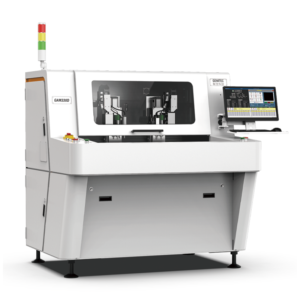
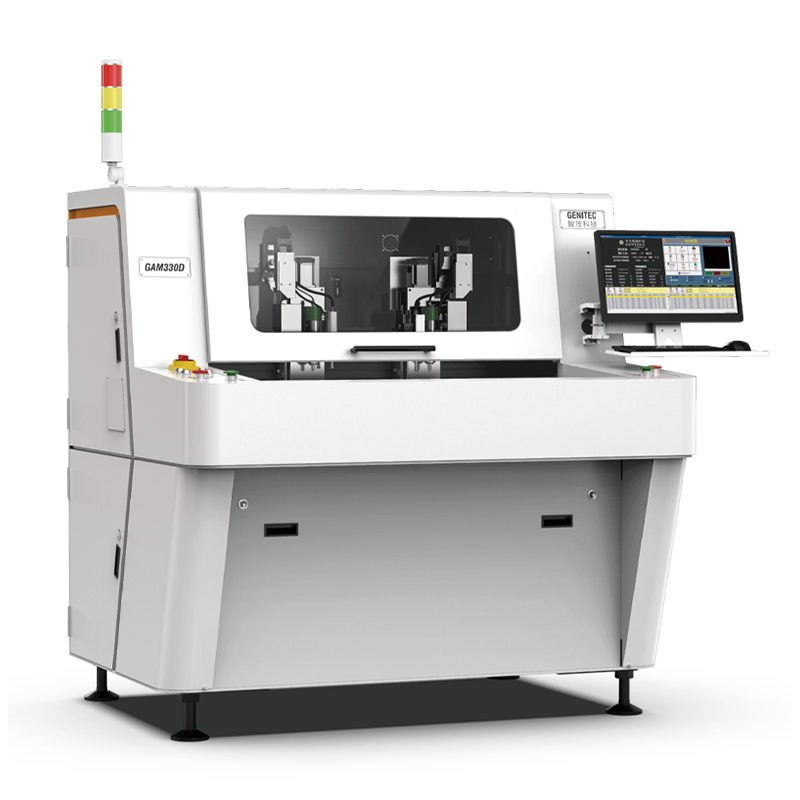
A PCB router machine — also called a PCB depaneling router, PCBA router, or PCB routing machine — is a CNC-controlled machine that separates individual printed circuit boards from a multi-up production panel after SMT assembly.
Instead of snapping a V-scored board (which flexes the PCB and risks cracked capacitors) or stamping a punch die (which adds impact stress), the router follows a programmed path and cuts cleanly through the connecting tabs with a high-speed milling bit.
The five core components of every PCB router machine are:
- High-speed spindle — typically 40,000 to 100,000 RPM, driving a tungsten carbide or diamond-tipped milling bit
- 3-axis motion system — linear guides and ball screws for X/Y/Z positioning with ±0.01 mm repeatability
- CCD vision system — locates fiducial marks on the PCB to compensate for panel placement tolerance
- Dust collection unit — top or bottom extraction capturing FR-4 dust at the cut point
- Touchscreen HMI — for programming, recipe management, and operator control
Modern inline PCB router machines add SMEMA-compatible conveyors, automatic tool changers, MES/ERP integration, and tray destackers for lights-out operation. Offline and desktop models keep things simple for prototyping and small-batch production.
For a definition-focused explainer, see our What Is a PCB Router Machine and How Does It Work? article.
2. How Does a PCB Router Machine Work?
The cutting process is straightforward but precision-engineered. Here is what happens from panel-in to board-out on a typical inline PCB router machine.
Step 1 — Panel loading
The PCB panel arrives on a conveyor (inline configuration) or is placed manually on a fixture table (offline). The machine locates the panel using tooling pins, locating edges, or CCD-captured fiducial marks. For inline systems, automatic loading reduces manual handling by 80 percent or more.
Step 2 — Vision alignment
A high-resolution CCD camera mounted coaxially with the spindle captures the fiducial coordinates. The control system compares the actual position against the programmed path and offsets the cutting trajectory by the deviation — typically within ±0.02 mm. This compensation is critical for high-density PCBs where a 0.1 mm misalignment can ruin a fine-pitch BGA footprint.
Step 3 — Spindle routing
The milling bit — typically 0.8 to 2.0 mm diameter — spins at the programmed RPM (often 60,000 RPM for FR-4 and 40,000 RPM for aluminum substrates) and follows the pre-programmed contour around each individual PCB. The bit cuts through the connecting tab (mouse bite) while leaving the rest of the panel intact.
Step 4 — Board unloading
The separated boards exit the cutting area on a belt or tray stacker. Inline routers connect directly to AOI, ICT, or downstream packaging equipment. Offline routers collect boards in a tray or stack them on the output conveyor for manual handling.
Step 5 — Continuous dust management
Throughout the process, a vacuum extraction system pulls FR-4 dust away from the cut point. This protects operators from respirable fiberglass dust and keeps the machine’s linear guides clean. Most production-grade routers include HEPA filtration and negative-pressure monitoring.
This whole cycle takes 5 to 30 seconds per board depending on complexity, panel size, and machine configuration.
Engineering note: A well-tuned PCB router machine produces zero measurable strain on components within 1 mm of the cut line — verified by IPC/JEDEC-9704 strain gauge testing. This is why medical and automotive OEMs with strict reliability requirements choose routing over V-cut or manual breaking.
3. Types of PCB Router Machines
There are five configurations you will encounter. Each fits a different production profile.
3.1 Inline PCB Router Machine
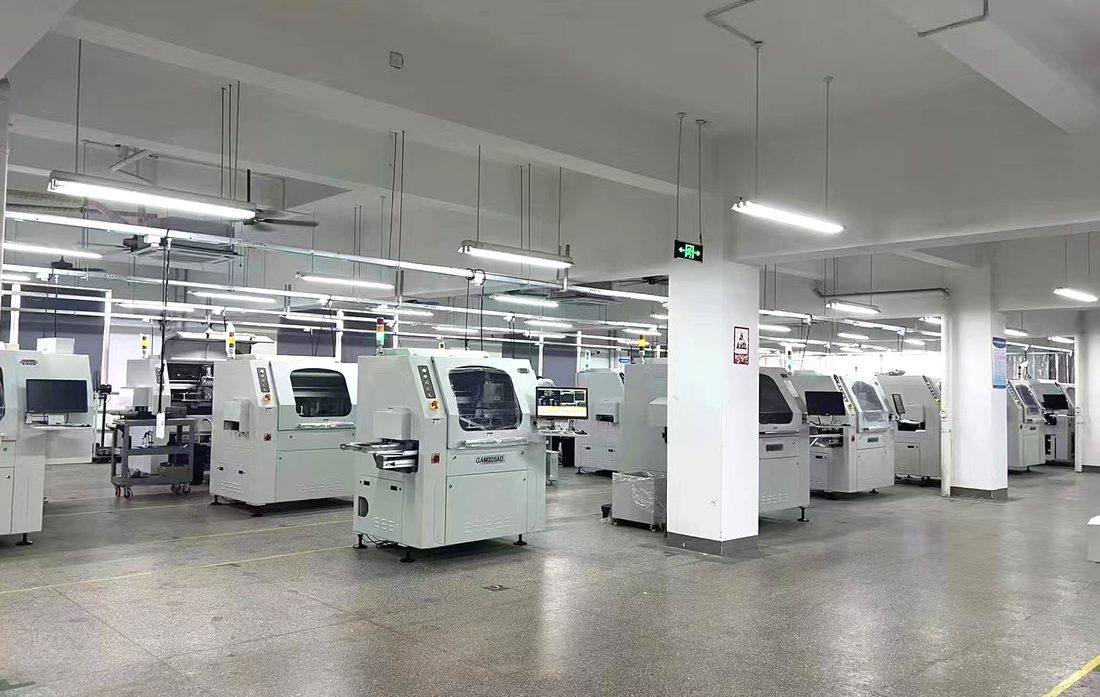
Designed for SMT lines. SMEMA-compatible conveyors, automatic loading, and tray destackers/stackers. Best for: high-volume, single-product runs above 10,000 boards per month. Throughput: 300 to 600 panels per hour.
3.2 Offline PCB Router Machine
Standalone machine with manual loading. Best for: prototyping, small batches, and high-mix production where changeover frequency is high. Throughput: 100 to 200 panels per hour. Lower capital cost than inline, but higher labor cost per board.
3.3 Desktop PCB Router Machine
Compact benchtop design with smaller working area (typically 250 × 350 mm). Best for: R&D labs, universities, low-volume specialty production. Throughput: 50 to 100 panels per hour.
3.4 Dual-Table PCB Router Machine
Two independent tables that operate in parallel — one cuts while the other loads. Best for: medium-volume production where throughput matters but inline automation is overkill. Throughput: 200 to 400 panels per hour, with theoretical efficiency gains of up to 85 percent.
3.5 Dual-Spindle PCB Router Machine
Two cutting spindles operating in parallel for the highest throughput. Best for: very high volume runs of the same PCB. Throughput: 500 to 800 panels per hour.
For a deeper comparison, see Inline PCB Router Machine: How It Integrates With Your SMT Line and Offline PCB Router Machine: When Standalone Depaneling Makes Sense.
4. PCB Router Machine vs Other Depaneling Methods
This is the comparison engineers ask about most. The short answer: each method has a place, and the right choice depends on your board’s geometry, volume, and tolerance.
| Method | Edge Quality | Speed | Mechanical Stress | Cost | Best For |
|---|---|---|---|---|---|
| PCB Router Machine | Excellent | Moderate | Low | Medium | Complex shapes, irregular outlines, mixed volumes |
| PCB Laser Depaneling | Best | Slow to moderate | None (non-contact) | High | Flex PCBs, ultra-thin boards, medical, semiconductor |
| V-Cut Separator | Good | Fastest | High | Low | Straight-line rectangular panels, low-cost consumer goods |
| Saw Blade Depaneling | Moderate | Fast | Medium | Medium | Thick or large panels, power electronics |
| Punch Die Depaneling | Moderate | Fastest | High | Medium (tooling) | Very high volume simple boards |
If your board is a simple rectangle with V-scores, V-cut wins on cost and speed. If your board is round, has internal cutouts, or has tall components close to the edge, a PCB router machine is the better choice. If you need zero mechanical stress on a flex PCB or a 0.3 mm ceramic substrate, laser depaneling is the only viable option.
For a deeper comparison, see our PCB Router vs Laser Depaneling and PCB Router vs V-Cut Depaneling articles, plus the broader PCB Depaneling Methods Compared guide.
5. Seven Key Specifications That Matter
When you evaluate a PCB router machine, focus on these seven numbers. Anything else is secondary.
1. Spindle speed and power. Look for 40,000 RPM minimum, 60,000 RPM or higher for FR-4 and aluminum substrates. Lower spindle speeds produce rough edges and reduce bit life. Quality machines specify brand-name spindles (KAVO, SycoTec, Morning Star) with documented runout below 1 µm.
2. Positioning repeatability. ±0.01 mm is the gold standard for BGA-bearing boards. Anything above ±0.05 mm risks cut deviation on dense layouts.
3. Cutting accuracy. ±0.02 mm or better. Combined with CCD vision alignment, this protects components within 0.5 mm of the cut line — critical for MLCCs, BGAs, and QFNs.
4. Working area. Match to your largest panel. Standard sizes: 350 × 350 mm, 450 × 350 mm, 610 × 610 mm. Bigger is more flexible but costs more and consumes more floor space.
5. CCD vision resolution. 12 MP cameras recognize fiducials down to 0.2 mm. Lower resolution slows alignment and risks errors on warped panels.
6. Dust extraction airflow. ≥5,000 Pa suction with HEPA filtration. Critical for operator safety, machine longevity, and cleanroom compatibility. Look for negative-pressure monitoring with automatic alerts.
7. Automation interface. SMEMA, MES, OPC-UA compatibility. Without this, you cannot integrate with the rest of your SMT line. Bonus: barcode reader, automatic tool diameter detection, and tool life monitoring.
For a full spec deep-dive, see PCB Router Specifications Explained.
6. Industries and Applications
PCB router machines are used in nearly every segment of electronics manufacturing. The five largest application areas in 2026 are:
- Consumer electronics — smartphones, tablets, wearables, AR/VR devices. The Seprays GAM series, for example, runs iPhone mainboard depaneling at Foxconn with a 99.94 percent yield rate and 450,000 panels per month per machine.
- Automotive electronics — ADAS modules, ECU boards, EV battery management systems, infotainment. Must meet IATF 16949 quality standards and withstand zero-defect requirements.
- Medical devices — implants, diagnostic equipment, imaging systems, patient monitors. Must comply with ISO 13485 and FDA traceability requirements.
- Aerospace and defense — avionics, satellites, military hardware. Must comply with AS9100 and meet strict reliability testing.
- Industrial control — PLCs, motor drivers, power conversion, robotics. Often requires thick PCBs up to 6 mm and metal-core substrates.
For industry-specific deep dives, see PCB Router Machines for Automotive Electronics and PCB Router Machines for Medical Device Manufacturing.
7. Common Problems and How to Avoid Them
Even a well-specified PCB router can produce defects if setup is wrong. Here are the five most common issues and how to fix them.
Problem 1 — Cracked solder joints near the edge. Cause: cutting force too high or components placed within 1 mm of the tab. Fix: reduce feed rate, increase spindle RPM, or move components further from the edge.
Problem 2 — Rough or burred edges. Cause: worn milling bit or incorrect feed rate. Fix: replace bit every 500 to 1,000 boards, calibrate feed per material, and inspect edges under magnification.
Problem 3 — MLCC cracking. Cause: mechanical vibration transferred to the board. Fix: improve fixture support, use lower-stress routing parameters, or switch to laser for sensitive assemblies.
Problem 4 — Dust contamination. Cause: inadequate extraction. Fix: check HEPA filter weekly; verify suction pressure ≥5,000 Pa; ensure dust collection hose is not blocked.
Problem 5 — Inconsistent yield between batches. Cause: tool wear or operator variability. Fix: standardize routing recipes, implement tool life monitoring, automate loading and unloading.
For a deeper troubleshooting guide, see Common PCB Depaneling Problems and Solutions and PCB Edge Cracking After Depaneling.
8. PCB Router Machine Pricing and ROI in 2026
PCB router machine prices vary widely based on configuration and automation level:
- Desktop / benchtop: USD 5,000 – 15,000
- Offline standalone: USD 10,000 – 40,000
- Inline with conveyor: USD 25,000 – 80,000
- Dual-spindle high-volume: USD 60,000 – 150,000+
ROI calculation: if a router saves 2 hours of manual depaneling per shift at USD 25/hour labor and processes 10,000 boards per month with a 30 percent defect reduction, payback is typically 12 to 18 months.
Do not focus only on the equipment cost. Total cost of ownership includes tooling (bits, vacuum filters), preventive maintenance, operator training, floor space, and software updates. A USD 30,000 machine with poor support often costs more than a USD 50,000 machine backed by a manufacturer with 30+ years of experience.
9. Why Choose Seprays for Your PCB Router Machine
Seprays Precision Machinery has been designing PCB depaneling solutions since 1993 — over 30 years of focused expertise in this single category. With two manufacturing facilities totaling 26,000 m² and nine service centers across China, Seprays delivers equipment that consistently meets the demanding tolerances of automotive, medical, aerospace, and consumer electronics production lines.
PCB router machine customers include Foxconn, Flex, Luxshare, Bosch, and CRRC. We hold ISO 9001, ISO 14001, ISO 45001, and CE certifications, with 100+ patents in PCB depaneling technology.
Our three flagship PCB router machine families are:
- GAM Series — Inline automatic PCB router machines for high-volume SMT lines
- ZAM Series — Precision offline routers for high-mix, low-volume production
- CAM Series — Compact desktop routers for R&D and prototyping
To discuss your specific production requirements, contact our technical team at jimmy@seprays.com or visit the PCB Router Machine product page. For applications where zero mechanical stress matters — flex PCBs, ultra-thin substrates, medical implants — explore our PCB Laser Depaneling line as well.
Conclusion
A PCB router machine is the workhorse of modern PCB depaneling. It handles complex shapes, multiple board sizes, and dense component layouts without the stress of V-scoring or the cost of laser cutting. For most SMT manufacturers producing 1,000+ boards per month with mixed or irregular PCB geometries, a router is the right choice.
If you are evaluating a new PCB router machine in 2026, focus on seven specifications — spindle speed, repeatability, accuracy, working area, vision, dust extraction, and automation interface — and choose a vendor with proven production-line experience and 10+ years in the category.
Seprays has been solving depaneling challenges for global manufacturers since 1993. Contact our engineering team at jimmy@seprays.com for application testing, ROI analysis, or equipment recommendations tailored to your specific production line.
Frequently Asked Questions (FAQ)
1. What is the difference between a PCB router machine and a PCB depaneling router?
They are the same machine. “PCB router machine” and “PCB depaneling router” are used interchangeably in the industry to describe a CNC-controlled machine that separates assembled PCBs from a multi-up panel using a high-speed milling bit. Some manufacturers use “PCBA router” or “PCB routing machine” as alternate terms.
2. How much does a PCB router machine cost in 2026?
Prices range from USD 5,000 for a desktop router to USD 150,000+ for a dual-spindle inline system. Most SMT manufacturers pay USD 25,000 – 80,000 for a production-grade inline router. Total cost of ownership over a 5-year lifecycle typically adds 30 to 50 percent on top of purchase price for tooling, maintenance, and training.
3. Can a PCB router machine cut FPC (flexible PCBs)?
Yes, with the right fixtures. FPC routers typically use a vacuum table with adjustable suction cups to hold the flexible material flat during cutting. For very thin (below 0.2 mm) or stretchy flex substrates, however, laser depaneling is often a better choice because routing can deform the material.
4. How often should I replace the router bit?
Every 500 to 1,000 boards for standard FR-4, or sooner if you notice rough edges, increased burrs, or unusual vibration. Tungsten steel bits can be re-ground 2 to 3 times; diamond-coated bits last longer but cost more upfront. Modern PCB router machines with tool life monitoring will alert you automatically when a replacement is due.
5. What is the best PCB router machine manufacturer?
The best manufacturer depends on your application, but look for vendors with 10+ years of focused PCB depaneling experience, ISO 9001 or IATF 16949 certifications, and a track record with named OEMs. Seprays, with 30+ years in PCB depaneling and customers including Foxconn, Bosch, Flex, and CRRC, is one example of a focused manufacturer with proven production-line experience across automotive, medical, aerospace, and consumer electronics.
About Seprays Precision Machinery
About Seprays Precision Machinery
Founded in 1993, Seprays has over 30 years of expertise in PCB depaneling solutions. With two manufacturing facilities totaling 26,000 m², 9 service centers across China, and clients in 31 countries — including Foxconn, Flex, Luxshare, Bosch, and CRRC — Seprays delivers equipment that consistently meets the demanding tolerances of automotive, medical, aerospace, and consumer electronics production lines.
Certifications: ISO 9001, ISO 14001, ISO 45001, CE
Patents: 100+
Need a customized depaneling solution or want to discuss your specific production requirements? Our technical team is ready to help.
Contact: jimmy@seprays.com