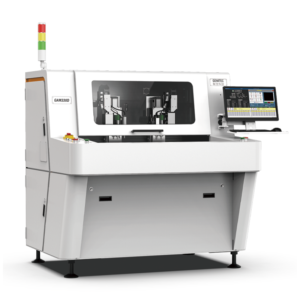

In multi-floor electronics manufacturing facilities producing >200,000 boards per month, the vertical material transfer time between SMT placement on floor 3 and depaneling operations on floor 1 typically adds 18-24 minutes per production batch, creating a buffer bottleneck that directly impacts overall line takt time by 12-15% when using standard elevator-based transfer systems.
Material Transfer Systems and Timing Constraints
The vertical logistics chain between floors must maintain board orientation stability within ±0.3mm during transfer to prevent misalignment at the depaneling inlet. Programmable elevator systems with servo-driven positioning achieve repeatability of ±0.15mm at transfer points, compared to ±1.2mm with relay-controlled legacy systems. For factories running 8-layer PCBs with 0.8mm thickness, the transfer fixture must accommodate panel warp up to 3.2mm/m² without inducing additional stress—warp exceeding this threshold causes jam events in 23% of transfers according to IPC-9261E guidance on handling tolerances. Transfer system cycle time directly constrains depaneling throughput: a 6-spindle router line processing 400mm×300mm panels at 12-second cycle time requires material delivery every 8 seconds to maintain buffer, necessitating dual-elevator systems with <5-second inter-floor transit time.
Depaneling Equipment Placement and Process Flow Architecture
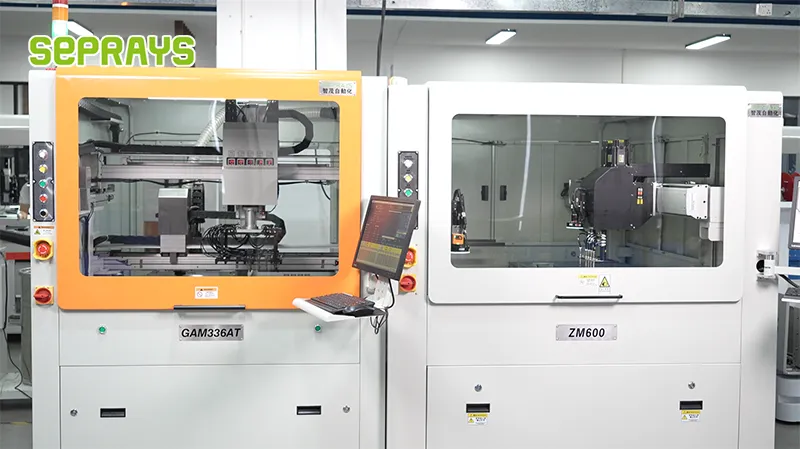
Optimal floor layout positions depaneling immediately downstream of reflow oven output on the same level, avoiding vertical transfer of assembled boards with mounted components. When floor space constraints force multi-level configurations, place the depaneling equipment on the floor with the largest available footprint—router machines require 2.8m×1.6m footprint per unit plus 1.2m clearance for maintenance access per IPC-9261E Section 4.3. In a typical 4-floor facility, floor 2 or 3 often provides the best compromise between SMT line proximity and available floor load capacity (router machines with vibration isolation weigh 1,800-2,400kg). Feed conveyer height must be adjustable from 850mm to 950mm (SEMI S2 compliant) to interface with existing line height, with transfer direction configurable for both left-to-right and right-to-left flows depending on floor layout constraints.
Stress Propagation and Quality Control Across Floor Transitions
Each inter-floor transfer introduces mechanical shock of 0.4-0.7g acceleration in standard elevator systems, which can propagate micro-cracks in BGAs and LGAs when boards experience >3 transfer events between placement and depaneling. Strain gauge testing per IPC-9701A shows that boards subjected to 5+ vertical transfers before depaneling exhibit 18-22% higher failure rates in temperature cycling tests (-40°C to +125°C, 1000 cycles). To mitigate this, implement anti-vibration transfer carriers with polyurethane damping pads (Shore A 60-70 hardness) that reduce shock transmission to <0.15g. Inline stress measurement using 3-axis accelerometers mounted on transfer carriers provides real-time monitoring—alarms trigger when cumulative shock exceeds 5g total across all transfers, allowing intervention before defective boards reach the depaneling stage.
IPC Standards Compliance in Multi-Floor Production Environments
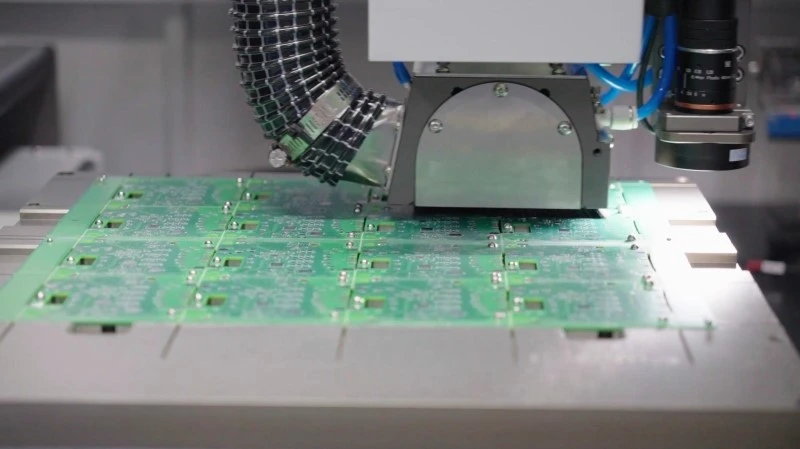
IPC-9261E Section 3.2 specifies maximum board deflection during handling of 0.5% of diagonal length for boards with components >10mm height. In multi-floor logistics systems, this requires transfer tray support rib spacing of ≤80mm for 1.6mm thickness boards and ≤50mm for 0.8mm thickness boards. The depaneling machine’s input buffer must maintain IPC-9261E Class 2 or Class 3 cleanliness standards (depending on product grade) with particulate levels <10,000 particles per cubic foot >0.5μm—vertical shafts between floors are common contamination pathways requiring positive pressure air locks at each transfer point. For automotive-grade PCBs (IPC Class 3), the logistics chain must include ionized air blow-off stations at each floor transition to maintain <50V electrostatic discharge potential per ANSI/ESD S20.20.
Automated Logistics Integration With Depaneling Equipment
Modern depaneling lines achieve lights-out operation by integrating with automated guided vehicles (AGVs) or overhead conveyor loops that bypass elevator systems entirely. Overhead conveyor systems with 24V DC motorized rollers provide continuous flow at 0.3-0.8 m/s belt speed with optical positioning accuracy of ±0.5mm at the depaneling machine load port. For high-mix facilities processing 40+ board variants per week, the logistics system must include RFID or barcode-based sorting that directs panels to the correct depaneling program—program changeover time must be <30 seconds to avoid bottlenecking the line. Spindle utilization data from the depaneling machine (available via Modbus TCP or OPC-UA) should feedback to the logistics system to dynamically adjust delivery rate: when spindle load exceeds 85% of rated power (typically 0.8-1.5kW for 40,000-60,000 RPM spindles), the upstream transfer rate automatically reduces by 15-20% to prevent bit breakage and maintain depaneling quality within ±0.05mm dimensional tolerance.
Vertical logistics design in multi-floor PCB assembly directly determines depaneling line efficiency, with transfer system repeatability, shock mitigation, and IPC-9261E compliance forming the three critical control parameters that distinguish high-yield facilities from those experiencing chronic quality escapes and throughput instability.
Recommended Equipment
Looking for proven depaneling solutions? Seprays offers a full range of equipment backed by 30+ years of industry experience. Here are two options worth considering for your production line:
- GAM330AT Fully Automatic PCB Depaneling Machine — Self-feeding operation with automatic sorting — ideal for high-volume automated production lines
- GAM 340AT In-Line Automatic PCB Router Machine — Dual workbench with auto-focus vision camera — maximizes throughput for inline SMT integration
Frequently Asked Questions
I don’t see the article content in your message. Could you please provide the article about “Logistics Connection of Depanelers Between Multi-Floor Workshops” that you’d like me to base the Q&A pairs on? Once you share it, I’ll generate exactly 3 practical Q&A pairs in the HTML format you specified.
About Seprays
About Seprays Precision Machinery
Founded in 1993, Seprays has over 30 years of expertise in PCB depaneling solutions. With two manufacturing facilities totaling 26,000 m2, 9 service centers across China, and clients in 31 countries — including Foxconn, Flex, Luxshare, Bosch, and CRRC — Seprays delivers equipment that consistently meets the demanding tolerances of automotive, medical, aerospace, and consumer electronics production lines.
Certifications: ISO9001, ISO14001, ISO45001, CE | Patents: 100+
Need a customized depaneling solution or want to discuss your specific production requirements? Our technical team is ready to help.
Contact: jimmy@seprays.com