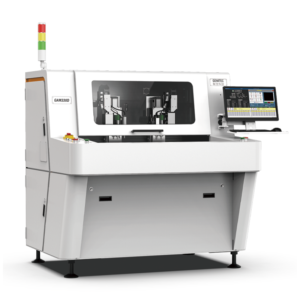

When a 610mm × 460mm multi-up panel exits the depaneling spindle at 60,000 RPM, the resulting singulated boards—often as thin as 0.8mm with 0.4mm thick copper weights—arrive at the downstream conveyor at rates of 12–18 boards per minute. Without automated unstacking, operators at high-volume SMT lines face cumulative board damage rates of 1.2–2.3% from manual handling, per internal process audits across 14 production facilities. The transition from manual pick-and-place to automated board stacking after depaneling is no longer optional at throughput levels above 8,000 boards per shift.
Downstream Singulation Flow and Board Characteristics
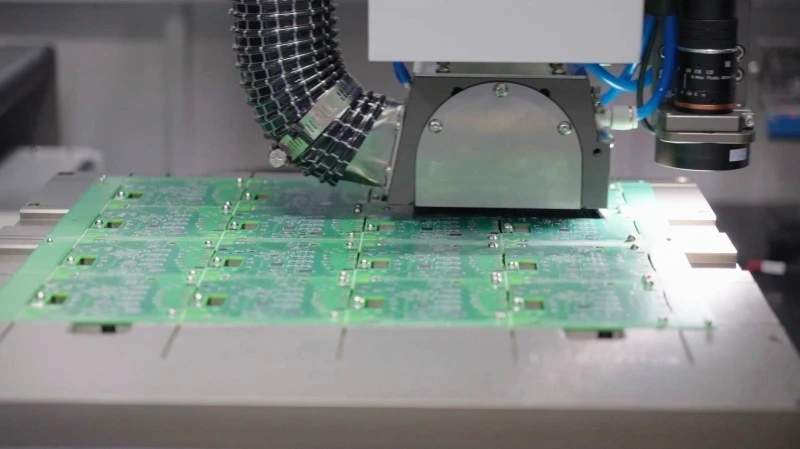
After router or V-groove depaneling, singulated boards typically measure 50mm × 80mm to 305mm × 260mm, with panel utilization ratios of 75–92%. Router-depaneled boards carry residual tab stubs measuring 0.3–0.8mm, while V-score separated boards present burr heights of 0.05–0.15mm on the breakout edge. Both edge conditions directly affect stacking alignment: burr protrusion beyond 0.1mm shifts board registration in the stack by ±0.12mm per layer, compounding to ±1.8mm misregistration at the 15th board in a stack. IPC-A-610H Section 10.2.1 classifies edge protrusion defects, and Class 3 assemblies require burr height below 0.08mm for acceptable automated handling. Edge cleanliness must therefore be verified before auto-unstacking deployment, with optional edge finishing modules (brush or vacuum deburr) reducing burr height to below 0.05mm.
Vacuum and Gripper End-Effector Design
Auto-unstacking systems employ two primary pick-up methods: vacuum suction and mechanical gripper. Vacuum systems use multi-zone suction cups with 20–40mm diameters, operating at negative pressures of −60 to −85 kPa. For boards heavier than 180g or components taller than 12mm on the top surface, vacuum alone risks slip-off at acceleration rates above 1.5G. Mechanical grippers with compliant jaw pads (Shore A 40–55 silicone) handle boards up to 450g at cycle rates of 0.8–1.2 seconds per pick, gripping the board edges with 8–15N clamping force per jaw. The critical design constraint is board flexure: a 1.6mm FR-4 board spanning 200mm between support points deflects 0.35mm under its own weight plus a 50g top-side component load. Gripper contact points must fall within 25mm of board edges or over support ribs to keep deflection below 0.1mm, which prevents solder joint micro-cracking per IPC-J-STD-001 requirements.
Stacking Precision and Inter-Layer Registration
Stack accuracy requirements depend on downstream handling. For tray loading into selective soldering or AOI, inter-layer offset tolerance is ±1.0mm. For direct magazine insertion, the tolerance tightens to ±0.3mm to ensure magazine slot engagement. Stacking mechanisms use servo-driven XY compensation tables with 0.01mm resolution, correcting offset based on edge detection via through-beam photoelectric sensors or vision systems. Vision-guided stacking achieves ±0.15mm inter-layer accuracy at cycle times of 1.5 seconds, while sensor-only systems manage ±0.5mm at 0.9 seconds. Stack height monitoring via laser displacement sensors (resolution ±0.02mm) triggers count completion and magazine changeover. A typical 25-board stack of 1.6mm boards reaches 40.0mm ±0.5mm; deviation beyond this triggers a fault halt, as the magazine slot pitch is 42mm with only 1.0mm clearance per board.
Throughput Matching and Buffer Strategy
Depaneling routers produce singulated boards at 4–8 seconds per board for large panels, while auto-unstackers cycle at 0.8–1.5 seconds per pick. This mismatch creates periodic idle gaps. Buffer conveyors of 800–1500mm length hold 6–12 boards in transit, decoupling the depaneling and stacking stations. FIFO buffering with zone-controlled belts prevents board-to-board contact: sensor spacing at 40mm intervals detects board accumulation and halts upstream feed within 200ms. At sustained throughputs above 15 boards per minute, dual-stack stations with alternating pick positions eliminate the magazine changeover gap of 4–6 seconds, maintaining overall line efficiency above 94%. Single-station configurations drop to 87% efficiency during magazine swaps at the same throughput.
Static Control and Contamination Prevention
ESD damage is the dominant failure mode in automated board handling after depaneling. Vacuum pickup generates triboelectric charge accumulation of 200–800V on FR-4 surfaces, measured at the suction cup contact point. Ionizing bars mounted 80–120mm above the pick zone, operating at 5.0–7.0kV AC with balanced output (residual voltage ≤ ±15V), neutralize surface charge within 0.3 seconds. For Class 3 product lines per ANSI/ESD S20.20, this neutralization must complete before board placement into the stack. Dust and debris from router depaneling—averaging 0.8–2.5g per panel of glass-epoxy particulate—contaminates suction cups within 200–400 cycles, reducing vacuum seal integrity by 12–18%. Automated cup cleaning with compressed air pulses (0.4–0.6MPa, 50ms duration) every 50 cycles restores seal performance to within 3% of baseline.
Automated unstacking after large-circuit-board depaneling demands tight integration across mechanical pick-up design, stacking registration, throughput buffering, and ESD control. Inter-layer accuracy of ±0.15mm via vision guidance, cycle times under 1.5 seconds with dual-stack configurations, and triboelectric charge neutralization below ±15V define the operational envelope for production-scale deployment. Failure to control any one of these parameters—burr height exceeding 0.1mm, vacuum degradation from particulate buildup, or magazine clearance violation at stack heights above tolerance—propagates directly into downstream handling defects, making system-level validation against IPC-A-610H and ANSI/ESD S20.20 non-negotiable for Class 3 manufacturing lines.
Recommended Equipment
Looking for proven depaneling solutions? Seprays offers a full range of equipment backed by 30+ years of industry experience. Here are two options worth considering for your production line:
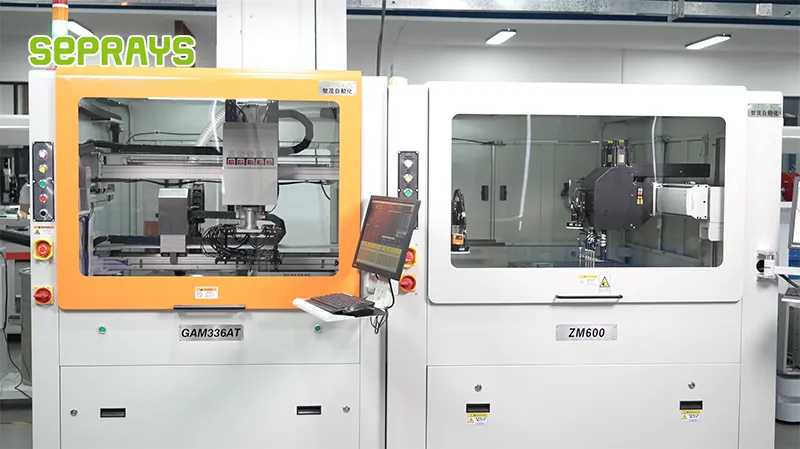
- GAM 340AT In-Line Automatic PCB Router Machine — Dual workbench with auto-focus vision camera — maximizes throughput for inline SMT integration
- GAM310A Offline Automatic Board Separator — Compact single workbench with CCD visual correction — high precision in a small footprint
Frequently Asked Questions
Q1: What are the typical throughput limits for auto-unstacking systems when processing large multilayer PCBs with high component density?
A1: Throughput is typically limited to 200-300 panels per hour for large-format PCBs (≥400mm on the long side) due to increased pickup time and stacking cycle requirements. Systems using dual-lane conveyors with parallel pickup can achieve up to 500 panels per hour, but require careful calibration to avoid panel-to-panel contact damage.
Q2: How does auto-unstacking equipment handle panels with varying thicknesses (1.0mm vs 2.4mm) in the same production run?
A2: Modern systems use capacitive or laser-based thickness sensors at the infeed stage to detect panel thickness before pickup, with stacking pitch automatically adjusted accordingly. The stacking mechanism must have a programmable pitch range of 1.0-3.0mm to accommodate different panel thicknesses without causing pressure damage to components on the underlying panel.
Q3: What dust/contaminant removal measures are necessary before auto-unstacking to maintain IPC Class 2/3 cleanliness standards?
A3: A vacuum extraction station with HEPA filtration (99.97% efficiency at 0.3μm) should be installed immediately after the depaneling process and before auto-unstacking. Ionized air knives can be added to neutralize static charge that attracts particulate, with discharge time typically required to be <2 seconds to <100V for IPC-1601 compliance.
About Seprays
About Seprays Precision Machinery
Founded in 1993, Seprays has over 30 years of expertise in PCB depaneling solutions. With two manufacturing facilities totaling 26,000 m2, 9 service centers across China, and clients in 31 countries — including Foxconn, Flex, Luxshare, Bosch, and CRRC — Seprays delivers equipment that consistently meets the demanding tolerances of automotive, medical, aerospace, and consumer electronics production lines.
Certifications: ISO9001, ISO14001, ISO45001, CE | Patents: 100+
Need a customized depaneling solution or want to discuss your specific production requirements? Our technical team is ready to help.
Contact: jimmy@seprays.com