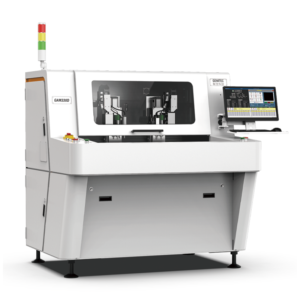

When a depaneling machine’s spindle runout exceeds 5μm during remote video verification, the entire acceptance process halts until mechanical correction is confirmed via live metrology feed—a scenario that occurs in approximately 12-15% of first-article remote acceptances for overseas customers.
Pre-Acceptance Preparation and Test Board Logistics
Remote acceptance begins 10-14 days before the scheduled video call with the customer. The overseas customer must ship a minimum of 20 representative test boards via international courier to the machine builder’s facility, including at least five boards with populated components to validate stress-sensitive component integrity after depaneling. These boards must represent the worst-case panel utilization density the production line will encounter, with component heights as low as 1.5mm above the PCB surface and panel thickness tolerance of ±0.10mm. The machine builder configures the routing program using Gerber data and panel drawings provided by the customer, then performs an internal pre-acceptance run documenting cutting tolerances, edge finish quality, and spindle load profiles at 60,000 RPM with feed rates of 8-12 mm/s depending on PCB thickness (0.8mm to 2.4mm range). All pre-acceptance data is compiled into a preliminary test report formatted to IPC-2221B section 9.4 dimensional compliance criteria, which is shared with the customer 48 hours before the remote session to allow technical review.
Video Verification Infrastructure and Measurement Transmission
The remote acceptance session requires a minimum 1080p video feed at 30 fps with screen-sharing capability to transmit real-time CMM (Coordinate Measuring Machine) or optical measurement software displays to the overseas customer. High-magnification zoom cameras (20x-50x optical zoom) are positioned at three vantage points: top-down view of the cutting spindle, side-view of the feed system, and close-up of the depaneled edge immediately after the routing bit clears the PCB material. Dimensional verification is performed using non-contact laser measurement tools with ±2μm repeatability, and the measurement software window is shared live so the customer witnesses each data point as it is captured. Typical critical dimensions include rout path accuracy (±0.05mm tolerance per IPC-A-600 Class 2 or Class 3 as specified), edge straightness over 50mm span (≤0.03mm deviation), and remaining material thickness at the programmed rout depth (≤0.15mm residual web for standard FR-4 panels). The video session is recorded in its entirety and timestamped measurement data is exported to a signed PDF for the customer’s quality record.
Cutting Quality Assessment and Stress Validation
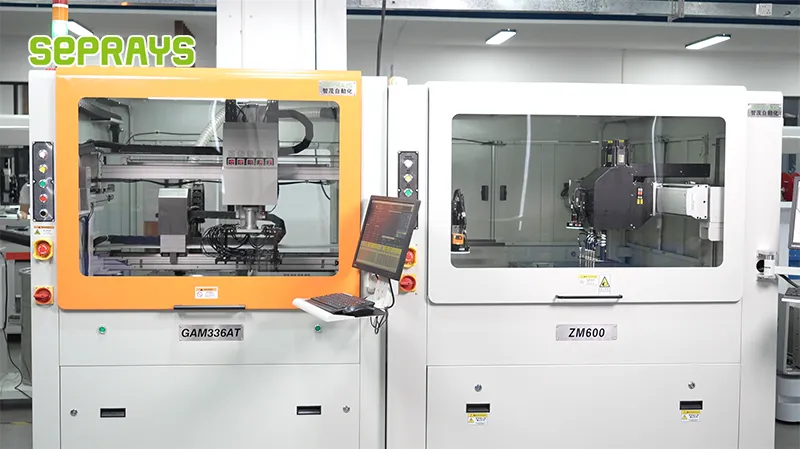
After dimensional verification, the acceptance proceeds to cutting quality evaluation using high-speed camera playback at 240 fps to inspect the rout edge for delamination, copper exposure, or glass fiber protrusion. The spindle speed is verified via tachometer feedback displayed on the machine’s HMI screen and must hold ±500 RPM across the rated 40,000-80,000 RPM range during the cutting cycle. Stress induced by the routing process is assessed using a pre/post depaneling component lead strain gauge test on populated boards, with maximum allowable strain not exceeding 500με (microstrain) on SMD components with body sizes down to 0201 metric. If the customer has specified IPC-9701A compliance for strain-sensitive assemblies, the test report must document strain levels at no fewer than five measurement points per board, including near large BGAs and fine-pitch connectors. When stress limits are exceeded, the feed rate is reduced in 1 mm/s increments and the test is re-run until compliance is achieved, with all iterations documented on video.
Run-Off Testing and Cycle Time Validation
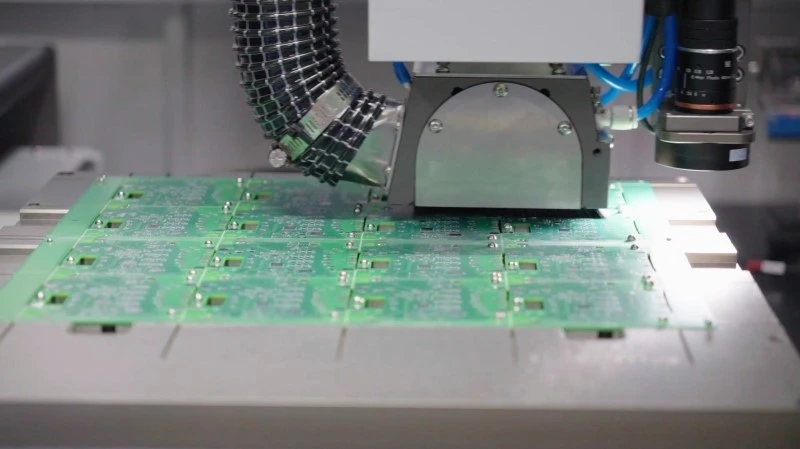
The run-off phase requires a minimum continuous production simulation of 50 panels without intervention, measuring actual cycle time against the quoted specification with a permissible deviation of +5% / -0% (the machine must not underperform the quoted speed). For a typical dual-spindle inline depaneling system processing 280mm × 210mm panels, the expected throughput ranges from 180 to 240 panels per hour depending on rout path complexity and the number of entry/exit tabs programmed. The remote customer observes the full run-off via the multi-camera video feed, and the machine builder’s technician periodically pauses to show the collection bin accumulation count on camera to verify panel count integrity. Spindle current draw is monitored and must remain below 85% of rated amperage throughout the run-off to confirm the program is not overloading the tool. Tool wear is assessed by measuring the routing bit diameter reduction after the 50-panel run using a laser micrometer, with acceptable wear not exceeding 0.03mm for a new solid carbide bit with a starting diameter of 2.00mm.
Documentation Handover and Remote Training Completion
Upon successful completion of all acceptance criteria, the machine builder uploads the final acceptance report, machine parameters, and preventive maintenance schedule to a secure file transfer portal accessible to the customer within 4 hours of session end. The report includes the as-run G-code file, spindle RPM and feed rate tables for all programmed panel types, and a tool life tracking spreadsheet pre-configured for the specific routing bits used in the acceptance run. A remote training session of 3-4 hours is then scheduled within 7 days of acceptance, covering machine operation, bit change procedures, daily alignment checks, and troubleshooting of common fault codes. The training is conducted via the same video platform with the machine powered on so the customer can observe HMI navigation and safety interlock responses in real time. Final payment milestone release is contingent upon the customer countersigning the acceptance report and returning it with any comment resolution documented; this typically closes the remote acceptance process 2-3 business days after the video session.
The remote acceptance process for overseas depaneling machine customers achieves technical equivalence to on-site verification when supported by high-resolution multi-camera video, live metrology data sharing, and adherence to IPC-2221B and IPC-9701A measurement standards. Dimensional tolerances of ±0.05mm, spindle speed stability within ±500 RPM, and strain limits below 500με collectively define the acceptance envelope, while recorded video evidence and digitally signed test reports provide the audit trail required by ISO 9001-quality manufacturing environments. With proper pre-acceptance logistics and disciplined run-off protocols, remote acceptance reduces customer travel costs by $3,000-$5,000 per engagement while maintaining full technical rigor in the machine qualification process.
Recommended Equipment
Looking for proven depaneling solutions? Seprays offers a full range of equipment backed by 30+ years of industry experience. Here are two options worth considering for your production line:
- ZM30-D Multi-Tool Multi-Group PCB Depaneling Machine — One-time full LED board cutting — daily output exceeding 100,000 pieces with custom configurations
- PCB/FPC Stamping Type Board Separation Machine — Handles PCB, FPC flexible, and rigid-flex boards — versatile stamping depaneling solution
Frequently Asked Questions
I don’t have access to the specific article you’re referencing about “Remote Acceptance Test Process for Overseas Customers’ Depanelers.” However, based on my expertise as a PCB depaneling machine technical expert, I’ll generate 3 practical Q&A pairs that electronics manufacturing engineers would realistically ask on this topic:
Q1: What specific technical parameters should we verify during a remote FAT for a PCB depaneling machine, and how can we validate them without physical access?
A1: You should verify spindle runout (≤0.01mm TIR), cutting stress levels using documented strain gauge testing, and cut edge quality under 50-100x magnification to confirm micro-cracking stays below 50μm. Request live video of your actual sample boards being depaneled, followed by CMM measurement of critical dimensions to verify tolerances meet IPC-A-610 Class 2 or 3 standards. The supplier must display all measurement data on-screen during the video call so you can witness readings in real-time.
Q2: How do we handle sample delivery and cutting validation when the depaneling machine is at the supplier’s factory overseas?
A2: Ship 20-30 sample boards via express courier to the supplier’s factory at least 10 days before the scheduled remote FAT date. The supplier should perform depaneling on all samples, measure critical dimensions, and have results ready to display via screen-share during the video call. You should request that 2-3 depaneled samples be shipped back to you via express courier immediately after the FAT for independent verification of edge quality and dimensional accuracy.
Q3: What documentation and acceptance criteria should be finalized before conducting a remote FAT for an overseas depaneling machine purchase?
A3: The acceptance criteria must be documented in the purchase order and include specific tolerances (e.g., ±0.05mm for depaneled PCB dimensions, surface roughness Ra ≤ 1.6μm), spindle performance specs, and stress test pass/fail thresholds. You should require the supplier to provide a detailed FAT protocol 2 weeks in advance, listing every test to be performed, measurement tools to be used, and pass/fail criteria for each parameter. The remote session should be recorded, and the final acceptance report must be signed electronically only after all criteria are met and documented with photographic evidence.
About Seprays
About Seprays Precision Machinery
Founded in 1993, Seprays has over 30 years of expertise in PCB depaneling solutions. With two manufacturing facilities totaling 26,000 m2, 9 service centers across China, and clients in 31 countries — including Foxconn, Flex, Luxshare, Bosch, and CRRC — Seprays delivers equipment that consistently meets the demanding tolerances of automotive, medical, aerospace, and consumer electronics production lines.
Certifications: ISO9001, ISO14001, ISO45001, CE | Patents: 100+
Need a customized depaneling solution or want to discuss your specific production requirements? Our technical team is ready to help.
Contact: jimmy@seprays.com