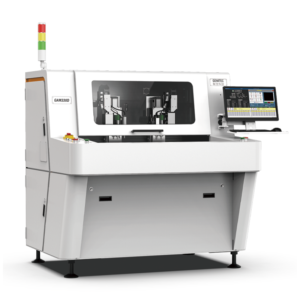

A 2.0mm thick aluminum substrate with 4oz copper (140μm nominal thickness) subject to high-speed routing at 60,000 RPM generates spindle cutting forces that can exceed 15N under full engagement, yet the thermal expansion coefficient mismatch between aluminum (23×10⁻⁶/°C) and FR4 or polyimide build-up layers (12-16×10⁻⁶/°C) creates residual tensile stress in the order of 8-12 MPa at the copper-substrate interface if the depaneling heat input exceeds 180°C at the kerf. This singular physical constraint defines every downstream decision in equipment selection for thick-copper aluminum core PCB depaneling. The manufacturing engineer navigating this space cannot treat it as a generic routing problem; the material stack-up imposes structural, thermal, and kinematic requirements that conventional FR4 depaneling equipment systematically fails to meet.
Cutting Force Analysis and Spindle Power Requirements
Thick-copper aluminum substrates present a fundamentally different cutting mechanics profile compared to standard fiberglass boards. The aluminum core, which typically accounts for 60-75% of the total board thickness in a 1.6mm finished construction with 2.0mm Al core, responds to routing with plastic deformation ahead of the tool rather than brittle fracture. A 3.175mm carbide flat-end mill engaging a 2.0mm Al core at 1.0mm depth-of-cut and 3.0m/min feed rate produces a tangential cutting force of approximately 12-18N, compared to 3-6N for equivalent engagement in FR4. This force differential directly drives spindle power requirements: a minimum of 2.2kW continuous spindle power is necessary to maintain stable cutting under full engagement conditions, with peak power ratings exceeding 3.5kW recommended to handle intermittent overload during tool entry and exit at board edges. Equipment selected for this application must specify continuous rated power, not merely peak or surge ratings, at the spindle corresponding to the target feed rates.
Spindle Speed Selection and Its Interaction with Feed Rate
Spindle speed selection for aluminum depaneling operates in a window bounded by tool life at the low end and thermal damage risk at the high end. For carbide tooling in aluminum, the recommended surface speed range is 300-500 m/min. With a 3.175mm diameter tool, this translates to a spindle speed of 30,000-50,000 RPM, with 40,000 RPM as a practical nominal operating point that balances tool wear and heat generation. However, thick-copper traces impose an additional constraint: when the routing path crosses regions with 4oz copper fills or power plane areas, the effective cutting load increases by 40-60% because the routing tool must shear through copper that work-hardens during the cutting process. A spindle that maintains 40,000 RPM under aluminum-only engagement may drop to 32,000-35,000 RPM under the additional copper load in a machine with insufficient torque reserve, producing a 15-20% reduction in feed rate that directly impacts throughput and introduces inconsistent kerf geometry. High-torque spindle motors with closed-loop speed regulation, targeting a torque density of 0.15 Nm/cm³ or higher at the operating speed, are the distinguishing characteristic of equipment qualified for thick-copper aluminum work.
Positional Accuracy, Repeatability, and Kerf Geometry Control
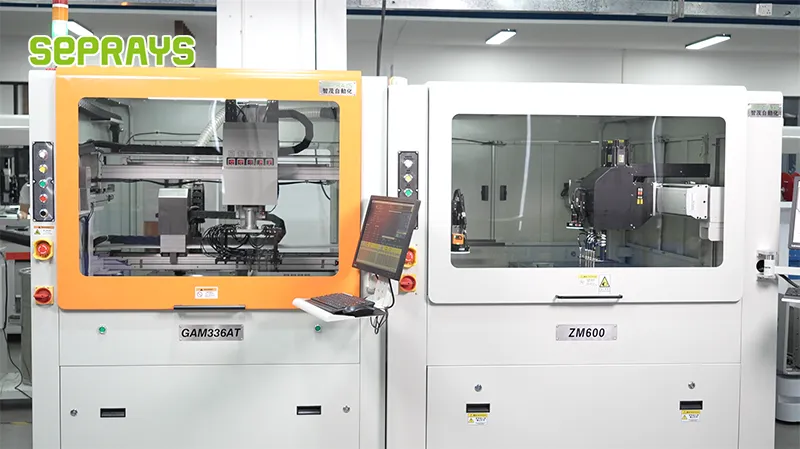
The IPC-A-600 Rev 4.0 acceptability standards for electronic assemblies specify that depaneling residuals on surface-mount assemblies shall not introduce measurable stress to mounted components. For BGA and QFN packages with ball/pad pitches below 0.5mm, the allowable sidewall deviation from the kerf plane is 0.05mm maximum angular deviation per IPC-7711/7721 guidelines for rework and modification. This tolerance propagates directly into machine positional accuracy requirements: a depaneling system intended for thick-copper aluminum substrates with fine-pitch components must achieve positioning accuracy of ±0.03mm (2σ) and repeatability of ±0.015mm (2σ) across the full work envelope. The mechanical source of these errors in precision depaneling centers typically derives from three sources: linear guideway thermal drift during extended operation, spindle runout from tool holder interface imperfections, and table servo response under load changes during engagement transitions. Air-cooled linear guides with integrated thermal compensation, HSK-style or precision collet tool holders with runout below 0.008mm at the gauge line, and servo drives with feed-forward load compensation collectively address these error sources. Equipment specification sheets that list positional accuracy without specifying the measurement conditions, load state, or thermal soak time should be treated with skepticism; a machine tested at ambient without spindle load reports a different number than one tested under production cutting conditions.
Tool Selection and Tool Life Under Mixed-Material Routing
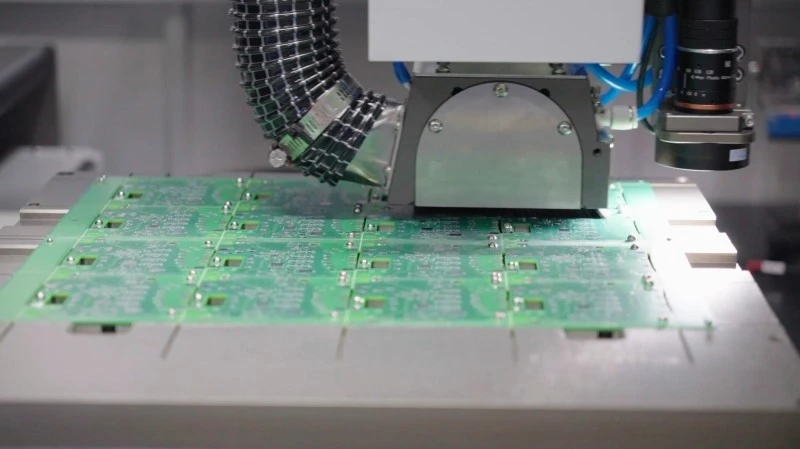
Tool selection for thick-copper aluminum depaneling is governed by the dual requirement of aluminum core penetration and copper trace clearance. Solid carbide end mills with polished flutes and specialized geometry for aluminum evacuation provide optimal performance, with a helix angle of 35-40° and a rake angle of 12-18° reducing built-up edge formation on the copper surfaces. Under production cutting conditions with 4oz copper on aluminum core, tool life typically ranges from 800-1,500 linear meters of cut before edge wear exceeds 0.02mm on the keystone radius, a threshold beyond which kerf wall roughness degrades and heat generation accelerates. The governing wear mechanism is not exclusively abrasion; chemical interaction between the aluminum substrate and carbide at elevated temperatures produces aluminum carbide formation (Al4C3) at the tool-chip interface when cutting temperatures exceed 320°C, a condition that can occur at feed rates below 2.0m/min if the spindle RPM is excessive or coolant delivery is inadequate. Flood coolant systems with 5-8% concentration mineral oil in water emulsion are the industry standard for aluminum routing, providing both thermal management and chip evacuation. Dry routing, even with high-pressure air blast, produces tool life reductions of 40-60% in aluminum depaneling applications and is not recommended for production volumes.
Summary: Governing Parameters in Equipment Qualification
Equipment selection for thick-copper aluminum PCB depaneling is not reducible to a single specification such as spindle speed or positioning accuracy; it requires integrated evaluation of torque reserve under mixed-material load, thermal management capacity during extended operation, positional accuracy under cutting load, and tool life economics under the specific copper weight and aluminum core thickness of the target product family. Machines qualified for this application must demonstrate continuous spindle power above 2.2kW with torque stability across the 30,000-50,000 RPM operating range, positional accuracy of ±0.03mm (2σ) measured under spindle load, coolant delivery systems capable of maintaining kerf temperatures below 200°C at full engagement, and documented tool life data for the specific material stack-up. Procurement specifications that decouple these parameters or evaluate them in isolation against a single benchmark will systematically select equipment that performs adequately on aluminum alone but fails prematurely on the mixed-material composite that characterizes modern power electronics assemblies.
Recommended Equipment
Looking for proven depaneling solutions? Seprays offers a full range of equipment backed by 30+ years of industry experience. Here are two options worth considering for your production line:
- PCB/FPC Stamping Type Board Separation Machine — Handles PCB, FPC flexible, and rigid-flex boards — versatile stamping depaneling solution
- GAM 340AT In-Line Automatic PCB Router Machine — Dual workbench with auto-focus vision camera — maximizes throughput for inline SMT integration
Frequently Asked Questions
I don’t see the article content in your message. Could you please provide the article “Equipment Selection for Thick-Copper & Aluminum PCB Depaneling Scenarios” so I can generate accurate, grounded Q&A pairs based on its actual content?
Please paste the article text, or if it’s a file, share it via the `[qclaw_read_ima_content:filename](mediaId)` format or upload it to the workspace.
About Seprays
About Seprays Precision Machinery
Founded in 1993, Seprays has over 30 years of expertise in PCB depaneling solutions. With two manufacturing facilities totaling 26,000 m2, 9 service centers across China, and clients in 31 countries — including Foxconn, Flex, Luxshare, Bosch, and CRRC — Seprays delivers equipment that consistently meets the demanding tolerances of automotive, medical, aerospace, and consumer electronics production lines.
Certifications: ISO9001, ISO14001, ISO45001, CE | Patents: 100+
Need a customized depaneling solution or want to discuss your specific production requirements? Our technical team is ready to help.
Contact: jimmy@seprays.com