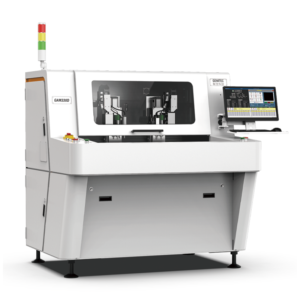

A single routed depaneling operation generating as little as 2.8 N of lateral force can crack a BGA solder joint with a melting temperature of 183°C, even when the joint appears visually intact. This is the foundational risk that drives every outsourcing decision in electronics manufacturing: the gap between acceptable process control in-house and the capabilities of a contract manufacturer. In high-mix, low-volume production environments — common in industrial IoT modules, medical device controllers, and aerospace instrumentation assemblies — PCB depaneling represents a critical junction where process capability directly determines end-product reliability.
The Physics of Board Stress During Depaneling
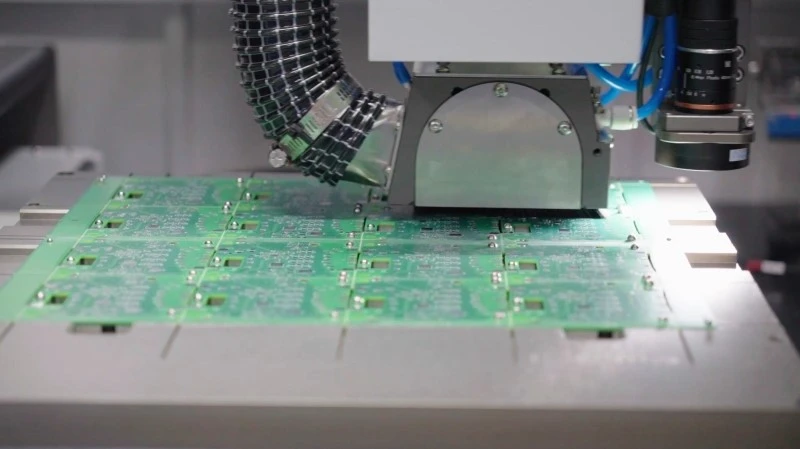
PCB depaneling is fundamentally a controlled fracture process. Whether performed by router, laser, or punch tool, the mechanism involves separating individual boards from a multi-up panel while managing the stress introduced into the board and its mounted components. Routing operations generate forces between 1.5–5 N depending on bit geometry and feed rate, with tangential cutting forces at the bit circumference creating both lateral and vertical stress vectors. For a standard FR-4, 1.6mm thick panel with Tg of 150°C, the critical tensile stress at the board edge during routing must remain below 8 MPa to avoid micro-cracking in adjacent solder joints. The heat generated at the cutting interface — typically 150–300°C at the bit tip — can reflow SAC305 solder joints (melting point 217°C) if the thermal exposure persists beyond 2–3 seconds, causing immediate field failures or latent reliability defects.
Tolerance Control in Routed and Laser Depaneling
Routed depaneling achieves positional accuracy of ±0.05mm to ±0.10mm when using precision linear guides and ball screw drives with 0.01mm resolution. Tool wear progressively degrades this tolerance: a 3.175mm carbide bit cutting through 50 panels of 1.6mm FR-4 exhibits measurable diameter reduction of 5–15 μm per panel, directly impacting slot width and edge quality. A worn bit producing a slot 0.08mm wider than nominal can cause a 0402 component positioned 0.15mm from the depaneling edge to experience stress concentration that leads to fatigue failure within 500–1000 thermal cycles (−40°C to +125°C range, per IPC-9701).
Laser depaneling eliminates mechanical tool contact entirely, using CO2 (wavelength 10.6 μm) or UV (wavelength 355 nm) laser sources to vaporize material along the cut line. UV lasers achieve kerf widths of 20–50 μm with negligible heat-affected zones, making them suitable for boards with components placed within 0.3mm of the cut line. CO2 lasers produce kerf widths of 100–200 μm with substantially greater HAZ, suitable only for boards with wider keep-out zones. The critical process parameter for laser cutting is the heat input per unit length, measured in J/mm, which must be calibrated against the panel thickness and material composition to prevent delamination at the Cu interface.
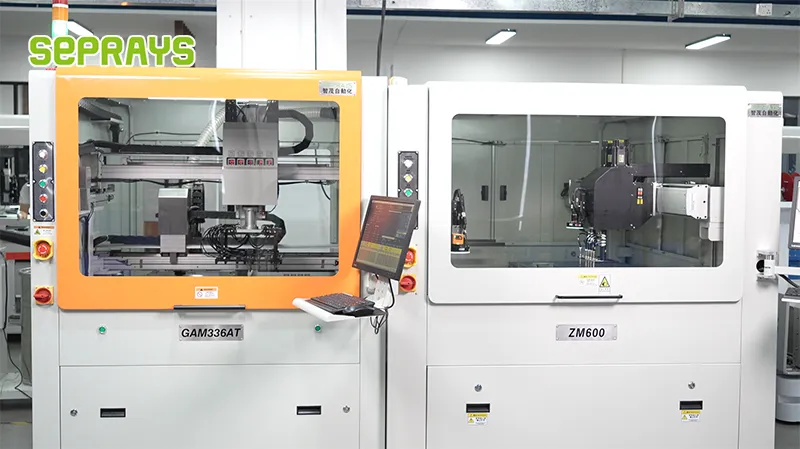
Evaluating a Contract Manufacturer’s Process Capability
For outsourced depaneling services, the Cpk index provides a quantifiable measure of process capability that goes beyond simple dimensional averages. A Cpk ≥ 1.33 indicates the manufacturer can maintain tolerance windows with 4-sigma control, meaning fewer than 63 non-conformances per million operations — acceptable for most industrial and medical applications. Consumer electronics typically require Cpk ≥ 1.0, while automotive and aerospace applications demand Cpk ≥ 1.67 to 2.0. Process capability is established through measurement system analysis (MSA), control charting of critical dimensions across production runs, and destructive testing of sample boards from each lot to verify internal board integrity post-depanel.
When qualifying an outsourced depaneling operation, request the process FMEA (Failure Mode and Effects Analysis) specific to the depaneling process, the MSA documentation for the CMM or vision system used for dimensional verification, and historical Cpk data from at least the last 20 consecutive production lots. The supplier’s willingness to share this data correlates directly with their process maturity and your risk exposure as the OEM.
Cost-Break-Even and Production Volume Thresholds
The decision to outsource depaneling hinges on a comparison of capital investment, operational cost, and production volume. A mid-range automated depaneling system with integrated AOI (automated optical inspection) costs between USD 45,000 and USD 80,000, with annual maintenance and tooling expenses of USD 5,000–10,000, plus one full-time operator at USD 40,000–55,000 per year. This totals USD 50,000–70,000 in annual fixed cost, meaning at a throughput of 2,000 panels per year with an outsourced cost of USD 25–35 per panel, the break-even point falls between 1,500 and 2,200 panels annually. Production volumes below this threshold favor outsourcing; above it, in-house depaneling becomes more economical.
Beyond pure cost, production flexibility during demand spikes, capital preservation for core assembly equipment, and the engineering burden of maintaining depaneling process documentation all factor into the total cost of ownership analysis. For prototype runs of fewer than 50 panels, outsourced services eliminate the need to qualify a depaneling process for a design that may change within weeks.
Technical Risk Mitigation in Outsourced Depaneling
Effective outsourcing requires treating depaneling as a qualified manufacturing process rather than a simple service transaction. Define acceptance criteria for edge quality according to IPC-A-600H, specify maximum allowable delamination depth (typically 0.05mm from the edge), and require cross-sectional analysis of the first article from each new board design. Establish a incoming inspection protocol that includes visual inspection at 10× magnification of the depaneled edges, (sampling inspection) of dimensional compliance via CMM, and pull-test verification of any press-fit connectors or through-hole components that may have experienced stress during separation.
Without these controls, outsourced depaneling introduces variability that propagates through subsequent assembly and test operations, surfacing as field failures at cost ratios of 10:1 to 50:1 relative to in-process detection. With rigorous qualification and ongoing monitoring, outsourcing provides access to specialized capabilities — such as laser cutting for ultra-fine pitch components or tandem routing stations for high-volume production — at a fraction of the capital investment required to build equivalent in-house capacity.
Technical Summary
Outsourced PCB depaneling services offer measurable economic and technical advantages when the contract manufacturer demonstrates documented process capability, employs calibrated measurement systems, and maintains rigorous incoming and outgoing quality verification. The decision to outsource requires balancing production volume economics against the engineering discipline needed to qualify and monitor the external process. For boards with components within 0.5mm of the depaneling edge, laser depaneling with UV sources provides the lowest risk profile but at higher per-panel cost; routed depaneling remains the dominant choice for boards with adequate keep-out zones when the manufacturer maintains tool wear monitoring and process control within Cpk ≥ 1.33. The thermal and mechanical stress introduced during depaneling is quantifiable and controllable, but only when the outsourcing decision includes the investment in technical qualification that distinguishes a reliable process partner from a simple job shop.
Recommended Equipment
Looking for proven depaneling solutions? Seprays offers a full range of equipment backed by 30+ years of industry experience. Here are two options worth considering for your production line:
- GAM300AT Double-Layer Track Online PCB Board Separation Machine — Full-carrier process with carrier return track — built for seamless full-line automation
- GAM310A Offline Automatic Board Separator — Compact single workbench with CCD visual correction — high precision in a small footprint
Frequently Asked Questions
I don’t see the article content attached or provided in your message. Could you either:
1. **Paste the article text** directly in the chat, or
2. **Attach the file** (PDF, DOCX, etc.) so I can read it
Once I have the actual article content, I’ll generate the 3 Q&A pairs exactly in the HTML format you specified.
About Seprays
About Seprays Precision Machinery
Founded in 1993, Seprays has over 30 years of expertise in PCB depaneling solutions. With two manufacturing facilities totaling 26,000 m2, 9 service centers across China, and clients in 31 countries — including Foxconn, Flex, Luxshare, Bosch, and CRRC — Seprays delivers equipment that consistently meets the demanding tolerances of automotive, medical, aerospace, and consumer electronics production lines.
Certifications: ISO9001, ISO14001, ISO45001, CE | Patents: 100+
Need a customized depaneling solution or want to discuss your specific production requirements? Our technical team is ready to help.
Contact: jimmy@seprays.com