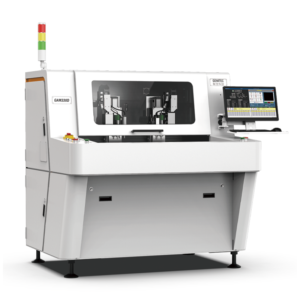

A spindle running at 60,000 RPM that has accumulated 12,000 operating hours typically exhibits bearing preload degradation of 15-25%, resulting in runout increasing from the factory-spec ±0.005mm to ±0.015-0.025mm. On a depaneling router, that deviation translates directly into tab residuals exceeding 0.3mm and micro-fracture zones along cut edges extending 200-400μm into the substrate — defects that trigger rejection under IPC-A-610 Class 3 criteria. The question of whether to pay for post-warranty service coverage is, at its core, a question of whether the cost of unplanned spindle replacement, recalibration, and line downtime exceeds the predictable annual premium of a service contract.
Failure Frequency and Cost Profile Beyond Warranty
Statistical data from high-volume SMT facilities running dual-shift operations shows that depaneling machines beyond the 24-month standard warranty experience an average of 2.3 service events per year, versus 0.6 during the warranty period. The most common failures include spindle bearing degradation (accounting for approximately 40% of post-warranty calls), linear guide wear on the X-Y gantry (25%), vacuum system seal deterioration (18%), and control board or servo driver faults (12%). A single unplanned spindle replacement — including the cartridge, installation labor, and recalibration to restore positional accuracy within ±0.05mm — typically costs $3,500-5,500 at current market rates. Linear guide replacement runs $1,800-2,800 per axis. When a machine sits idle awaiting parts on a non-contract basis, lead times for spindle cartridges average 10-15 business days versus 2-3 days for contract-holders with priority parts allocation.
Downtime Economics in Continuous Production
For a line producing 300-500 assemblies per hour with an average unit value of $12-18, each hour of depaneler downtime represents $3,600-9,000 in lost throughput. A single unplanned 48-hour outage — common when parts must be sourced without contract priority — costs $172,800-432,000 in deferred production value. Even discounting for line rebalancing and buffer inventory, the effective cost rarely falls below $8,000-15,000 per incident. An annual service contract for a mid-range depaneler typically runs $4,000-7,500, covering two scheduled preventive maintenance visits, priority response within 4-8 hours, and discounted parts. The break-even point is straightforward: one unplanned failure event per year generally exceeds the full contract premium.
Preventive Maintenance and Calibration Drift
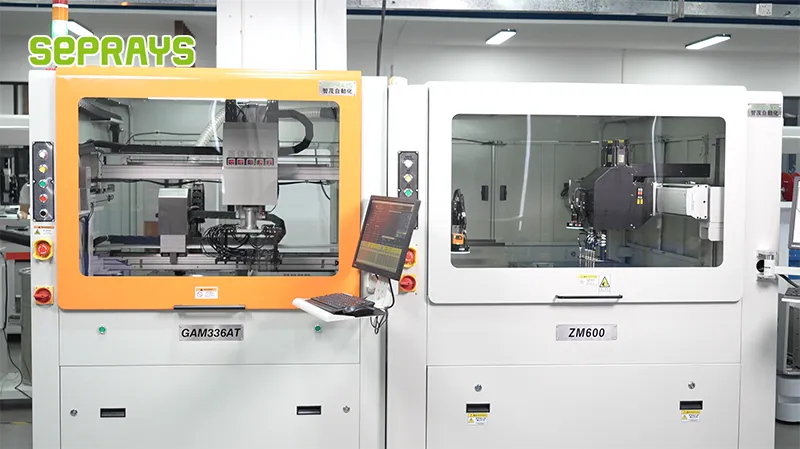
Service contracts typically include semi-annual preventive maintenance that addresses the root causes of most post-warranty failures. Technicians measure and correct spindle runout (target: ≤0.008mm TIR), verify X-Y positional accuracy across the full travel envelope (±0.05mm per IPC-6012 Class 3 routing requirements), replace vacuum seals before suction degradation drops below the 80% efficiency threshold, and recalibrate the tool length offset sensor to maintain cutting depth consistency within ±0.03mm. Without scheduled PM, calibration drift accumulates silently. Facilities that skip post-warranty PM show a 3.5x increase in first-pass yield losses traceable to depaneling — primarily delamination at routed edges, burr heights exceeding the 0.1mm limit, and misaligned V-score breaks that stress BGA solder joints within 3mm of the score line, violating the 5mm keep-out recommendation in IPC-2221.
Software Updates and Process Optimization
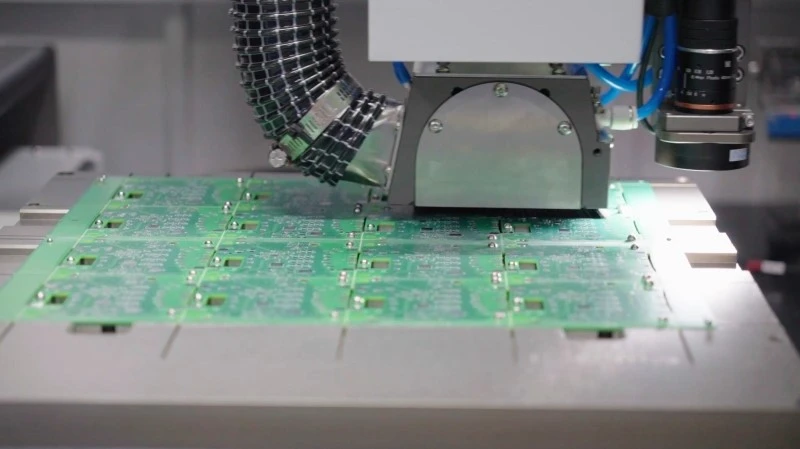
Modern depanelers rely on firmware and motion control software that receive periodic updates addressing feed rate optimization, tool path algorithms, and safety interlocks. Non-contract customers frequently lose access to these updates after the warranty period. In practice, this means missing optimizations that can improve routing throughput by 8-12% through revised plunge-and-exit strategies, or failing to receive patches for known servo tuning anomalies that cause overshoot at direction-change points — overshoot that adds 0.02-0.05mm of positional error per reversal. For a machine executing 200-400 direction changes per panel, the cumulative effect on edge quality is measurable and, under IPC-A-610 inspection, can push marginal cuts from acceptable to rejectable.
Risk Triage: When to Self-Insure
Not every installation justifies a service contract. Single-shift operations running low-density panels at feed rates below 50mm/s with large routing tolerances (±0.15mm acceptable) experience significantly lower stress on spindles and guides. Facilities with redundant depanelers that can absorb an outage by shifting production, or those maintaining an in-house stock of spindle cartridges and possessing the calibration equipment to verify ±0.05mm accuracy after replacement, may reasonably self-insure. The critical metric is mean time between failures relative to production sensitivity: if MTBF exceeds 18 months and a single 72-hour outage costs less than the annual contract premium, declining coverage is defensible. However, this calculation must account for escalation — post-warranty failure rates increase approximately 30% year-over-year for machines beyond 36 months of service life.
The decision to purchase post-warranty service coverage for a PCB depaneling machine reduces to a quantifiable risk equation: contract premiums of $4,000-7,500 per year versus unplanned failure costs of $8,000-15,000 per incident with 2.3 average annual occurrences, compounded by priority response reducing downtime from 48+ hours to 8-12 hours and PM visits that suppress failure rates by approximately 60%. For dual-shift Class 3 production where depaneling accuracy at ±0.05mm is non-negotiable, service contracts deliver positive ROI within the first post-warranty year; for relaxed-tolerance single-shift operations with redundant capacity, self-insurance remains a credible alternative provided spare parts and calibration capability are maintained in-house.
Recommended Equipment
Looking for proven depaneling solutions? Seprays offers a full range of equipment backed by 30+ years of industry experience. Here are two options worth considering for your production line:
- PCB/FPC Stamping Type Board Separation Machine — Handles PCB, FPC flexible, and rigid-flex boards — versatile stamping depaneling solution
- GAM310A Offline Automatic Board Separator — Compact single workbench with CCD visual correction — high precision in a small footprint
Frequently Asked Questions
Q1: Our depaneler runs three shifts with 20,000 boards per day — does a post-warranty service contract actually pay off compared to per-incident repairs?
A1: For high-utilization lines, yes. A single emergency service visit for a spindle or conveyor failure typically costs $1,500–$3,000 in parts and labor plus 24–48 hours of unplanned downtime. An annual contract at roughly 8–12% of machine acquisition cost generally includes two scheduled preventive maintenance visits and discounted response times, which breaks even after just one unscheduled failure event per year.
Q2: What specific maintenance items should a service contract cover to keep our routing depaneler within ±0.05mm positional accuracy?
A2: The contract should explicitly include spindle bearing inspection and replacement at rated hour intervals (typically 6,000–8,000 hours), linear guide lubrication and backlash measurement, tool collet runout verification (must stay below 0.01mm TIR), and optical alignment calibration for vision-guided systems. Without these scheduled checks, positional drift accumulates gradually and often goes unnoticed until scrap rates spike.
Q3: Our facility has basic maintenance technicians — can we negotiate a parts-only contract and handle labor ourselves to reduce cost?
A3: It depends on your in-house capability depth. Routine tasks like blade replacement, belt tensioning, and dust extraction filter changes are straightforward. However, spindle balancing, servo tuning, and control board diagnostics require OEM-specific tools and firmware access that most contracts reserve for factory-trained technicians. A hybrid contract — covering parts plus critical labor for spindle and control system work — often delivers 15–20% savings over full coverage while protecting against the highest-cost failure modes.
About Seprays
About Seprays Precision Machinery
Founded in 1993, Seprays has over 30 years of expertise in PCB depaneling solutions. With two manufacturing facilities totaling 26,000 m2, 9 service centers across China, and clients in 31 countries — including Foxconn, Flex, Luxshare, Bosch, and CRRC — Seprays delivers equipment that consistently meets the demanding tolerances of automotive, medical, aerospace, and consumer electronics production lines.
Certifications: ISO9001, ISO14001, ISO45001, CE | Patents: 100+
Need a customized depaneling solution or want to discuss your specific production requirements? Our technical team is ready to help.
Contact: jimmy@seprays.com