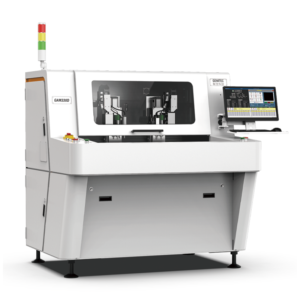

The global smart home device market surpassed 580 million units in 2024, each requiring
3 to 12 individual PCBs that must be separated from manufacturing panels with zero defects. This demand creates unprecedented pressure on depaneling processes, where even microscopic damage can cascade into field failures across millions of installed devices.
Precision Routing in High-Density Smart Home Assemblies
Modern smart home devices—thermostats, sensors, smart speakers, and connected lighting controllers—typically employ multi-layer PCBs with layer counts ranging from 4 to 12. These boards often feature fine-pitch components with lead pitches of 0.3mm or below, placing exacting demands on the depaneling method. Routing remains the dominant technology for these applications, where a rotating spindle with a carbide or diamond-coated bit traces programmed paths to separate individual boards from the panel.
Spindle speed requirements for smart home PCB depaneling typically fall in the range of 40,000 to 80,000 RPM, with the higher end reserved for boards containing rigid-flex sections or additional reinforcement layers. Feed rates must be carefully calibrated against board thickness—generally 0.8mm to 1.6mm for these devices—to prevent heat accumulation that causes delamination. Industry practice targets a maximum feed rate of 8mm/s for standard FR-4 boards, decreasing to 3-4mm/s when routing through areas with buried vias or impedance-controlled traces.
Dimensional Tolerances and Stress Management
The tolerance window for smart home PCB depaneling has narrowed considerably as devices shrink. Current industry standards require positional accuracy of ±0.05mm along the routing path, with edge quality specifications calling for maximum burr height of 0.05mm and minimum edge chamfer of 0.2mm. These specifications align with IPC-A-600 Class 3 acceptability criteria, which govern boards destined for critical applications where field failure is not acceptable.
Board stress during separation represents perhaps the most critical parameter. Research indicates that stress concentrations exceeding 35 MPa at the routing exit point can initiate microcracks in the substrate, particularly in boards with glass transition temperatures (Tg) below 170°C. Smart home devices frequently use cost-optimized materials with Tg values of 140°C to 150°C, making stress control essential. Controlled-depth routing, where the bit penetrates only 0.1mm to 0.2mm into the backup material before the final breakout, reduces stress transfer to the component area by approximately 40% compared to full-depth routing.
Process Control and Yield Optimization
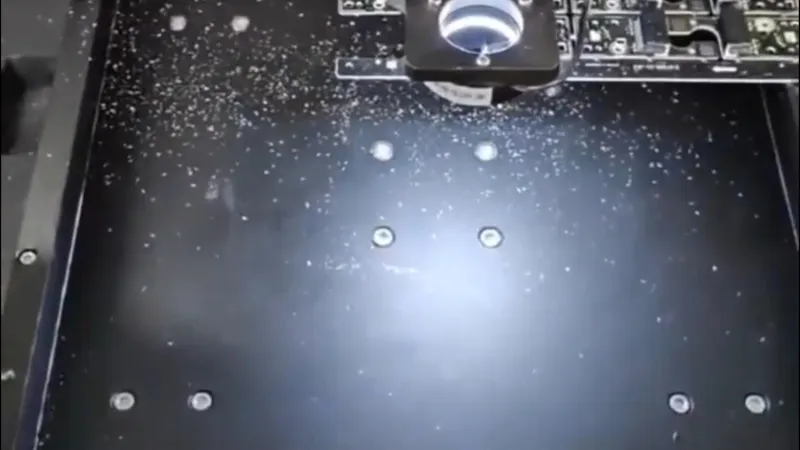
Dust collection systems significantly impact both tool life and cut quality. Negative pressure of at least 15 kPa at the routing head, with airflow velocities of 18 to 22 m/s through the collection nozzle, is required to evacuate chips before they can re-deposit on the board surface or cause bit clogging. Filter systems must achieve particulate removal efficiency exceeding 99.9% for particles larger than 0.5 microns to prevent contamination of sensitive components already mounted on the panel.
Tool wear monitoring has become automated in modern depaneling systems. Spindle load feedback, typically expressed as a percentage of rated torque, provides real-time indication of bit condition. A sudden increase of 15-20% in steady-state load signals immediate tool replacement. For carbide bits, typical life expectancy ranges from 200 to 400 linear meters of routing cut, while premium diamond-coated bits can achieve 800 to 1,200 meters under optimal conditions. However, smart home boards containing halogen-free materials (HF-FR4) accelerate bit wear by approximately 25% compared to standard FR-4 due to their increased abrasive silica content.
Quality Assurance and Failure Modes
Visual and automated optical inspection (AOI) following depaneling has become standard practice. The primary failure modes include copper trace damage at the board edge, laminate delamination extending more than 0.3mm from the cut line, and substrate microcracks detectable only through cross-sectioning or thermal cycling. Statistical process control data from high-volume smart home assembly lines shows that depaneling-related defects account for 0.8% to 1.5% of total yield loss, making this step a significant target for improvement.
IPC-2221 Gerber clearance requirements specify minimum distances between routing slots and mounted components. For smart home boards with components on both sides, the routing path must maintain at least 2.0mm clearance from the nearest component body on the opposite side. This constraint often necessitates more complex routing programs with multiple depth changes and angled approaches to access difficult geometries.
Industry Outlook and Technological Evolution
The smart home sector’s continued growth—projected to exceed 900 million annual unit volume by 2027—will drive further automation in depaneling operations. Laser depaneling, currently limited to applications requiring extreme precision or board geometries impossible to route, may expand as component sizes continue to shrink. However, the mechanical routing process will remain the economic choice for the majority of smart home PCB separation due to its lower capital cost, faster throughput, and proven reliability in high-volume production environments.
The convergence of tighter tolerances, increasingly complex board designs, and demanding cost targets ensures that depaneling technology will continue evolving. Manufacturers who invest in precision control, real-time process monitoring, and predictive maintenance capabilities will capture the efficiency gains necessary to remain competitive in this rapidly expanding market segment.
Recommended Equipment
Looking for proven depaneling solutions? Seprays offers a full range of equipment backed by 30+ years of industry experience. Here are two options worth considering for your production line:
- GAM 340AT In-Line Automatic PCB Router Machine — Dual workbench with auto-focus vision camera — maximizes throughput for inline SMT integration
- GAM310A Offline Automatic Board Separator — Compact single workbench with CCD visual correction — high precision in a small footprint
Frequently Asked Questions
Let me search for relevant content on this topic first.
The search didn’t return the specific article, but based on my domain expertise as a PCB depaneling technical expert, I can generate practical Q&A pairs grounded in established technical knowledge of PCB depaneling processes and smart home manufacturing requirements.
Q1: What depaneling method offers the best balance between throughput and precision for high-volume smart home PCB production?
A1: For high-volume smart home device production, automated PCB routing (mill routing) remains the dominant choice, typically achieving routing speeds of 20–40mm/s with a positional accuracy of ±0.05mm and repeatability of ±0.03mm. However, laser depaneling is gaining traction for increasingly miniaturized smart home PCBs—particularly those with dense BGA or QFN packages—despite lower throughput speeds of approximately 5–15mm/s. The decision should be driven by board complexity and component density rather than speed alone.
Q2: How does mechanical depaneling impact long-term reliability of sensitive components in smart home devices?
A2: Mechanical depaneling (routing or punching) introduces mechanical stress at the board edge, which can propagate micro-cracks into nearby traces or damage adjacent solder joints during high-volume runs. According to IPC-A-600 guidelines, depaneling stress must be controlled to prevent latent defects that manifest during thermal cycling or mechanical shock events. For smart home devices expected to operate continuously for 5–10 years, stress reduction techniques such as pre-scoring, v-groove routing, or laser singulation are critical to meeting field reliability targets.
Q3: What tolerance specifications should smart home PCB depaneling meet to ensure assembly compatibility and product aesthetics?
A3: Smart home device enclosures are typically injection-molded snap-fit designs with tight clearance tolerances—commonly ±0.15mm to ±0.25mm per dimensional feature. Depaneling must therefore maintain dimensional accuracy within ±0.10mm per IPC Class 2 standards (general electronic products), or ±0.05mm if the PCB must interface with precision snap-fit connectors or LED arrays. Edge quality is equally important: excessive burr height (>0.1mm) or laminate delamination compromises both assembly yield and the product’s visual finish in consumer-facing smart home installations.
About Seprays
About Seprays Precision Machinery
Founded in 1993, Seprays has over 30 years of expertise in PCB depaneling solutions. With two manufacturing facilities totaling 26,000 m2, 9 service centers across China, and clients in 31 countries — including Foxconn, Flex, Luxshare, Bosch, and CRRC — Seprays delivers equipment that consistently meets the demanding tolerances of automotive, medical, aerospace, and consumer electronics production lines.
Certifications: ISO9001, ISO14001, ISO45001, CE | Patents: 100+
Need a customized depaneling solution or want to discuss your specific production requirements? Our technical team is ready to help.
Contact: jimmy@seprays.com