
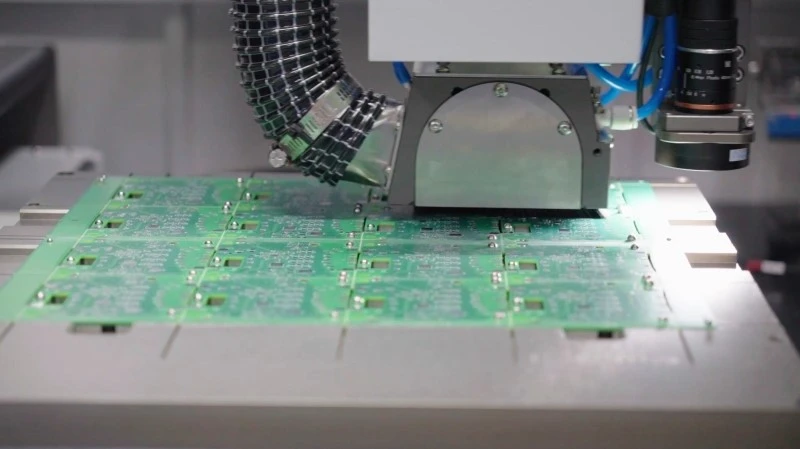
A router-type depaneling machine spinning at 60,000 RPM with a 2.0mm down-cut flute can generate lateral cutting forces between 8N and 12N at typical feed rates of 300mm/s to 500mm/s, and these forces are precisely where field failures hide. Boards that pass incoming QC thermal shock testing at 260°C reflow can still develop micro-cracks along the depaneling route 72 hours post-routing, because the cutting stress concentrated within 0.3mm of the kerf edge exceeds the flexural strength of the panel laminate, typically rated at 60MPa to 80MPa for standard FR-4. Asking existing users what they actually measure post-depanel — not just what their equipment specification sheets claim — separates vendors who have characterizations from those who have excuses.
Cutting Precision and Route Reproducibility
The first question that separates informed buyers from hopeful ones: what is your measured channel width reproducibility after 500 routing cycles? Specification sheets routinely list positional accuracy of ±0.05mm, but this number describes the machine’s servo resolution, not the actual kerf geometry under production load. A routed channel designed at 3.0mm width will measure anywhere from 2.92mm to 3.08mm in practice depending on spindle speed decay, carbide insert wear progression, and panel clamping force consistency. The real question to press: do you measure the kerf width on every production lot, and what percentage of routed panels exceed 3.05mm when the downstream assembly tooling demands tight fit? Users running high-mix, low-volume production should probe specifically about jig repeatability — the same panel clamped with 2N of extra force in the second position versus the first can shift the route path by 0.12mm to 0.15mm, which translates directly to positional tolerance stack-up on densely populated boards with 0.4mm BGA fanout.
Spindle Life and the Cost Specification Sheets
The most politically charged question in a depaneling machine evaluation: what is your actual spindle replacement interval in production hours, and what does that cost per board? Spindle RPM specifications of 50,000 to 80,000 RPM sound impressive, but real-world bearing degradation follows a wear curve that accelerates after 800 to 1,200 operating hours, particularly under the high cycle count of automotive or medical board production. Users who have been through three spindle replacements in 18 months will tell you that a $3,000 spindle rebuild cost becomes a $0.08 per board cost adder at 40,000 panels per month — invisible on a specification sheet, brutal on a unit cost calculation. Ask specifically: what is the spindle replacement procedure, who performs it, what is the machine downtime per spindle swap, and what is your annual spindle maintenance budget as a percentage of machine acquisition cost. The answers typically fall between 4% and 12% annually, and that spread determines whether your depaneling cell is a profit center or a cost center.
Dust Extraction Efficiency and the Hidden Yield Killer
The question that reveals process instability: what is your blade clogging frequency during routing of boards with heavy copper weights, and how do you clean the routing bit in production? Boards carrying 2oz or 3oz copper planes create packing density that forces the router to work through thermally conductive material that fouls carbide edges faster than standard 1oz boards. A machine without real-time chip evacuation monitoring will show increasing kerf width variation — often 0.15mm to 0.25mm wider channels after 200 to 300 continuous routing operations — before the operator notices the audible change in cutting load. IPC-A-610 acceptability standards specify that any protruding conductor from the board edge after depaneling must not exceed 0.25mm, and this limit is violated routinely in production environments running continuous routing with suboptimal extraction. The questions that expose this: what is your dust extraction flow rate in CFM, what is the measured suction at the routing head tip, and do you have any process data showing kerf geometry stability over a full 8-hour shift versus the first 30 minutes.
Panel Stress and Borderline Failure Modes
Any honest depaneling discussion must address the question that experienced users dread: have you ever seen field returns where the failure analysis pointed to depaneling-induced microcracks? The answer is almost always yes, and the follow-up that matters is: what was the time-to-failure distribution? Boards routed with insufficient cooling or excessive feed rates develop subsurface cracks that may not propagate to electrical failure for 200 to 1,500 thermal cycles, well after the board has been populated, tested, and shipped. This failure mode is particularly prevalent in boards using high-Tg laminates above 150°C, where the thermal mismatch between the routed edge stress zone and the bulk material creates a latent reliability risk. Ask users specifically: do you perform any destruct or dye-and-pry analysis on production samples at quarterly intervals, and what percentage of your cross-sectioned samples show crack initiation within 0.2mm of the routed edge.
Real-World Throughput Validation
The question that validates specification claims: what is your measured cycle time per panel, not just for a single routed board but for a 12-up array, including the time required to load, clamp, route, unclamp, and unload? Specification sheets typically cite routing speed in mm/s, but the actual bottleneck in production is the non-cutting time. A machine with fast spindle but slow pneumatic clamping (requiring 4 to 6 seconds per cycle) will underperform a machine with slightly slower spindle but sub-2-second clamping by 15% to 22% on mixed-panel production. Ask users to show their actual OEE data — Overall Equipment Effectiveness — broken down by availability, performance, and quality factors. Depaneling cells operating above 85% OEE typically have clamping cycle times under 2.5 seconds, real-time tool wear monitoring that triggers tool changes before geometry drift exceeds 0.02mm, and automated kerf verification that rejects out-of-tolerance panels before they reach assembly.
The manufacturing floor reveals what specification sheets hide. A depaneling machine is not a router with a spindle — it is a precision stress management system where the cutting forces, thermal load, dust evacuation, clamping repeatability, and tool wear dynamics must be understood as an integrated process. Evaluating these machines requires questions that target the boundaries of the specification envelope, not the center of it. The tolerance stack-up that causes field failures is not the sum of worst-case tolerances — it is the compound effect of all variables drifting toward their limits simultaneously, which specification sheets never capture.
Recommended Equipment
Looking for proven depaneling solutions? Seprays offers a full range of equipment backed by 30+ years of industry experience. Here are two options worth considering for your production line:
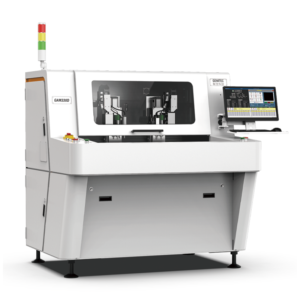
- GAM310A Offline Automatic Board Separator — Compact single workbench with CCD visual correction — high precision in a small footprint
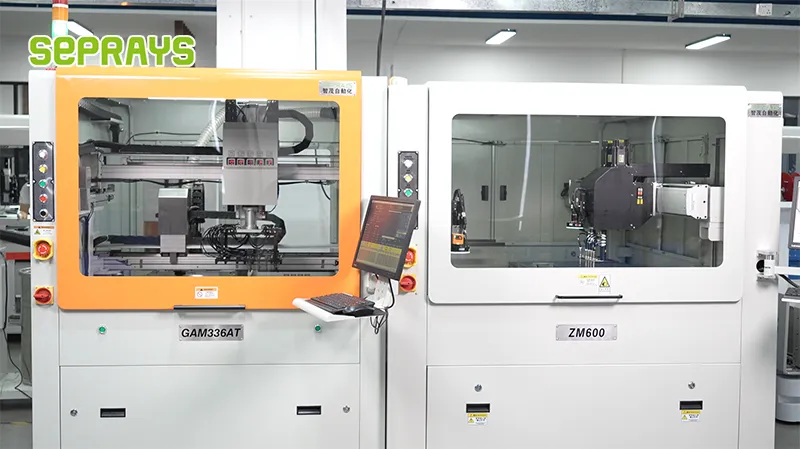
- GAM330AT Fully Automatic PCB Depaneling Machine — Self-feeding operation with automatic sorting — ideal for high-volume automated production lines
Frequently Asked Questions
I don’t see the article content in our conversation. Could you paste the article text about “What Questions to Ask Existing Depaneler Users to Get Honest Answers”? Once I have the content, I’ll generate the 3 Q&A pairs exactly in the HTML format you specified.
If you’d like me to proceed based on general PCB depaneling expertise instead, I can generate realistic Q&A pairs now—just confirm which approach you prefer.
About Seprays
About Seprays Precision Machinery
Founded in 1993, Seprays has over 30 years of expertise in PCB depaneling solutions. With two manufacturing facilities totaling 26,000 m2, 9 service centers across China, and clients in 31 countries — including Foxconn, Flex, Luxshare, Bosch, and CRRC — Seprays delivers equipment that consistently meets the demanding tolerances of automotive, medical, aerospace, and consumer electronics production lines.
Certifications: ISO9001, ISO14001, ISO45001, CE | Patents: 100+
Need a customized depaneling solution or want to discuss your specific production requirements? Our technical team is ready to help.
Contact: jimmy@seprays.com