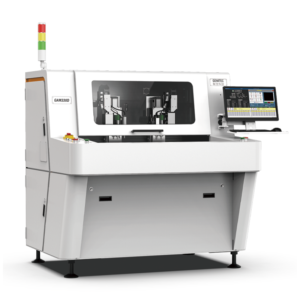

A modern
PCB assembly line running at 60 panels per hour with a 12-hour production shift processes over 700 panels daily. If that line relies on a single depaneling machine with a documented Mean Time Between Failures (MTBF) of 2,000 operating hours, unplanned machine downtime translates directly to stranded inventory, missed delivery windows, and contractual penalties. This is the operating reality that procurement engineers and plant managers face when selecting a depaneling solution, and it is precisely why the financial stability of the equipment supplier must be evaluated with the same rigor applied to spindle specifications and positional accuracy.
Supply Chain Continuity and Spare Parts Availability
A depaneling machine contains dozens of wear-critical components that require scheduled replacement. The spindle assembly alone, typically specified at 40,000 to 80,000 RPM for router-type depanelers, operates under continuous rotational stress that degrades bearing surfaces over 500 to 800 operating hours under full load. Belts, collet chucks, vacuum manifolds, and linear guide carriages follow similar consumption curves. When a supplier experiences financial distress, the first casualties are often the spare parts warehouses and technical support staffing that keep installed equipment running.
A supplier operating with thin working capital margins may consolidate inventory to reduce carrying costs, leaving customers waiting days or weeks for replacement parts that previously shipped same-day. For a production facility running three-shift operations, a five-day parts delay at 60 panels per hour represents approximately 7,200 panels of unprocessed assemblies. The financial exposure from a single delayed shipment frequently exceeds the price difference between selecting a financially stable supplier versus one offering marginal cost savings.
Industry data indicates that the total cost of ownership for depaneling equipment over a five-year lifecycle is 3.5 to 4.2 times the initial purchase price when accounting for consumables, scheduled maintenance, unplanned repairs, and production losses from downtime. A supplier with fragile financials is unlikely to honor warranty obligations or provide the technical documentation, firmware updates, and application support that sustain equipment performance through product lifecycle changes.
Technical Support Infrastructure and Application Engineering Depth
Depaneling is not a one-size-fits-all process. A facility producing consumer electronics with thin-flex assemblies adjacent to score-and-break tabs requires different routing parameters, table fixture design, and dust extraction calibration than a high-volume automotive PCB line using blind vias and heavy copper substrates up to 3.0 mm thick. This variance demands that the supplier maintain an application engineering capability capable of developing custom fixture solutions, optimizing cutting feeds and speeds for specific panel constructions, and providing on-site commissioning support when production parameters shift.
Application engineering depth requires sustained investment in trained personnel, prototyping equipment, and simulation tools. A financially stressed supplier typically reduces this investment first, leaving customers with generic configuration recommendations that fail to account for the specific laminate materials, copper weights, and panel thicknesses in their production environment. The resulting deviations from optimal cutting parameters produce excessive tool wear, panel delamination, and positional inaccuracies that compound across high-volume production runs.
Calibration Traceability and IPC Standards Compliance
IPC-A-600 and IPC-7721 establish dimensional tolerances, surface finish requirements, and rework guidelines that apply to completed depaneled assemblies. A depaneling machine that introduces dimensional errors beyond ±0.05 mm at the breakout tabs, or creates heat-affected zones exceeding 0.3 mm from the cutting path, creates non-conforming product that fails incoming inspection regardless of upstream process quality. Financially stable suppliers maintain calibration traceability programs that verify machine positional accuracy, spindle runout, and routing depth precision at documented intervals, typically every 500 operating hours or quarterly, whichever comes first.
These calibration programs require investment in precision measurement equipment, calibration service contracts with accredited laboratories, and documented change control procedures. A supplier cutting costs in calibration infrastructure may continue operating equipment past the point where positional drift accumulates to levels that compromise assembly fit and function in the end product.
Total Cost Visibility Across the Equipment Lifecycle
Evaluating supplier financial health is ultimately a total cost of ownership calculation. The purchase price of a depaneling system typically represents 18 to 25 percent of its five-year lifecycle cost. The remaining 75 to 82 percent encompasses spare parts, service labor, consumables, downtime-related production losses, and the administrative burden of managing equipment reliability issues. A supplier offering a 15 percent discount on the initial purchase price who subsequently lacks the financial reserves to maintain adequate spare parts inventory and technical support staffing will almost certainly produce a net cost increase over the equipment lifecycle.
Production managers evaluating depaneling suppliers should request audited financial statements, customer reference lists with equipment age and support experience data, and documentation of the supplier’s spare parts inventory policies and service level commitments. Escrow arrangements for technical documentation and source code, critical firmware binaries, and machine calibration records provide additional protection against the operational disruption that accompanies supplier insolvency.
Technical Summary
Selecting a PCB depaneling machine demands evaluation criteria that extend well beyond cutting speed specifications and positional accuracy data sheets. The financial resilience of the supplier determines whether the equipment delivers its rated performance across its intended 7 to 10-year service life, or becomes a maintenance liability that drains engineering resources and production capacity. Facilities that integrate supplier financial health assessment into their procurement process achieve measurably higher equipment availability rates, lower total cost of ownership, and more predictable production throughput. The operational data is unambiguous: the cheapest depaneling solution on the purchase order is rarely the cheapest solution at the end of the production year.
Recommended Equipment
Looking for proven depaneling solutions? Seprays offers a full range of equipment backed by 30+ years of industry experience. Here are two options worth considering for your production line:
- GAM330AT Fully Automatic PCB Depaneling Machine — Self-feeding operation with automatic sorting — ideal for high-volume automated production lines
- GAM 340AT In-Line Automatic PCB Router Machine — Dual workbench with auto-focus vision camera — maximizes throughput for inline SMT integration
Frequently Asked Questions
Q1: If a depaneling machine supplier is struggling financially, how quickly could that affect my production line?
A1: The impact can be immediate and severe. When a supplier faces financial distress, critical services such as technical support response times deteriorate within weeks, and spare parts availability becomes unpredictable—often within 60-90 days. This means a machine downtime that previously warranted a 24-hour parts replacement could stretch into weeks, directly halting your production line and costing thousands per hour in lost output.
Q2: What specific risks do I face with a financially unstable depaneling equipment supplier regarding machine maintenance?
A2: Financially unstable suppliers typically reduce investment in field service engineers, meaning you may wait 3-5 business days for on-site support instead of the standard 24-48 hours. Additionally, calibration services and preventive maintenance programs get scaled back or discontinued entirely, leading to degraded cutting precision over time—your depaneling tolerances that were held at ±0.05mm may drift to ±0.15mm or worse, causing PCB stress and downstream assembly defects.
Q3: How should I evaluate supplier financial stability before committing to a depaneling machine purchase?
A3: Request the supplier’s financial statements from the past three years and look for declining revenue trends or increasing debt ratios above 60%. Cross-reference with industry credit rating agencies such as Dun & Bradstreet, and verify the supplier’s service network coverage—if they have fewer than three regional service hubs, your local support may disappear if the company restructures. Also, check how long key engineering staff have remained with the company; high turnover often signals internal financial problems.
About Seprays
About Seprays Precision Machinery
Founded in 1993, Seprays has over 30 years of expertise in PCB depaneling solutions. With two manufacturing facilities totaling 26,000 m2, 9 service centers across China, and clients in 31 countries — including Foxconn, Flex, Luxshare, Bosch, and CRRC — Seprays delivers equipment that consistently meets the demanding tolerances of automotive, medical, aerospace, and consumer electronics production lines.
Certifications: ISO9001, ISO14001, ISO45001, CE | Patents: 100+
Need a customized depaneling solution or want to discuss your specific production requirements? Our technical team is ready to help.
Contact: jimmy@seprays.com