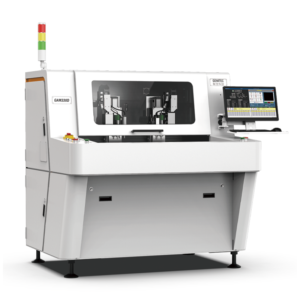

ISO Class 5 cleanrooms maintain a maximum particulate count of 3,520 particles per cubic meter for particles ≥0.5μm, yet standard PCB depaneling operations with improperly designed dust collection can inject upwards of 50,000 particles/m³ into the local environment within seconds of spindle startup. At spindle speeds of 60,000 RPM, router bits generate particulate debris spanning 0.3μm to 500μm, with the sub-10μm fraction presenting the highest contamination risk to downstream SMT processes, particularly solder paste printing and component placement accuracy.
Particulate Size Distribution and Contamination Thresholds in Cleanroom Depaneling
Router-style PCB depaneling generates a bimodal particle size distribution: macro-chips (100-500μm) and micro-dust (0.3-10μm). The macro fraction is mechanically separable through standard chip collection, but the micro-dust fraction—particularly particles in the 0.3-2.0μm range—remains airborne for extended periods and penetrates standard electrostatic discharge (ESD) packaging. IPC-A-610 Section 10.1 specifies that foreign particulate contamination on solderable surfaces must not exceed 0.1mg/cm² for Class 2 assemblies and 0.05mg/cm² for Class 3. In cleanroom environments producing medical or automotive PCBs, these thresholds tighten further: ISO 14644-1 Class 5 limits permit zero particles ≥5μm and fewer than 29 particles/ft³ for the 0.5μm threshold. Depaneling dust containing glass fiber fragments from FR-4 substrates presents additional risk: these sharp-edged particles penetrate conformal coating films and create latent insulation resistance failures measurable at 500V DC test conditions.
HEPA Filtration Grade and Capture Velocity Requirements
Cleanroom-compatible dust collection for PCB routers requires minimum H13-grade HEPA filtration (99.95% efficiency at 0.3μm) with optional H14 (99.995%) for ISO Class 5 and tighter environments. The filtration train must be multi-stage: primary filtration at 10μm captures the bulk chip load, secondary filtration at 1μm intercepts the mid-range fraction, and the final HEPA stage captures sub-micron particulate. Capture velocity at the router bit entry point must maintain a minimum of 0.5 m/s (100 ft/min) across the entire cutting window to overcome the centrifugal particle ejection velocity from the spindle. Computational fluid dynamics (CFD) modeling of the extraction hood geometry shows that a wrap-around shroud with 270° coverage achieves 94% capture efficiency at 60,000 RPM, compared to 67% for a simple open-hood design. The pressure drop across the full filtration train must not exceed 2.5 kPa at rated flow to prevent fan motor overheating and maintain consistent CFM delivery.
Negative Pressure Zoning and Static Control Integration
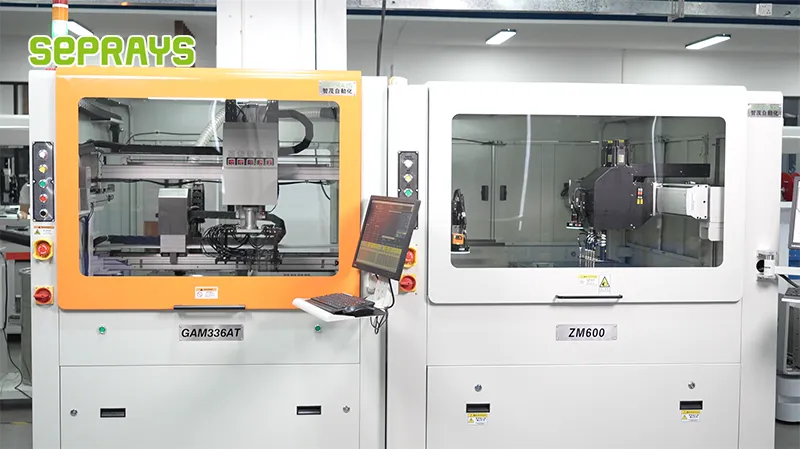
Cleanroom dust collection systems for PCB depaneling must maintain negative pressure relative to the surrounding cleanroom environment by a minimum differential of -15 Pa to -25 Pa, ensuring that any leakage flows inward toward the router enclosure rather than allowing particulate-laden air to escape into the cleanroom. This negative pressure zoning requires independent HVAC balancing: the dust collector exhaust must be ducted to outdoor discharge or through a secondary HEPA exhaust filter before recirculation. Static charge accumulation on routed PCB edges and in the collection ductwork presents a secondary contamination mechanism—particles with static adhesion forces exceeding 50 pN resist normal gravitational settling and bypass filtration. Integration of alpha-source or AC corona discharge static eliminators at the router bit exit point reduces surface potentials to below 100V, measured per ESD STM5.1-2022. The ductwork itself must employ grounded, smooth-bore conductive material with a minimum diameter of 75mm to maintain laminar flow and prevent particulate settling and re-entrainment.
Spindle Parameter Optimization to Minimize Fine Particulate Generation
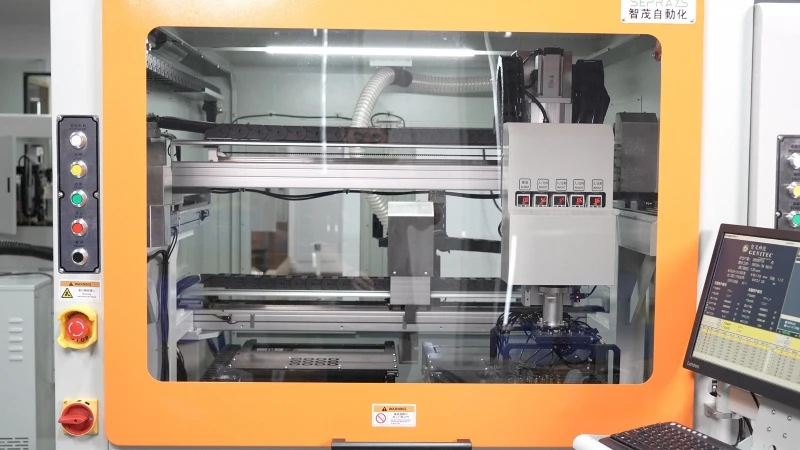
Spindle speed and feed rate directly control the volume fraction of sub-5μm particles generated during depaneling. Empirical data from production environments shows that operating at 80,000 RPM with a feed rate of 0.8 mm/sec generates 38% more sub-2μm particulate by mass compared to operation at 40,000 RPM with a 1.5 mm/sec feed rate. The optimal parameter window for cleanroom compatibility is 40,000-50,000 RPM with feed rates of 1.2-2.0 mm/sec, balancing throughput (boards/hour) against particulate generation. Tool geometry also influences dust characteristics: 2-flute up-cut spiral router bits produce a more controlled chip formation with larger average particle size (reducing the sub-micron fraction) compared to 4-flute compression bits. Tool wear monitoring is critical: bits with flank wear exceeding 0.15mm generate measurable increases in fine dust due to frictional heating and material smearing rather than clean shearing.
Continuous Monitoring and Compliance Verification Protocols
ISO 14644-1 compliance for depaneling operations in cleanrooms requires continuous particulate monitoring with calibrated laser particle counters (LPC) sampling at 1-minute intervals. The monitoring points must be positioned at the operator work zone (1.2m above floor level) and at the router enclosure exhaust plenum. Alarm thresholds are typically set at 150% of the ISO Class limit for the relevant particle size, triggering automatic spindle shutdown and HEPA filter integrity verification. Filter differential pressure sensors provide early warning of filter loading: a 30% increase in differential pressure across any filtration stage indicates approaching end-of-life and requires scheduled filter replacement before efficiency degrades below specification. Quarterly verification per ISO 14644-3 Annex B6 (particle count test) documents ongoing compliance and supports audit requirements for IATF 16949 and ISO 13485 certified facilities.
Cleanroom PCB depaneling demands an integrated dust collection strategy that addresses particulate generation at the source through spindle parameter optimization, captures airborne debris through engineered negative-pressure enclosures with H13/H14 HEPA filtration, and verifies performance through continuous monitoring against ISO 14644-1 limits; when properly implemented, this approach maintains ISO Class 5 compliance while supporting depaneling throughput of 200-400 boards per hour with cutting tolerances of ±0.1mm and surface contamination levels well below the 0.05mg/cm² threshold specified in IPC-A-610 for Class 3 assemblies.
Recommended Equipment
Looking for proven depaneling solutions? Seprays offers a full range of equipment backed by 30+ years of industry experience. Here are two options worth considering for your production line:
- PCB/FPC Stamping Type Board Separation Machine — Handles PCB, FPC flexible, and rigid-flex boards — versatile stamping depaneling solution
- ZM30-D Multi-Tool Multi-Group PCB Depaneling Machine — One-time full LED board cutting — daily output exceeding 100,000 pieces with custom configurations
Frequently Asked Questions
Q1: What is the minimum filtration efficiency required for a PCB router dust collection system operating in an ISO Class 7 cleanroom?
A1: The dust collection system must utilize a three-stage filtration design with a final HEPA filter rated at H13 or higher, achieving 99.97% efficiency at 0.3 microns. Pre-filtration with F9 grade bags is required to extend HEPA service life, and all filtration stages must be sealed to prevent bypass leakage that would compromise cleanroom integrity.
Q2: How does the static pressure setpoint in the router enclosure affect both dust containment and cleanroom particle counts?
A2: The enclosure must maintain a negative differential pressure of -15 to -25 Pa relative to the cleanroom to prevent particle migration outward during bit changes and board loading. However, excessive negative pressure increases laminar airflow disruption, so the setpoint must be balanced against the cleanroom’s total air change rate, typically 30-60 ACH for ISO Class 7 environments.
Q3: What is the recommended duct velocity and material specification for PCB router dust collection lines to prevent fiberglass dust accumulation and static buildup?
A3: Duct velocity must be maintained at 18-22 m/s to ensure fiberglass dust remains entrained and does not settle, with smooth interior surfaces specified to minimize pressure drop and particle adhesion. Ducting must be electrically conductive PVC or grounded stainless steel to dissipate static charges from the high-velocity glass fiber particles, which can otherwise cause arcing risks near sensitive electronics in the production area.
About Seprays
About Seprays Precision Machinery
Founded in 1993, Seprays has over 30 years of expertise in PCB depaneling solutions. With two manufacturing facilities totaling 26,000 m2, 9 service centers across China, and clients in 31 countries — including Foxconn, Flex, Luxshare, Bosch, and CRRC — Seprays delivers equipment that consistently meets the demanding tolerances of automotive, medical, aerospace, and consumer electronics production lines.
Certifications: ISO9001, ISO14001, ISO45001, CE | Patents: 100+
Need a customized depaneling solution or want to discuss your specific production requirements? Our technical team is ready to help.
Contact: jimmy@seprays.com