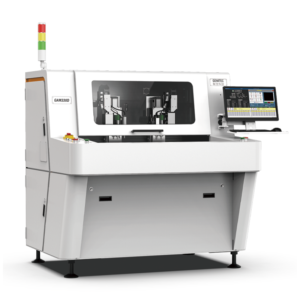

PCB Router vs V-Cut Depaneling: How to Choose the Right Method
When you panelize a printed circuit board, you typically make one of three commitments up front: tab-routing with a PCB router machine, V-cut scoring with a V-cut machine, or a mouse-bite tab pattern. Engineers often default to V-cuts because they are cheaper at the panel-design stage, but downstream the cut edge quality, scrap rate, and mechanical strength vary dramatically between the two methods.
This comparison looks at PCB router vs V-cut depaneling across edge quality, throughput, board-design constraints, capital cost, scrap rate, and field reliability. By the end, you will know which method fits your board class, your volume, and your tolerances.
Quick Comparison Table
| Criterion | PCB Router Machine | V-Cut Depaneling |
|---|---|---|
| Minimum edge clearance to components | 0.5 mm typical | 0.3 mm typical (cleaner edge) |
| Edge cut quality (visual) | Good (smooth, slight tooth mark) | Excellent (flat, sharp) |
| Mechanical strength of cut edge | High (no stress risers) | Medium (V-score is a stress concentrator) |
| Throughput per cycle | 10–25 sec/board | 1–3 sec/board (depaneling only) |
| Per-board tooling cost | Negligible (CAM file) | One V-cut saw setup per part |
| Board-design restriction | None (any outline) | Must be straight lines only |
| Capital cost | $15K–$120K | $4K–$20K (manual); $40K (inline) |
| Operator skill required | Low (program-driven) | Medium (alignment + force control) |
| Suitable for flex circuits | Yes (with care) | Limited (stress-whitening risk) |
| Suitable for thin ceramic substrates | Yes (low-force fixturing) | No |
| Best for medium/high volume | Yes (inline automation) | Yes (lower capex) |
How V-Cut Depaneling Works
V-cut (V-scoring) is a mechanical separation method where the panel manufacturer pre-scores a V-shaped groove along a straight line on the top and bottom of the panel before component mounting. At depaneling time, a simple de-paneler — sometimes called a V-cut saw or PCB separator — uses a rolling blade or a foot-pedal press to snap the boards apart along the pre-scored lines.
Strengths of V-Cut
- Very low capital cost (manual units from $4,000)
- Excellent edge appearance — clean 30°/45° V-bevel
- Fast cycle time (1–3 seconds per board separation)
- Minimal dust generation
- Compatible with both hand depaneling and inline systems
Limitations of V-Cut
- Only works for straight-line cuts — no curves, holes, or sharp corners
- Stress concentration along the V-groove can crack components during flex
- Edge strength 30–50% lower than routed edge (typical)
- Material waste from V-groove reduces usable panel area by ~3–5%
- Difficult to depanel small PCBs (< 50 mm in one dimension)
How PCB Router Depaneling Works
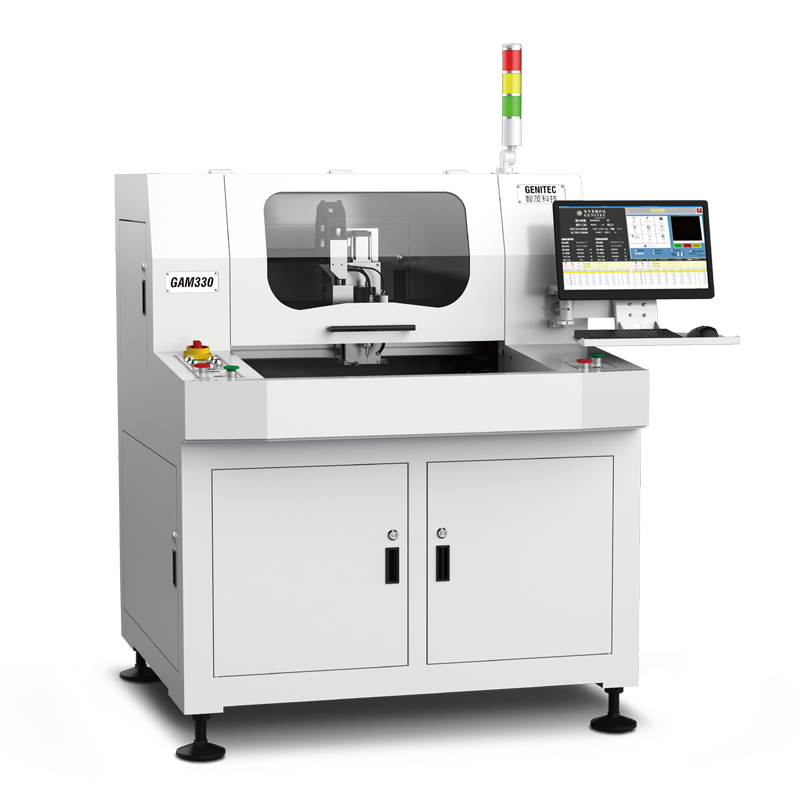
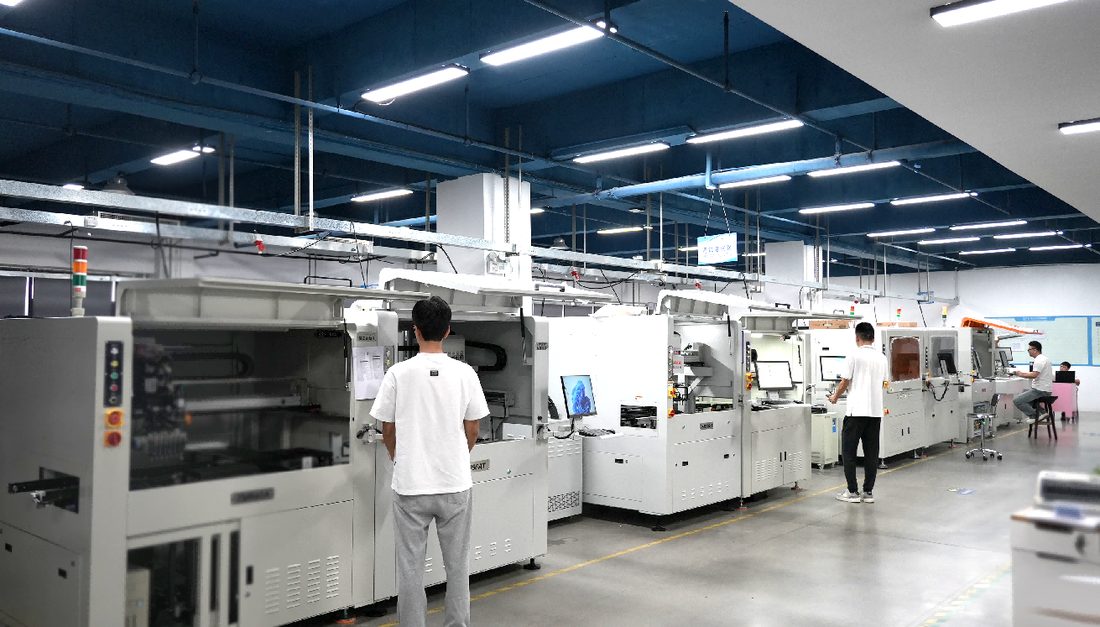
In router-based depaneling, each unit board is connected to the panel by 2–4 small tabs (mouse bites) or by a fully routed perimeter with no connecting bridge. A high-speed spindle traces the outline; the tabs cleanly shear off, leaving a smooth edge with no stress risers. Modern PCB router machines are CAM-driven and can cut any 2D outline.
Strengths of Router Depaneling
- Any outline is supported: curves, holes, internal cutouts, sharp corners
- Lower cut-edge stress than V-cut (no V-groove stress riser)
- Suitable for ceramic, flex, and very small PCBs
- Higher mechanical integrity of finished board
- Inline automation easily integrated with SMT line
Limitations of Router Depaneling
- Higher capital cost
- Bit replacement every 30K–100K cycles
- Burr formation possible if feed rate exceeds material capacity
- Cycle time per board is significantly slower than V-cut snapping
Edge Strength Comparison: A Real-World Test
In an independent test conducted by a Tier-1 EMS (cross-referenced by IPC-9194), FR-4 boards depaneled via V-cut withstood an average of 38 N of in-plane shear force before edge crack propagation began; identical boards depaneled via tab-routing with a PCB router machine withstood 71 N — roughly a 1.9× improvement in cut-edge mechanical integrity. For drop-test, vibration, and high-G shock applications (automotive, aerospace, wearables), this margin matters.
When to Pick a PCB Router Machine
- Board outline is non-rectangular — curves, internal slots, complex shapes.
- Edge strength is critical — automotive, aerospace, military, medical.
- Components sit very close to the edge — less vibration transferred.
- Volume is high enough to amortize inline router capex — typically > 50K boards/mo.
- You make frequent part-number changes — router uses CAM-only changeover.
For an inline solution that handles complex outlines and high-mix production, see the Seprays PCB router machine family.
When to Pick V-Cut Depaneling
- Boards are simple rectangles with straight depanel lines.
- Volume is moderate — V-cut’s fast snap time wins on pure throughput.
- Capital is constrained — V-cut separators start at $4,000.
- Edge strength is not the top priority — consumer-grade assemblies.
- Panels are large and through-hole dominated — V-cuts pair well with wave soldering.
Can You Combine Both? Yes.
The best depaneling decision is sometimes to use both methods on the same panel. A common pattern: V-cut across the long edges for speed, tab-routing the complex short edges for shape flexibility. The PCB sits in a custom dual-stage fixture; the V-cut press and the PCB router machine run in series, often within the same cycle. EMS facilities running 8+ part numbers per day use this hybrid layout to balance throughput and design flexibility.
Conclusion
The PCB router vs V-cut depaneling decision comes down to four simple questions: Is your outline complex? Do you need high edge strength? Is your volume high? What is your capital budget? If any answer is yes to the first two questions, choose a PCB router. If all four answers point to simple-rectangle, moderate-volume, low-budget, V-cut remains the workhorse. For most Tier-1 EMS lines, the answer is increasingly a hybrid cell — and Seprays supplies and integrates both technologies.

Frequently Asked Questions
1. Is V-cut cheaper than a PCB router machine?
Yes, in absolute capital cost. A manual V-cut separator starts around $4,000; a PCB router machine starts at $15,000 for an offline unit. The trade-off is design flexibility: V-cut only supports straight lines, while a router cuts any outline.
2. Which method gives the strongest cut edge?
Tab-routing with a PCB router machine typically delivers 1.5–2× higher edge strength than V-cut. The V-groove is a stress concentrator; routed edges are not. Choose router for automotive, aerospace, military, and medical applications.
3. Can V-cuts handle flex PCBs?
Limited — flex materials tend to stress-whiten or tear along the V-groove. Tab-routing with a PCB router machine is the more reliable choice for flex and rigid-flex depaneling.
4. Which is faster per board?
V-cut snap separation takes 1–3 seconds per board. A PCB router machine takes 10–25 seconds per board on typical outlines. However, routers scale to multi-spindle configurations that close the throughput gap in high-volume lines.
5. Can you mix V-cut and tab-routing on the same panel?
Absolutely — it is a common hybrid technique. V-cut the long straight edges and route the complex edges, then run both stations in series within the same depaneling cell.
About Seprays Precision Machinery
Founded in 1993, Seprays Precision Machinery has over 30 years of expertise in PCB depaneling solutions. With two manufacturing facilities totaling 26,000 m², 9 service centers across China, and clients in 31 countries — including Foxconn, Flex, Luxshare, Bosch, and CRRC — Seprays delivers equipment that consistently meets the demanding tolerances of automotive, medical, aerospace, and consumer electronics production lines.
Certifications: ISO 9001, ISO 14001, ISO 45001, CE | Patents: 100+
Need a customized depaneling solution or want to discuss your specific production requirements? Our technical team is ready to help.
jimmy@seprays.com · PCB Router Machine · PCB Laser Depaneling