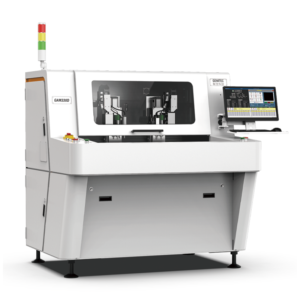

Acoustic Emission Sources in Depaneling Operations
In a
standard electronics manufacturing facility operating at 40,000 RPM spindle speed, a PCB depaneling machine generates continuous acoustic emissions in the 85-95 dB(A) range during routine routing operations. For workshops where exposure limits are capped at 80 dB(A) per OSHA 29 CFR 1910.95 or the EU Physical Agents Directive 2003/10/EC, this baseline noise level alone exceeds regulatory thresholds before accounting for ambient facility noise. The challenge, therefore, is not merely selecting a quieter machine, but understanding the acoustic signature of each depaneling technology under actual production conditions and matching those characteristics to an 8-hour time-weighted average (TWA) budget that keeps worker exposure compliant.
Routing Versus Laser Separation: Acoustic Performance Trade-Offs
PCB routing remains the most common depaneling method, typically employing high-speed spindles in the 40,000 to 60,000 RPM range. The dominant noise mechanism in routing is aerodynamic noise from blade rotation, which scales approximately with the 4.5th power of spindle RPM according to the Stefan-Boltzmann-derived blade tip velocity relationship. At 50,000 RPM with a 2.0 mm blade diameter, tip velocities reach 52 m/s, generating blade-passing frequencies between 800-1,200 Hz that are particularly intrusive to human hearing.
Laser depaneling systems, by contrast, operate fundamentally differently. A CO2 laser separation system at 10.6 μm wavelength generates acoustic emissions primarily during the kerf formation phase, with burst-type noise events of 70-78 dB(A) measured at 1 meter during individual cuts. Sustained equivalent continuous sound level (Leq) for a laser system under continuous production load typically falls 12-18 dB(A) below equivalent routing operations. However, laser systems introduce a different constraint: the thermal budget on the PCB assembly. FR-4 substrates experience heat-affected zones (HAZ) of 0.3-0.8 mm from the cut edge, and for boards with sensitive components positioned within 1.5 mm of the routing path, this thermal margin becomes the limiting selection factor, not acoustic performance.
Enclosure Design and Sound Isolation Engineering
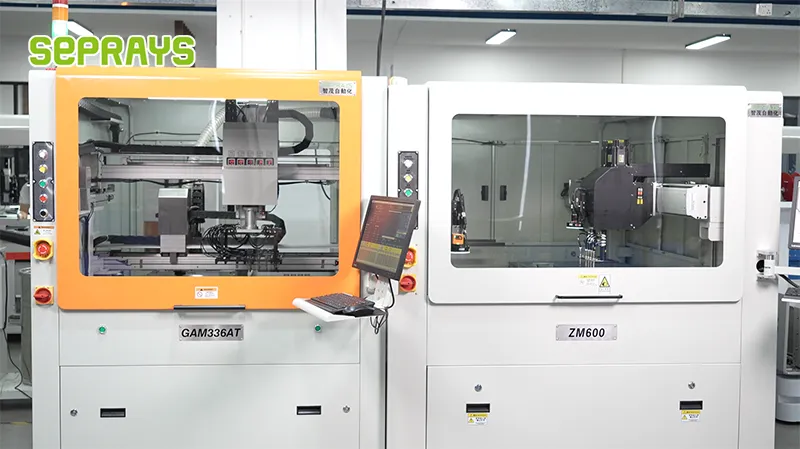
When selecting a depaneling system for a noise-constrained environment, the machine enclosure transmission loss specification is the single most critical procurement parameter. A well-engineered acoustic enclosure achieves 25-35 dB(A) insertion loss across the 500-4,000 Hz frequency band where most depaneling noise concentrates. This means a 92 dB(A) source noise level can be reduced to approximately 60-65 dB(A) at the operator position with proper enclosure design.
The enclosure transmission loss (TL) follows the mass-law relationship: TL ≈ 20 × log₁₀(f × m) − 47, where f is frequency in Hz and m is surface mass in kg/m². Double-layer steel enclosures with 1.5 mm walls and 50 mm mineral wool interlayers achieve STC-45 to STC-52 ratings, translating to practical insertion losses of 28-32 dB(A) across the speech frequency range. Perforated intake and exhaust vents require acoustic labyrinths or array-type silencers to prevent parasitic noise leakage that can reduce effective isolation by 8-12 dB(A) if left unaddressed.
Spindle Speed Optimization and Tool Life Considerations
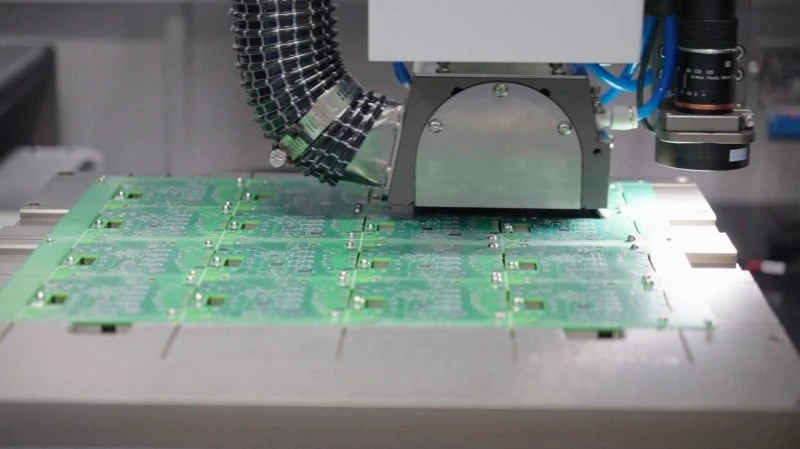
Foruv-based routing systems selected for low-noise operation, a counterintuitive trade-off emerges: reducing spindle RPM below 40,000 RPM does not proportionally reduce acoustic output due to increased cutter deflection and chatter. At 30,000 RPM, dynamic runout tolerances of ±0.015 mm on a 2.0 mm carbide router can generate lateral vibration amplitudes of 0.08-0.12 mm, producing broadband noise that peaks between 2,000-6,000 Hz—a frequency range with high A-weighted penalty.
The optimal noise-performance balance for most workshop scenarios falls in the 35,000-45,000 RPM range with spindle runout held to ±0.005 mm maximum. At this speed band with rigid collet clamping providing tool stick-out of less than 6.0 mm, the combination of reduced tip velocity and minimal deflection yields acoustic levels 6-10 dB(A) below maximum-speed operation while maintaining routing feed rates of 30-50 mm/s on 1.6 mm standard FR-4 panels. Tool life at these optimized parameters typically extends to 800-1,200 linear meters of routing per flute, compared to 400-600 meters at 60,000 RPM, providing a secondary operational benefit that partially offsets the lower throughput.
Compliance Verification and Measurement Protocol
Noise level verification for depaneling machine procurement must follow IEC 61672-1 Class 1 sound level meter specifications with octave-band or one-third-octave-band analysis capability. Measurement positions should include operator ear position (1.2 m height, 0.5 m from enclosure) and bystander positions at 1.0 m and 2.0 m distances. Per ISO 9612:2009, measurements should capture the full production cycle including tool change pauses, since automated loading and unloading events can add 3-5 dB(A) to Leq if the measurement duration is insufficient.
A complete acoustic compliance assessment requires measurement of the TWA across a full production shift, not merely peak or average levels during active cutting. For a workshop with a 78 dB(A) TWA limit, a depaneling machine generating 85 dB(A) during cutting can be acceptable if the machine operates less than 25% of the shift duration—provided the remaining ambient noise floor is controlled below 72 dB(A). This integration approach, rather than simple machine-by-machine comparison, determines whether a given depaneling technology meets the facility’s regulatory and ergonomic requirements.
Technical Summary
Selecting a low-noise depaneling machine for noise-limited workshops requires systematic evaluation across three interconnected engineering domains: the intrinsic acoustic output of the separation technology, the effectiveness of enclosure engineering in containing that output, and the optimization of operating parameters to maintain the noise-acoustic-performance equilibrium. Laser separation offers the lowest acoustic signature at 70-78 dB(A) but imposes thermal constraints on substrate selection and component proximity. Optimized spindle routing at 35,000-45,000 RPM with tight runout tolerances achieves 75-82 dB(A) with full compatibility across standard FR-4 and polyimide assemblies. Acoustic enclosures providing 28-32 dB(A) insertion loss are mandatory for routing-based systems in regulated environments, and compliance verification must account for full-shift TWA exposure rather than instantaneous cutting noise levels alone. The selection decision ultimately hinges on the thermal sensitivity of the PCB assembly, the available acoustic budget in the existing facility, and the production duty cycle that determines cumulative exposure.
Recommended Equipment
Looking for proven depaneling solutions? Seprays offers a full range of equipment backed by 30+ years of industry experience. Here are two options worth considering for your production line:
- GAM300AT Double-Layer Track Online PCB Board Separation Machine — Full-carrier process with carrier return track — built for seamless full-line automation
- GAM310A Offline Automatic Board Separator — Compact single workbench with CCD visual correction — high precision in a small footprint
Frequently Asked Questions
Q1: What noise level should we target when selecting a depaneler for a workshop adjacent to office areas or cleanrooms?
A1: Target a depaneler rated at 65 dB(A) or below at the operator position under full load. Most routing-type depanelers produce 70–85 dB(A), which exceeds the 65 dB(A) limit typical of ISO 14644 Class 7 cleanroom or mixed-use facility requirements. Laser depaneling systems generally operate below 60 dB(A) since the primary noise source is the fume extraction unit rather than the cutting mechanism itself, making them the preferred choice for noise-critical adjacencies.
Q2: Can we achieve acceptable noise levels with a router-based depaneler, or is switching to laser the only viable path?
A2: Router-based depanelers can reach 68–72 dB(A) with proper mitigation: acoustic enclosures rated for 10–15 dB attenuation, vibration-damped spindle mounts, and optimized tool paths that reduce rapid directional changes. However, even with these measures, routers typically remain 5–10 dB(A) above laser systems. If your facility mandates compliance below 65 dB(A) at 1 meter, laser depaneling is the more reliable and cost-effective long-term solution despite its higher capital cost.
Q3: How does cutting speed on a low-noise depaneler compare to a standard unit, and will it bottleneck our throughput?
A3: Low-noise depanelers using laser cutting typically achieve 80–150 mm/s feed rates on 1.6 mm FR-4, which is comparable to mid-range router systems operating at 100–200 mm/s. The throughput gap narrows further because laser systems eliminate tool-change downtime and reduce post-depaneling cleaning. For production volumes under 500 boards per shift, a laser depaneler’s throughput is generally sufficient; above that threshold, evaluate dual-head or dual-laser configurations to maintain cycle time targets.
About Seprays
About Seprays Precision Machinery
Founded in 1993, Seprays has over 30 years of expertise in PCB depaneling solutions. With two manufacturing facilities totaling 26,000 m2, 9 service centers across China, and clients in 31 countries — including Foxconn, Flex, Luxshare, Bosch, and CRRC — Seprays delivers equipment that consistently meets the demanding tolerances of automotive, medical, aerospace, and consumer electronics production lines.
Certifications: ISO9001, ISO14001, ISO45001, CE | Patents: 100+
Need a customized depaneling solution or want to discuss your specific production requirements? Our technical team is ready to help.
Contact: jimmy@seprays.com