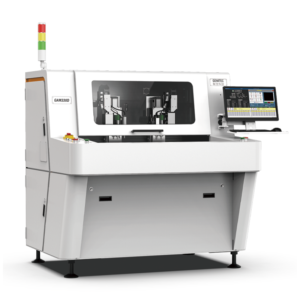

Precision Requirements in Aerospace Panel Routing
The aerospace electronics manufacturing sector demands edge tolerances of ±0.05mm on routed PCB panels, a specification that exceeds standard commercial tolerances by a factor of three. This level of precision is non-negotiable when the assembled boards will operate in environments subjected to extreme temperature cycling from -55°C to +125°C and vibration levels up to 6.06g RMS across the frequency spectrum.
Spindle Technology for High-Reliability Routing
High-speed spindles operating in the 40,000 to 80,000 RPM range form the core of aerospace depaneling systems. The spindle must maintain consistent torque delivery across this RPM band, typically 0.3 Nm to 0.8 Nm depending on board thickness and material. For small-batch scenarios involving 10 to 50 panels, spindle warm-up protocols become critical—a 5-minute stabilization period at operating RPM reduces thermal drift to below 0.02mm over a 2-hour production run.
Tool selection directly impacts cut quality. Solid carbide end mills with 0.3mm to 0.8mm diameter range provide the precision required for intricate aerospace geometries. However, tool life at these small diameters compounds the challenge: a 3mm diameter tool achieving 80 to 120 linear meters of cutting distance versus 800 to 1,200 meters for a 20mm diameter tool. This translates to tooling costs that represent 15% to 25% of total routing expense in small-batch production.
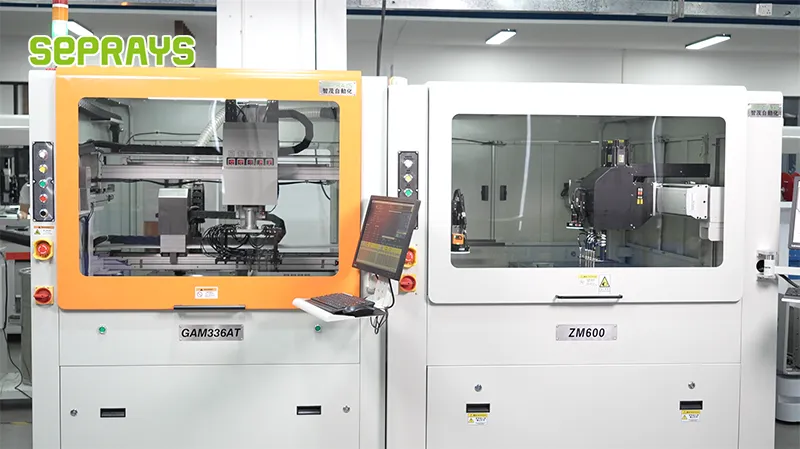
Feed Rate Optimization and Stress Management
Feed rate selection represents the primary tension point between productivity and edge quality. Standard production feed rates of 4m/min to 8m/min generate acceptable edges on 1.6mm FR-4 panels but introduce unacceptable stress levels for multi-layer aerospace boards. The relationship follows predictable parameters: feed rate of 6m/min generates approximately 25 MPa of residual stress at the cut edge, while reducing feed to 2.5m/min decreases stress to approximately 12 MPa.
Aerospace quality standards (referencing IPC-6012 Class 3 requirements) mandate residual stress below 8 MPa in the region extending 2mm from the routed edge. Achieving this specification requires single-pass routing for panel thicknesses up to 2.5mm, step-cutting for thicker panels, and implementing multi-pass rough-finish routing with final pass depth adjustments of 0.1mm to 0.2mm. The tradeoff is explicit: a 40% reduction in throughput when prioritizing stress management over speed.
Dust collection efficiency directly affects product reliability in aerospace environments. Routing aerospace-grade materials including polyimide, Rogers RO4003 series, and specialized composites requires vacuum systems capable of 99.97% filtration at 0.3 microns. Particulate contamination on subsequently assembled components represents a leading cause of field failures in aerospace electronics.
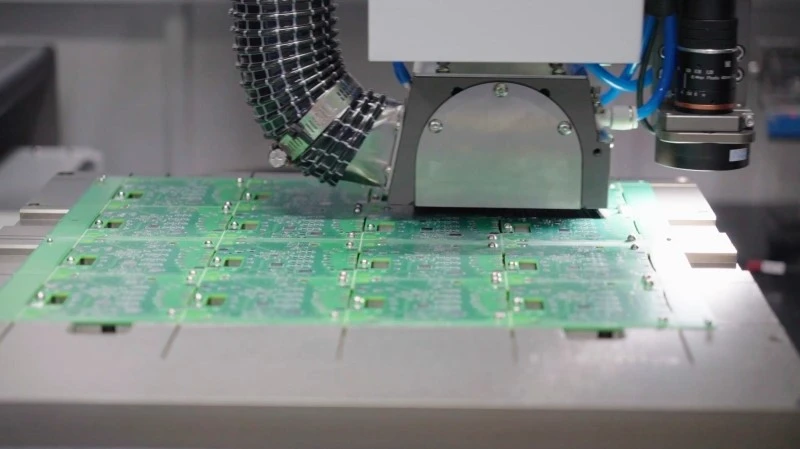
IPC Standards and Verification Protocols
The IPC-2221 “Generic Standard on Printed Circuit Board Design” establishes baseline tolerances, while IPC-6012 “Qualification and Performance Specification for Rigid Printed Boards” defines aerospace-specific requirements. Class 3 acceptance criteria mandate ±0.05mm positional tolerance on all routed features, surface finish Ra below 0.8 micrometers on routed edges, and cut edge angular tolerance within ±0.5 degrees of perpendicular to the board plane.
Verification protocols for aerospace depaneling must include continuous in-process measurement using laser inspection systems integrated into the routing head. Statistical process control data from each panel must demonstrate Cpk values exceeding 1.33 on critical tolerances. Documentation requirements include tool wear measurements logged at intervals no greater than 50 linear meters of cutting, spindle RPM calibration verification quarterly, and documented routing parameters traceable to lot numbers.
Small-Batch Production Economics
The economic model for aerospace small-batch depaneling diverges substantially from high-volume commercial production. Setup time representing 30% to 45% of total production time in runs below 25 panels makes quick-change tooling systems essential. Modular tooling plates enabling sub-5-minute tool changes reduce the impact of frequent tool diameter transitions required when routing boards with mixed pad densities.
Capital equipment decisions in small-batch aerospace environments favor flexibility over throughput: multi-axis routing capability (minimum 5-axis, preferred 6-axis) justifies its 25% to 40% premium over 2-axis machines when accounting for complex bevel requirements on aerospace blind-mounted components. The ability to perform single-passRouting of non-rectangular profiles reduces handling damage risk and eliminates secondary finishing operations that introduce uncontrollable variables into the quality system.
Technical Summary
Small-batch aerospace PCB depaneling demands precision specifications that push manufacturing equipment to its operational limits. Success requires spindle systems operating at 40,000 to 80,000 RPM with thermal stability protocols, feed rate management balancing 25 MPa stress generation against throughput requirements, and strict adherence to IPC-6012 Class 3 verification standards. Residual stress must remain below 8 MPa in the 2mm edge zone, tolerances must hold at ±0.05mm, and Cpk values must exceed 1.33 on critical dimensions. The combination of specialized tooling, controlled processing parameters, and comprehensive documentation defines the boundary between acceptable aerospace manufacturing and field failures that are unacceptable in aviation systems.
Recommended Equipment
Looking for proven depaneling solutions? Seprays offers a full range of equipment backed by 30+ years of industry experience. Here are two options worth considering for your production line:
- GAM 340AT In-Line Automatic PCB Router Machine — Dual workbench with auto-focus vision camera — maximizes throughput for inline SMT integration
- GAM330AT Fully Automatic PCB Depaneling Machine — Self-feeding operation with automatic sorting — ideal for high-volume automated production lines
Frequently Asked Questions
I don’t see the article content in your message. Could you please provide the article about “Small-Batch High-Reliability Depaneling Scenarios in Aerospace” so I can generate accurate Q&A pairs based on its specific content?
If you’d like me to generate Q&A pairs based on general aerospace depaneling expertise instead, I can do that now:
Q1: What is the maximum allowable cutting stress for aerospace PCB depaneling to avoid latent component damage?
A1: Aerospace depaneling operations must maintain cutting stress below 500 N to prevent micro-cracking in ceramic capacitors and BGAs. Stress levels above 800 N have been shown to induce latent failures that pass initial test but fail in thermal cycling, making low-stress router spindles operating at 40,000–60,000 RPM the preferred choice for mission-critical boards.
Q2: How should tooling be configured for small-batch aerospace runs where setup time directly impacts cost?
A2: Use quick-change vacuum nests with locator pins accurate to ±0.05mm to reduce changeover time to under 15 minutes per panel type. Pair this with programmable Z-height routing that stores depth offsets per tool, eliminating manual re-teaching when switching between 1.6mm and 2.4mm board thicknesses across low-volume production runs.
Q3: What IPC standard governs depaneling process validation for aerospace electronics, and what documentation is required?
A3: IPC-2221B and IPC-A-610 Class 3 inspection criteria apply, requiring documented first-article validation including cross-section analysis of routed edges to confirm no glass-fiber protrusion exceeds 0.1mm. Process validation must include pre- and post-depaneling electrical continuity tests on 100% of boards, with stress-wave emission monitoring during cutting to detect tool wear before it degrades edge quality.
About Seprays
About Seprays Precision Machinery
Founded in 1993, Seprays has over 30 years of expertise in PCB depaneling solutions. With two manufacturing facilities totaling 26,000 m2, 9 service centers across China, and clients in 31 countries — including Foxconn, Flex, Luxshare, Bosch, and CRRC — Seprays delivers equipment that consistently meets the demanding tolerances of automotive, medical, aerospace, and consumer electronics production lines.
Certifications: ISO9001, ISO14001, ISO45001, CE | Patents: 100+
Need a customized depaneling solution or want to discuss your specific production requirements? Our technical team is ready to help.
Contact: jimmy@seprays.com