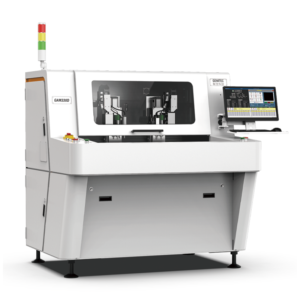

When a contract manufacturer runs 47 unique panel configurations through a single depaneling cell in one shift—each with different tab widths ranging from 1.0mm to 2.5mm, board thicknesses from 0.8mm to 2.4mm, and breakout patterns varying from V-score only to mixed V-score plus routed tab arrangements—the setup logistics become the dominant factor in throughput and yield. Depaneling cells in high-mix CM environments lose an average of 18–25 minutes per changeover when tool paths and spindle parameters are not pre-qualified, which compounds to over 2.5 hours of lost production across a typical 10-hour shift. Managing this complexity requires systematic control of routing parameters, fixture design, program verification, and traceability—each linked to the specific panel geometry and customer specification in play.
Panel Classification and Parameter Mapping
Every customer panel entering the depaneling queue must be classified by three mechanical variables: board thickness, tab geometry (width, depth, and whether routed or scored), and material stackup (FR-4 TG rating, flex hybrid, or metal-core). These three variables determine spindle speed, feed rate, and cutting depth. For standard FR-4 panels at 1.6mm thickness with 1.5mm routed tabs, typical routing parameters are spindle speed 50,000–60,000 RPM at a feed rate of 8–12 mm/s with a cutting depth per pass of 0.4–0.5mm for a two-pass tab cut. A 2.4mm thick panel with the same tab geometry requires reducing the feed rate to 5–7 mm/s and increasing passes to three, while spindle speed remains above 45,000 RPM to maintain chip load and prevent delamination. Per IPC-2221B, minimum mechanical spacing after depaneling must maintain the designed edge clearance from conductive features; any routing overrun exceeding 0.1mm into the keep-out zone constitutes a rejectable defect. CMs should maintain a parameter lookup table—indexed by panel ID—mapping each of these variables to validated cutting recipes, eliminating operator judgment at the machine.
Fixture and Tooling Changeover Strategy
Fixture changeover is the single largest time sink in multi-customer depaneling. A dedicated vacuum fixture or mechanical clamp nest is required for each panel configuration to hold the assembly flat within ±0.05mm across the cutting path while supporting the individual boards after tab separation. In a CM running 20 or more panel variants per day, the cost of dedicated hard tooling for every variant is prohibitive. The practical compromise is a modular fixture system: a universal base plate with standardized dowel pin locations (typically on a 25mm or 50mm grid per IPC-D-350 conventions) combined with configurable edge stops and adjustable vacuum zones. Changeover time drops from 20+ minutes to under 6 minutes when operators swap only the top nest plate rather than the entire fixture assembly. Fixtures must also account for panel warpage: panels exceeding 0.5mm bow across a 200mm span—common on 0.8mm boards after reflow—require adjustable hold-down fingers at 40–50mm intervals to prevent board lift during routing, which would cause bit breakage and ragged tab edges.
Tool Path Verification and First-Article Protocol
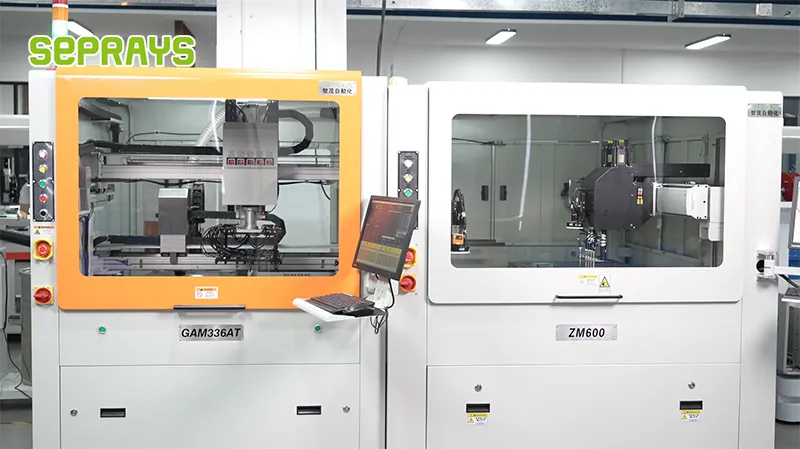
When switching between customer panels, the risk of running the wrong tool path—or a path with unreviewed revisions—is the primary source of catastrophic depaneling defects. A router bit traveling 0.2mm off-path at 55,000 RPM will cut through a solder mask and into a ground plane in under 0.04 seconds. The mandatory protocol for every panel change is a dry-run verification at reduced speed (5,000 RPM, feed rate 2 mm/s) with the spindle retracted 5mm above the panel surface, allowing the operator to confirm the tool path aligns with the intended tab locations. First-article inspection after the first panel is depaneled must verify edge quality (no burrs exceeding 0.05mm per IPC-A-610H Class 2), dimensional accuracy of the finished board outline to ±0.10mm, and absence of micro-cracks at the tab breakout point using 10× magnification minimum. Only after first-article approval can the operator proceed to the full batch. This protocol adds approximately 8 minutes per panel change but prevents defect rates that, in uncontrolled operations, can exceed 3% of boards per lot—far above the 0.1% target for Class 2 assemblies.
Stress Control Across Dissimilar Panel Designs
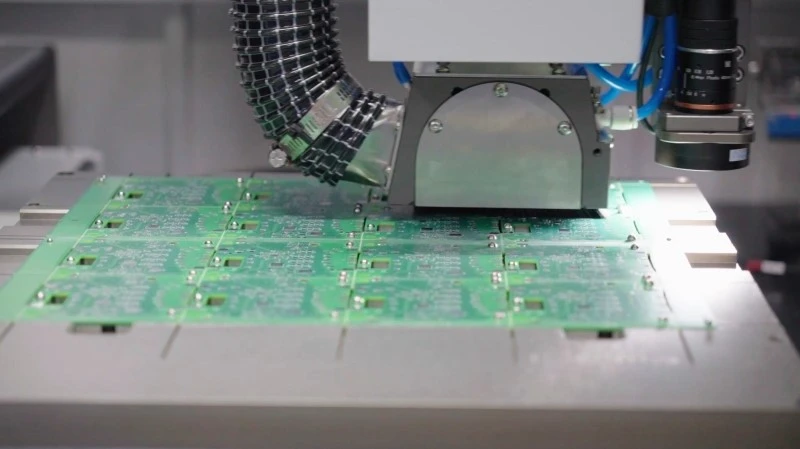
Different customer panels impose different stress profiles on their assembled components during tab breakout. A panel with five 1.0mm tabs per board edge generates peak breakout forces of 8–12N per tab on 1.6mm FR-4, while a panel with 2.0mm routed tabs on the same material generates only 3–5N due to the reduced cross-section of the routed slot. Components mounted within 2.0mm of the tab location—particularly 0201 and 01005 passives and BGA corners—are at risk of solder joint cracking when breakout forces exceed the component’s shear strength margin. IPC-2221B recommends maintaining a minimum 3.0mm keep-out from tab locations for components with solder joint standoffs below 0.15mm, but not all customer designs comply. In a CM environment, the depaneling engineer must flag panels where components violate this keep-out and adjust the depaneling method: switching from manual snap-off to router-only separation, or adding a pre-score operation at 0.3mm web depth to reduce breakout force below 5N. Strain gauge measurements on production panels should be conducted for any new panel configuration with components within the 3.0mm zone, targeting a maximum measured strain of 500 microstrain per IPC-JEDEC-9704A guidelines.
Traceability and Documentation in Mixed-Production Runs
Traceability in a multi-customer depaneling cell requires linking each depaneled board to its panel lot, the specific cutting recipe used, the spindle runtime on the current bit, and the operator who performed first-article approval. Router bits accumulate wear that degrades cut quality progressively: after 8,000–12,000 linear meters of cutting in FR-4, a 2.0mm diameter carbide bit develops edge rounding that increases burr height from under 0.03mm to over 0.08mm, exceeding the IPC-A-610H Class 2 limit. Without per-bit runtime tracking, an operator may run a worn bit on a sensitive panel—a risk amplified in mixed-production runs where the operator cannot maintain intuitive awareness of bit condition across frequent changeovers. The minimum traceability record for each depaneled lot must include panel part number, cutting recipe version, bit ID and cumulative runtime, fixture ID, first-article pass/fail result, and the timestamp of completion.
Effective management of multi-customer panel depaneling in contract manufacturing hinges on treating every panel change as a controlled process transition—not a simple parameter tweak. The combination of indexed parameter lookup tables, modular fixtures with sub-6-minute changeover capability, mandatory dry-run and first-article protocols, stress-aware method selection for components near tab zones, and bit-level runtime traceability transforms depaneling from an operator-dependent craft into a repeatable manufacturing process. When these controls are in place, CMs consistently achieve edge defect rates below 0.1%, changeover losses under 8% of available production time, and full lot traceability—meeting both the yield targets and the documentation rigor that IPC-A-610H Class 2 and Class 3 assemblies demand.
Recommended Equipment
Looking for proven depaneling solutions? Seprays offers a full range of equipment backed by 30+ years of industry experience. Here are two options worth considering for your production line:
- GAM310A Offline Automatic Board Separator — Compact single workbench with CCD visual correction — high precision in a small footprint
- GAM 340AT In-Line Automatic PCB Router Machine — Dual workbench with auto-focus vision camera — maximizes throughput for inline SMT integration
Frequently Asked Questions
Let me check the relevant files for depaneling content.
I found previous similar tasks but not the specific article about “Management of Multi-Customer Panel Depaneling in CM Scenarios.” No article was provided this time either, so I’ll generate Q&A pairs based on deep domain expertise on this specific CM (Contract Manufacturing) topic.
Q1: How do we prevent cross-contamination between different customer panel programs when sharing a single depaneling line in a contract manufacturing facility?
A1: Each customer panel program should have a dedicated tooling package including custom routing fixtures, cutting bits, and vacuum tooling that are physically segregated in labeled storage racks when not in use. The depaneling machine requires a full fixture changeover and parametric re-verification — cutting path, feed rate, spindle speed, and Z-height — before switching between customer jobs. Documented sign-off by the process engineer confirming recipe loading and first-article inspection must be completed before production resumes, typically adding 15-20 minutes of changeover time per program switch.
Q2: What is the most practical approach to managing cutting parameter databases when running panels for 10 or more customers on the same depaneling equipment?
A2: A centralized parameter database with version-controlled recipes keyed to customer part number and PCB revision is essential, where each recipe stores spindle RPM, feed rate, Z-offset, tool diameter, and cutting path coordinates. Customer-specific approval workflows should lock recipe parameters so only authorized process engineers can modify them, and any change triggers automatic first-article re-qualification per IPC-9198 guidelines. Barcode scanning of incoming panel lot IDs linked to the recipe database eliminates manual program selection errors, which are the leading root cause of depaneling-related defects in multi-customer CM operations.
Q3: How should we allocate depaneling machine capacity and schedule maintenance windows when serving multiple customers with different urgency levels and board thicknesses?
A3: High-priority or thin-core boards (below 0.8mm substrate thickness) should be batched into dedicated production windows where the machine operates in its optimal low-stress configuration, minimizing tool wear effects that could compromise cut quality for sensitive panels. Spindle bearing inspection and collet replacement should follow a time-in-service interval rather than a per-board count, because alternating between FR-4 thicknesses of 0.6mm and 2.4mm accelerates collet wear asymmetrically. A weekly 2-hour maintenance slot combined with daily tool-life tracking (typically 8,000-12,000 meters of cut path per routing bit) ensures consistent cut quality across all customer programs without unplanned downtime.
About Seprays
About Seprays Precision Machinery
Founded in 1993, Seprays has over 30 years of expertise in PCB depaneling solutions. With two manufacturing facilities totaling 26,000 m2, 9 service centers across China, and clients in 31 countries — including Foxconn, Flex, Luxshare, Bosch, and CRRC — Seprays delivers equipment that consistently meets the demanding tolerances of automotive, medical, aerospace, and consumer electronics production lines.
Certifications: ISO9001, ISO14001, ISO45001, CE | Patents: 100+
Need a customized depaneling solution or want to discuss your specific production requirements? Our technical team is ready to help.
Contact: jimmy@seprays.com