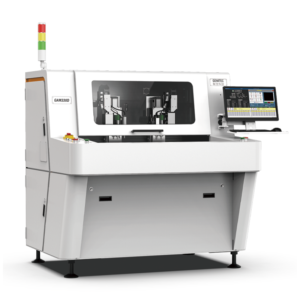

At spindle speeds exceeding 60,000 RPM, inline PCB routers consistently achieve depaneling stress levels below 350 µε (microstrain) as measured by strain gauge testing per IPC-9701, while offline manual loading systems typically exhibit 500-800 µε due to inconsistent fixturing and feed rate variation. This 40-60% reduction in mechanical stress directly correlates with PCBA failure rates in thermal cycling tests, where excessive depaneling stress induces solder joint microcracking that standard visual inspection cannot detect.
Stress Generation and Mechanical Integrity
The fundamental difference between inline and offline depaneling lies in stress controllability during the routing process. Inline systems utilize servo-driven XY stages with positioning repeatability of ±0.02mm, maintaining consistent feed rates between 8-15 mm/s depending on PCB thickness and bit diameter. Stress generation in FR-4 substrates follows a predictable relationship with feed rate and spindle speed: at 60,000 RPM with a 2.0mm router bit, feed rates above 20 mm/s generate cutting forces exceeding 2.5N, pushing PCB strain beyond the 500 µε threshold identified in IPC-9701 Annex A for reliable board operation.
Offline systems present unavoidable stress variability due to manual PCB loading. Fixture repeatability in offline setups typically falls within ±0.1mm, causing the router bit to deviate from the programmed tool path by up to 0.15mm in worst-case misalignment. This deviation forces the spindle to compensate by increasing lateral cutting forces, which transfers additional mechanical stress into mounted components. Components with lower standoff heights—specifically BGAs and LGAs with <0.5mm clearance—exhibit significantly higher failure rates when depaneled on offline equipment due to this uncontrolled stress transmission.
Inline systems mitigate this through programmable feed rate profiling. The controller reduces feed rate to 3-5 mm/s when approaching component keep-out zones (defined as 3mm from SMT devices per typical IPC-7351 land pattern guidelines), then resumes full speed in unpopulated board areas. This dynamic feed control is not practically achievable in offline systems where the operator manually controls feed advancement via joystick or pendant.
Throughput Capacity and Cycle Time Analysis
Cycle time differentiation between inline and offline depaneling is substantial and measurable. A dual-spindle inline router processing a standard 1.6mm thick FR-4 multi-array panel (300mm × 250mm with 12 individual PCBs) completes the depaneling cycle in 38-45 seconds including load/unload time, achieving throughput of approximately 960-1,100 boards per hour. This calculation assumes 2.5 seconds per cut length of 200mm average and simultaneous routing of two board arrays in the dual-spindle configuration.
Offline systems require 90-140 seconds per panel depending on operator skill level and panel complexity. The manual loading process alone consumes 15-25 seconds per panel, followed by program selection, vision alignment (typically 3-5 seconds for CCD-based offline systems), routing execution, and manual unloading. Real-world throughput for offline systems averages 280-350 boards per hour—a 65-70% reduction compared to inline throughput.
The throughput gap widens when considering panel size and layer count. High-density panels with complex routing contours (curved cutouts, internal cutouts, or multi-segment separation) amplify the inline advantage because CNC path optimization algorithms reduce air-cutting time between routing segments. Offline systems cannot match this optimization because the rigid mechanical fixture design limits panel orientation options, forcing longer tool paths.
Changeover time represents another critical differentiator. Inline systems with automatic tool changers (ATC) accommodate up to 4 router bit sizes and complete bit changes in 8-12 seconds. Program changeover between panel types requires 30-45 seconds including vision system recalibration. Offline systems typically require 10-15 minutes for mechanical fixture changeover plus 3-5 minutes for program loading, creating substantial downtime in high-mix production environments.
Dimensional Accuracy and Repeatability
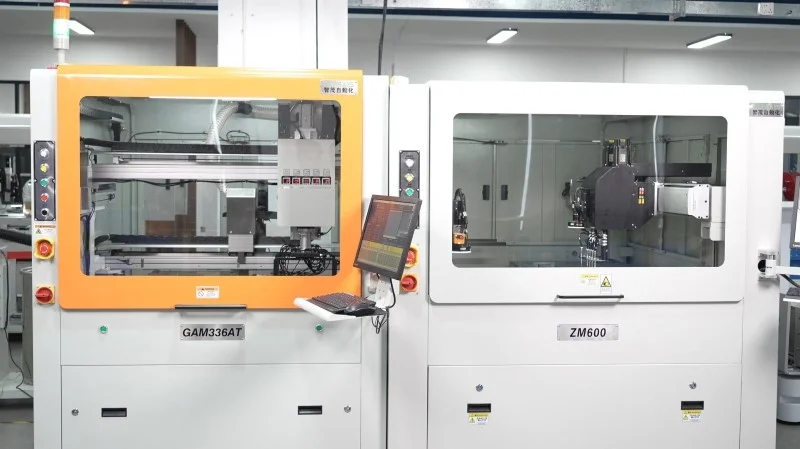
Precision requirements in modern PCB depaneling are driven by miniaturization trends—specifically the proliferation of 01005 passive components and 0.4mm pitch BGAs that cannot tolerate depaneling-induced board flexure. Inline routers achieve cut lane positioning accuracy of ±0.05mm through glass scale linear encoders on X and Y axes, with thermal compensation algorithms correcting for spindle heat expansion during continuous operation.
The Z-axis accuracy is equally critical. Inline systems maintain routing depth within ±0.03mm of the programmed value using force-feedback control: the spindle detects increased cutting resistance when the bit contacts the backing material (typically aluminum or phenolic backing board) and automatically retracts. This prevents both incomplete cutting (bit stops above the panel bottom surface) and backing board damage (excessive bit penetration).
Offline systems lack this level of Z-axis control. The routing depth is set mechanically via limit switches or manual Z-axis positioning, with typical accuracy of ±0.15mm. In production environments where panel thickness varies by ±0.1mm due to prepreg resin content variation, this accuracy limitation causes either incomplete separation (requiring secondary manual breaking that introduces uncontrolled stress) or excessive backing board wear that transfers cutting stress back into the PCB.
Vision system capabilities further differentiate the two approaches. Inline systems employ 5-megapixel CCD cameras with telecentric lenses, achieving fiducial recognition accuracy of ±0.01mm. The vision system compensates for panel warpage up to 3mm across the panel width by generating a 3D mapping of the panel surface and adjusting the tool path in real time. Offline vision systems typically use 2-megapixel cameras without telecentric optics, limiting fiducial accuracy to ±0.05mm and providing no warpage compensation capability.
Production Integration and Workflow Considerations
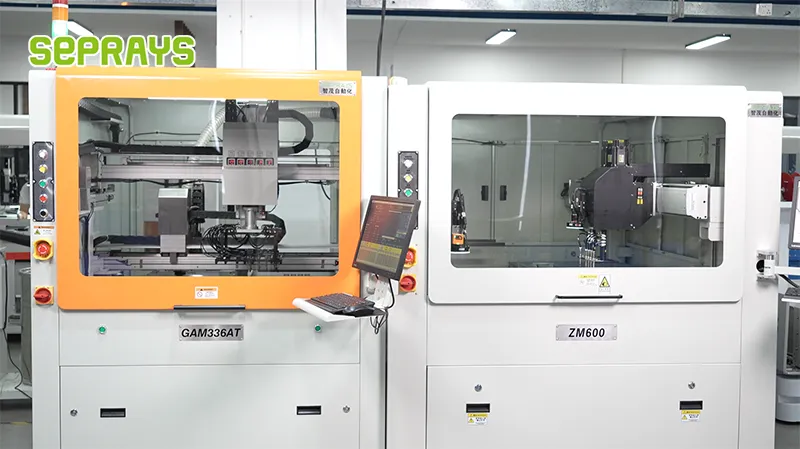
Integration with upstream and downstream processes determines the real-world effectiveness of the depaneling strategy. Inline routers interface directly with SMT production lines via SMEMA-compatible conveyor systems, receiving panels from the reflow oven outlet and delivering separated PCBs to the functional test station. The handshake protocol ensures that panel flow never stops: when the inline router buffer reaches capacity (typically 3-5 panels), it signals upstream equipment to hold; when the buffer empties, it requests the next panel within 2-3 seconds.
This integration eliminates work-in-process (WIP) accumulation between process steps. In a typical SMT line with 15-second cycle time, an offline depaneling station creates a WIP bottleneck because the manual loading process cannot match the continuous flow. Production data from high-volume SMT facilities shows that offline depaneling reduces overall line utilization by 18-24% due to this WIP accumulation and the inherent variability in manual handling time.
Cleanliness requirements add another dimension. Inline systems incorporate integrated dust extraction with HEPA filtration rated at 99.97% efficiency for particles ≥0.3μm, maintaining ISO Class 7 (Class 10,000) cleanliness in the depaneling area. The extraction nozzle follows the spindle position dynamically, capturing >95% of generated FR-4 dust at the source. Offline systems rely on fixed extraction hoods with static positioning, capturing 60-75% of dust by weight and allowing fine conductive debris to settle on nearby PCB surfaces—a contamination vector that contributes to field failure rates in humidity-exposed electronics.
Technical Summary
The selection between inline and offline PCB depaneling must be governed by measurable production requirements: inline systems deliver superior stress control (<350 µε), higher throughput (960-1,100 boards/hour), and precision positioning (±0.05mm) suitable for high-density SMT assemblies with 01005 components or fine-pitch BGAs, while offline systems remain viable for low-mix production with tolerant component layouts where 280-350 boards/hour throughput and ±0.15mm accuracy meet acceptance criteria. The 65-70% throughput advantage of inline depaneling, combined with integrated dust extraction and SMEMA line integration, justifies the capital expenditure in high-volume SMT environments where WIP reduction and process repeatability directly impact first-pass yield targets per IPC-A-610 acceptance classes.
Recommended Equipment
Looking for proven depaneling solutions? Seprays offers a full range of equipment backed by 30+ years of industry experience. Here are two options worth considering for your production line:
- GAM 340AT In-Line Automatic PCB Router Machine — Dual workbench with auto-focus vision camera — maximizes throughput for inline SMT integration
- PCB/FPC Stamping Type Board Separation Machine — Handles PCB, FPC flexible, and rigid-flex boards — versatile stamping depaneling solution
Frequently Asked Questions
I don’t see the article “Inline vs Offline PCB Routers: A Decision-Maker’s Comparison Guide” in our conversation context. To generate accurate Q&A pairs grounded in that specific article’s content, I need you to provide the article text.
Could you please paste the article content, or let me know where I can find it? Once I have the article, I’ll generate exactly 3 practical Q&A pairs in the HTML format you specified.
About Seprays
About Seprays Precision Machinery
Founded in 1993, Seprays has over 30 years of expertise in PCB depaneling solutions. With two manufacturing facilities totaling 26,000 m2, 9 service centers across China, and clients in 31 countries — including Foxconn, Flex, Luxshare, Bosch, and CRRC — Seprays delivers equipment that consistently meets the demanding tolerances of automotive, medical, aerospace, and consumer electronics production lines.
Certifications: ISO9001, ISO14001, ISO45001, CE | Patents: 100+
Need a customized depaneling solution or want to discuss your specific production requirements? Our technical team is ready to help.
Contact: jimmy@seprays.com