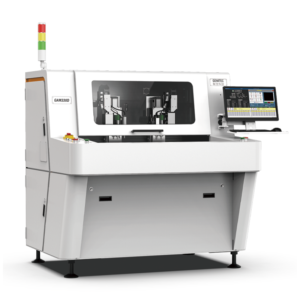

A depaneling machine producing 1,200 boards per hour on a high-mix SMT line generates approximately $8,400 per hour in board value at a typical 85% yield — which means a 4-hour downtime event due to router bit breakage or spindle bearing failure costs over $33,000 in lost production, before accounting for expedite fees on replacement components or overtime labor for manual routing. When the spindle operates at 60,000 RPM with a runout tolerance of ±0.02 mm, even a 0.05 mm deviation in the depaneling path requires immediate supplier intervention to prevent cumulative stress exceeding 600 microstrain across the PCB v-score line, a threshold at which component-side capacitor cracking becomes statistically significant according to IPC-9701 vibration test criteria.
Response Time Metrics and Remote Diagnostic Accessibility
After-sales service evaluation begins with quantifying the supplier’s mean time to respond (MTTR) to a Level 1 spindle fault, measured from the moment the machine’s vibration sensor exceeds 2.5 mm/s RMS to the initiation of a remote diagnostic session. A technically competent supplier provides 24/7 access to a secure VPN tunnel into the depaneling machine’s PLC, allowing real-time interrogation of servo axis positioning data at 0.01 mm resolution without requiring an on-site visit. The diagnostic software should log feed rate deviations exceeding ±5% of the programmed 150 mm/s rate, spindle load current spikes above 3.5 A (indicating imbalanced tooling or bearing preload loss), and linear encoder feedback errors that exceed the Heidenhain or Renishaw scale’s 0.1 μm repeatability specification. Suppliers who cannot provide a guaranteed 2-hour remote response window for critical faults — defined as any alarm that stops production for more than 30 minutes — introduce unacceptable risk into a line cycling 40 panels per hour. The service contract must specify penalty clauses for response time breaches, calibrated against the €2,800 per hour average cost of idle SMT placement equipment waiting on a single depaneling station.
Spare Parts Inventory Depth and Critical Component Lead Times
Spindle replacement on a depaneling router rated for 80,000 RPM requires a matched pair of hybrid ceramic bearings (typically ABEC-7 grade) and a dynamically balanced collet (G2.5 balance grade at 15,000 RPM), components that have a standard lead time of 6-8 weeks when sourced from European or Japanese bearing manufacturers. A supplier’s local parts depot must stock at a minimum: 2x complete spindle cartridges, 10x router bits per tool diameter from 0.8 mm to 2.0 mm (coated with DLC or diamond for FR-4 and aluminum-backed PCBs), 1x set of X/Y/Z axis linear guides (Hiwin or THK, 15 mm or 20 mm profile rail), and 2x servo drive modules rated for the 400 W to 750 W motors used in the depaneling axes. The parts availability metric that matters is not “percentage of parts in stock” but rather “lead time to ship critical path components” — any supplier requiring more than 72 hours to deliver a replacement spindle or 48 hours for a router bit of standard geometry fails the evaluation for high-volume production environments. Request the supplier’s spare parts price list and cross-reference 10 randomly selected part numbers against their online ordering system to verify claimed inventory depths; suppliers with fewer than 85% of high-wear items (router bits, dust extraction brushes, vacuum table seals) available for next-day shipment lack the supply chain maturity required for production-critical equipment.
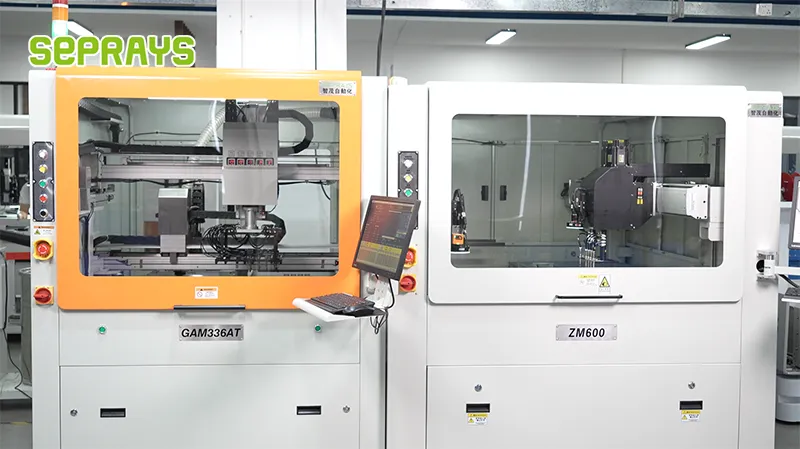
Calibration Services and Stress Validation Capabilities
Quarterly calibration of the depaneling machine must verify that the robot-mounted router or saw blade maintains ±0.05 mm positioning accuracy across a 500 mm × 500 mm depaneling area, tested using a laser interferometer (Renishaw XL-80 or equivalent) capable of 0.5 ppm linear accuracy. The supplier’s service technicians must demonstrate proficiency in measuring residual stress in the PCB after the depaneling cut, using either a pre-calibrated strain gauge rosette (with 350 Ω resistance and 2.1 strain factor) or a Schaevitz LVDT displacement sensor to detect board bow of more than 0.3 mm across a 100 mm span — a condition that indicates excessive cutting force above the 15 N threshold specified in IPC-2221B for stress-sensitive assemblies. A technically capable supplier provides a calibrated cutting stress test report with each preventive maintenance visit, documenting the peak force measured by a Kistler dynamometer during a representative depaneling operation and comparing it against the 10 N/mm feed force limit for 1.6 mm thick FR-4 with 1.0 mm remaining web thickness after V-scoring. If the supplier cannot produce a NIST-traceable calibration certificate for their measurement equipment (with calibration dates within the previous 12 months), their claimed positioning tolerances are unverified and should be treated as marketing specifications rather than manufacturing commitments.
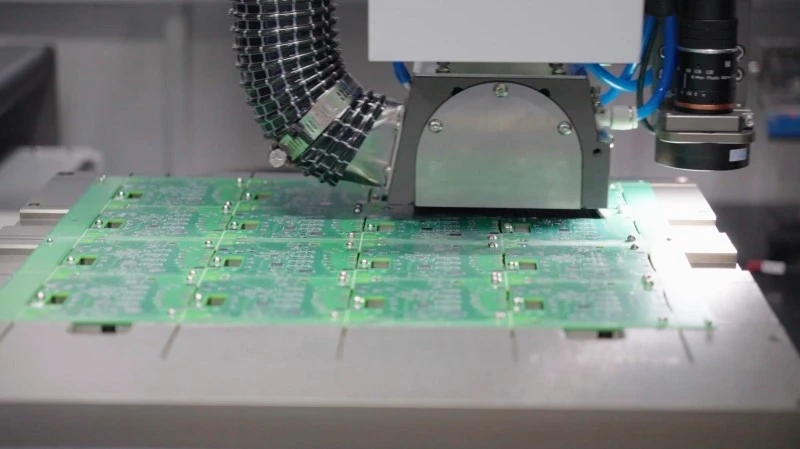
Field Service Technical Competency and IPC Standards Compliance
The supplier’s field service engineers must hold active certifications in IPC-A-610 (Acceptability of Electronic Assemblies) and IPC-7711/7721 (Rework, Modification, and Repair of Electronic Assemblies), with documented training on the specific depaneling stress thresholds that cause barrel crack defects in plated through-holes. During the on-site evaluation, the service technician should be able to configure the depaneling machine’s feed rate (typically 50-200 mm/s for routing, 300-500 mm/s for sawing) and spindle speed (40,000-80,000 RPM range) to achieve a surface roughness Ra < 3.2 μm on the cut edge, verified using a Mitutoyo SJ-210 surface roughness tester. The technician must also demonstrate the ability to program the machine's software to compensate for tool wear — a 0.8 mm router bit loses approximately 0.02 mm diameter per 500 millimeters of cut length in FR-4 material, requiring automatic tool offset adjustment to maintain the ±0.1 mm depaneling tolerance. Request the supplier's service technician training syllabus and verify that it includes hands-on troubleshooting of servo following errors, spindle warm-up routines (required to achieve bearing preload stability within ±1 µm), and dust extraction system balancing (maintaining -12 mbar vacuum at the cutting head to prevent conductive dust migration onto the PCB surface).
Remote Monitoring Integration and Predictive Maintenance Capability
Modern depaneling machines generate approximately 2.5 MB per hour of telemetry data, including spindle vibration spectra (FFT analysis up to 10 kHz), servo motor temperature (monitored via Pt100 sensors with ±0.5°C accuracy), and pneumatic pressure in the board clamping system (maintained at 6.0 bar ±0.2 bar for warp-resistant clamping). A supplier with mature after-sales capability provides an MQTT or OPC-UA interface that streams this data to the factory’s MES, enabling predictive maintenance algorithms to detect spindle bearing degradation 200-400 operating hours before catastrophic failure — identified by a 3× increase in vibration amplitude at the bearing’s characteristic defect frequency (typically 5-7× RPM for inner race defects). The supplier must provide the data dictionary for all telemetry points, with engineering units, expected ranges, and alarm thresholds documented to IPC-9798 Section 7.2 requirements for machine health monitoring. Suppliers who lock telemetry data behind a proprietary cloud platform (preventing local data logging at 1-second resolution) create a single point of failure in the maintenance workflow and should be disqualified from consideration for Industry 4.0-ready production lines. The after-sales evaluation must confirm that the supplier’s remote monitoring system complies with the facility’s cybersecurity requirements, including support for TLS 1.3 encryption on all data streams and role-based access control for the 15-20 parameter dashboards used by maintenance technicians.
Technical Summary
Evaluating after-sales service capability for PCB depaneling equipment requires quantifying five measurable dimensions: remote diagnostic response time (target <2 hours for critical faults), spare parts lead time for critical components (target <72 hours for spindles, <48 hours for tooling), calibration accuracy validated by NIST-traceable equipment (±0.05 mm positioning, <600 microstrain cutting stress), field service technician IPC certification and tool wear compensation programming skills, and telemetry data accessibility for predictive maintenance (2.5 MB/hour streaming at 1-second resolution). A supplier meeting all five criteria reduces unplanned downtime from the industry average of 4.2% to less than 1.5% annually on high-mix SMT lines producing 500,000 to 2,000,000 depaneled boards per year, a reduction that recovers $127,000 to $510,000 in annual production value for a typical mid-volume electronics manufacturing facility operating 6,000 annual production hours.
Recommended Equipment
Looking for proven depaneling solutions? Seprays offers a full range of equipment backed by 30+ years of industry experience. Here are two options worth considering for your production line:
- GAM310A Offline Automatic Board Separator — Compact single workbench with CCD visual correction — high precision in a small footprint
- PCB/FPC Stamping Type Board Separation Machine — Handles PCB, FPC flexible, and rigid-flex boards — versatile stamping depaneling solution
Frequently Asked Questions
Q1: What is the acceptable response time for technical support when our PCB depanelizer goes down during a production run?
A1: For production-critical equipment, demand a service level agreement (SLA) guaranteeing remote troubleshooting response within 4 hours and on-site technician dispatch within 24 hours. Verify the supplier has local or regional service centers—suppliers relying solely on factory-based support from overseas locations will have unacceptable lead times that cost you >$10,000 per day in downtime.
Q2: How do we verify that a depanelizer supplier can provide timely spare parts replacement?
A2: Require the supplier to maintain a local parts warehouse with >85% of consumables and critical components in stock for same-day or next-day delivery. Cross-check their parts inventory list against your MTBF (mean time between failure) data—if lead times for your highest-risk components exceed 72 hours, negotiate consignment stock held at your facility.
Q3: What specific technical qualifications should we look for in the supplier’s field service engineers?
A3: Field service engineers must demonstrate hands-on experience with your specific depaneling technology (router, laser, or punch method) and hold certifications in both mechanical alignment and electrical safety (e.g., IPC-610, local electrical licensing). They should complete a baseline competency test on your floor before being authorized for solo service calls—this ensures they can troubleshoot to ±0.05mm tolerances without extended downtime.
About Seprays
About Seprays Precision Machinery
Founded in 1993, Seprays has over 30 years of expertise in PCB depaneling solutions. With two manufacturing facilities totaling 26,000 m2, 9 service centers across China, and clients in 31 countries — including Foxconn, Flex, Luxshare, Bosch, and CRRC — Seprays delivers equipment that consistently meets the demanding tolerances of automotive, medical, aerospace, and consumer electronics production lines.
Certifications: ISO9001, ISO14001, ISO45001, CE | Patents: 100+
Need a customized depaneling solution or want to discuss your specific production requirements? Our technical team is ready to help.
Contact: jimmy@seprays.com