
Choosing a PCB router machine manufacturer is not only about comparing machine specifications and prices. Buyers should also evaluate whether the manufacturer can match the actual process, provide reliable technology, support long-term production, and deliver effective after-sales service.
1. Define Your Production Requirements Before Comparing Manufacturers
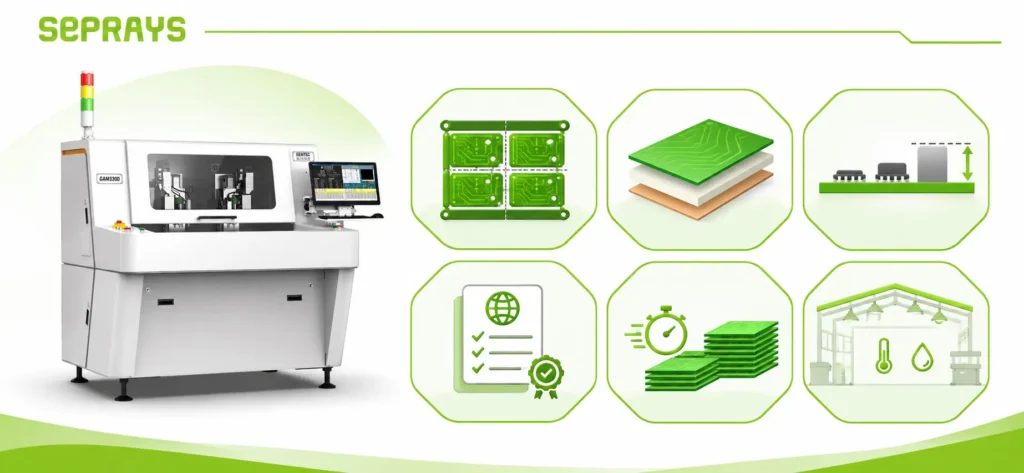
Before contacting suppliers, organize your actual production requirements:
① Panelization Method
② PCB Material
③ Component Layout & Height
④ Industry Standards
⑤ Production Capacity
⑥ Workshop Environment
Gerber / DXF files and actual PCBA samples should also be provided whenever possible. A capable manufacturer should be able to recommend a suitable depaneling process based on your product and verify the result through sample cutting.
2. Compare the Manufacturer’s Core Technical Capabilities
| Core Technology | What to Verify |
|---|---|
| Positioning Accuracy | Ask for the actual cutting-position tolerance and whether it meets your PCBA routing margin. |
| Repeat Accuracy | Check whether multiple identical PCBAs maintain consistent cutting positions during continuous production. |
| CCD Vision System | Check Mark-point recognition, offset detection, automatic correction, and positioning functions. |
| Z-Axis Depth Control | Confirm whether cutting depth remains stable across different PCB thicknesses. |
| Depaneling Stress Control | Ask whether stress testing can be performed and whether actual test results can be provided. |
Do not compare specification-sheet numbers alone. Actual cutting samples, test data, and production cases are more useful for evaluating technical capability.
3. Compare Manufacturer Qualifications and Industry Experience
When evaluating whether a manufacturer is suitable for long-term cooperation, check:
✓ Certifications: ISO, CE, and other relevant certifications;
✓ R&D Capability: Independent engineering teams and patented technologies;
✓ Proprietary Technology: Self-developed software, control systems, or key machine functions;
✓ Industry Experience: Long-term specialization in PCB / PCBA depaneling;
✓ Customers & Reputation: Major customer references, similar-industry cases, and market reputation.
Strong R&D and industry experience are especially valuable for non-standard PCBAs, customized applications, and future equipment upgrades.
4. Compare the Manufacturer’s Service System
PCB router machines are long-term production equipment, so service capability directly affects downtime and production risk.
A complete support system should cover service locations, installation and commissioning, operator training, remote technical support, spare-parts supply, and fault response. For overseas buyers, regional technical support and remote troubleshooting capability are particularly important.
5. Compare Price Last
Price should be evaluated only after technical capability, qualifications, and service have been compared.
If one supplier’s price is significantly lower than comparable machines on the market, carefully examine the core components, accuracy stability, software, spare-parts availability, and after-sales support.
The lowest purchase price does not necessarily mean the lowest long-term operating cost.
6. PCB Router Manufacturer Comparison Table
| Evaluation Item | Manufacturer A | A Notes | Manufacturer B | B Notes | Manufacturer C | C Notes |
|---|---|---|---|---|---|---|
| Process Matching | 5/5 | Custom solution based on actual PCBA | 4/5 | Good standard machine range | 3/5 | Limited customization |
| Sample Cutting | 5/5 | Provides actual samples and test results | 4/5 | Sample cutting available | 2/5 | Only specification data provided |
| Accuracy | 5/5 | CCD + strong repeat accuracy | 4/5 | Good positioning performance | 3/5 | Basic positioning system |
| Stress Control | 5/5 | Stress testing supported | 3/5 | Basic stress evaluation | 2/5 | No clear test data |
| R&D & Certifications | 5/5 | In-house R&D, patents, ISO / CE | 4/5 | Certified with partial in-house development | 3/5 | Limited technical documentation |
| Industry Cases | 5/5 | Strong references across multiple industries | 4/5 | Several relevant customer cases | 2/5 | Few similar applications |
| After-Sales Service | 5/5 | Training, remote support, service network | 4/5 | Remote support and spare parts available | 2/5 | Limited overseas support |
| Price & Long-Term Cost | 4/5 | Higher initial cost, strong long-term value | 4/5 | Balanced purchase and operating cost | 3/5 | Lower price but higher service risk |
| Total Score | 39 / 40 | Strong overall capability | 31 / 40 | Balanced option | 20 / 40 | More risks to verify |
Example only: The scores above are for illustration. Buyers should replace them with actual test results, manufacturer documentation, sample-cutting data, service capability, and commercial information.
7. What Can SEPRAYS Provide?
SEPRAYS can support customers from initial process evaluation through machine selection and production support:
- Process Evaluation: Analyze PCBA structure, Gerber / DXF files, and production requirements;
- Sample Cutting: Verify edge quality, cutting accuracy, dust control, and actual depaneling results;
- R&D and Manufacturing: Provide multiple PCB / FPC depaneling technologies backed by in-house development and manufacturing;
- Service Support: Provide technical and service support through domestic and international service resources.
8. Conclusion
When comparing PCB router machine manufacturers, evaluate process capability, core technology, manufacturer qualifications, service system, and long-term cost instead of focusing only on machine price.
The most reliable method is to let shortlisted manufacturers test your actual PCBA and then compare cutting quality, accuracy, stress performance, and the overall capability of each supplier.
If you are evaluating PCB router machine manufacturers, you can send SEPRAYS your PCBA samples, Gerber / DXF files, and production requirements for process analysis and sample cutting.
9. FAQ
How long can an industrial PCB router machine normally be used?
With proper maintenance, an industrial PCB router machine can remain in service for many years. Long-term reliability mainly depends on spindle condition, motion components, electrical parts, dust control, and maintenance quality.
Does a PCB router machine require daily maintenance?
Basic daily maintenance is recommended, including dust cleaning, router-bit inspection, checking dust extraction, and inspecting fixtures or vacuum components. More detailed maintenance can be performed periodically.
Can one PCB router machine process different PCB products?
Yes. As long as the PCB size, thickness, component height, and routing path remain within the machine’s capability, one machine can process multiple products by changing programs, fixtures, or process parameters.
Does every PCB router machine require a fixture?
No. Some machines use fixtures for stable positioning, while others use vacuum positioning, suction transfer, or fixture-free gripping structures. The best method depends on the PCBA design and machine structure.
Does router depaneling create high mechanical stress?
Router depaneling is generally considered a low-stress mechanical separation method compared with manual breaking or some V-cut processes. Actual stress still depends on PCB fixing, cutting speed, tool condition, and routing path.
Can PCB router machines handle frequent product changeovers?
Yes, especially when the machine supports flexible programming, CCD positioning, easy fixture changes, or fixture-free processing. These configurations are particularly useful for high-mix production.
Email: millie@seprays.com
WhatsApp: +86 139 2552 7370