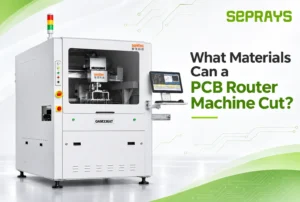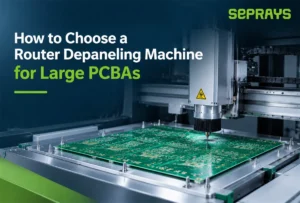

PCB router machines are mainly used for mechanical depaneling of rigid PCBs and PCBAs.
Because different PCB materials vary in hardness, thickness, and structure, the actual cutting process should also be evaluated according to the board design and production requirements.
1. How Do Different PCB Materials Perform in Router Depaneling?
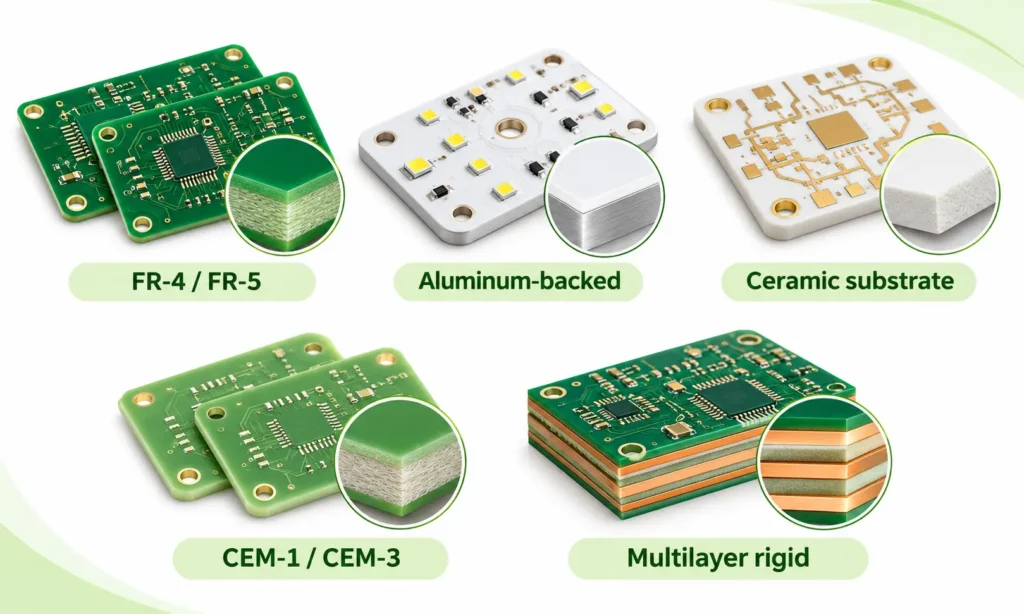
Although several rigid PCB materials can be processed with a PCB router machine, their material properties and cutting requirements are different.
| PCB Material | Characteristics | Cutting Considerations |
|---|---|---|
| FR-4 / FR-5 Fiberglass PCB | Common glass-fiber reinforced rigid PCB material used in a wide range of electronic products | Match the router bit and cutting parameters to the PCB thickness, routing width, and cutting contour |
| Aluminum-Backed PCB | Includes a metal base layer and provides good thermal conductivity | Check the aluminum layer thickness, total PCB thickness, cutting parameters, and router bit wear |
| Ceramic Substrate | Hard material commonly used for thermal management, electrical insulation, and high-temperature applications | Evaluate material hardness, board thickness, and required edge quality; sample cutting is recommended |
| CEM-1 / CEM-3 Composite PCB | Common composite rigid PCB materials with a different structure from FR-4 | Match the router bit, cutting speed, and process parameters to the board thickness and material characteristics |
| Multilayer Rigid PCB | Consists of multiple conductive and insulating layers and may have greater total thickness | Confirm total PCB thickness, cutting depth, and whether the router bit can complete the cutting path consistently |
For these rigid PCB materials, material type alone does not determine the cutting result. The machine configuration and cutting parameters should also match the actual board thickness and product structure.
2. Which PCBs Are Not Recommended for Router Depaneling?
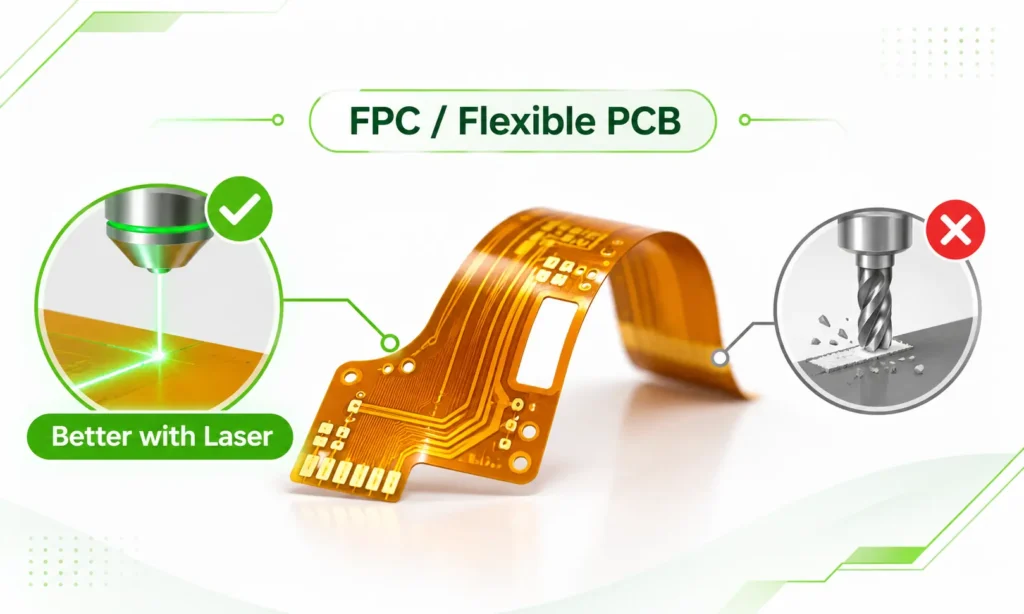
FPC and flexible PCBs are generally not the first choice for mechanical router depaneling.
Because these boards are flexible and may have strict requirements for mechanical stress, narrow cutting gaps, and fine contours, a non-contact cutting process is often more suitable.
For FPC and flexible PCBs, laser depaneling is generally a more suitable option.
3. What Else Should You Check Besides PCB Material?
Even when the PCB material is suitable for router depaneling, stable production still depends on the actual board structure and cutting requirements.
PCB Thickness → Cutting Path → Component Clearance → Router Bit Size → Positioning Accuracy → Edge Quality
These factors determine whether the router bit can access the complete cutting area and whether the machine can achieve the required cutting accuracy, edge quality, and production consistency. Therefore, PCB material should not be the only factor considered when selecting a PCB router machine.
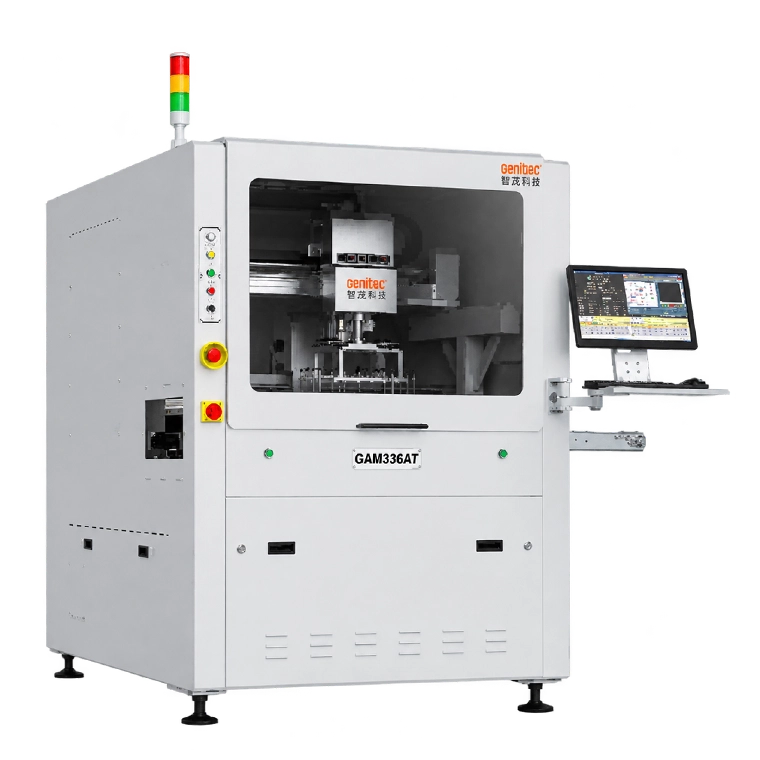
4. SEPRAYS Recommended Machine: GAM336AT
GAM336AT Inline PCB Router Machine
The GAM336AT is an inline automatic PCB router machine designed for rigid PCB and PCBA depaneling applications.
- Supports straight, L-shaped, U-shaped, circular, and arc cutting paths;
- Inline automated production for integration into production lines;
- Dual-table structure to improve loading, unloading, and depaneling efficiency;
- CCD vision positioning for accurate PCB alignment;
- Repeat accuracy: ±0.01 mm;
- Cutting accuracy: ±0.05 mm.
5. Confirm the Cutting Result with Sample Testing
Even two PCBs made from the same material can produce different cutting results because of differences in thickness, routing paths, and component layout. For this reason, testing the actual PCB is more reliable than evaluating the material alone.
Edge Quality → Burrs → Dust → Cutting Accuracy → Tool Wear → Repeatability
A sample test can help confirm whether the cutting result, process parameters, and machine configuration are suitable for mass production.
If you are not sure whether your PCB is suitable for router depaneling, send SEPRAYS your PCB material, thickness, dimensions, Gerber or DXF files, and cutting requirements. We can evaluate the depaneling process and perform sample cutting before machine selection.