
R
ush-order PCB assembly environments frequently face a hard constraint that standard production planning cannot absorb: the depaneling step becomes the sudden bottleneck after assemblies are surface-mounted and reflowed. A typical 250mm × 200mm multi-up panel with six routing-quality scored mouse-bite bridges holds residual stress concentrations of 12–18 N/mm² at the bridge root after full cure of SAC305 solder (peak reflow 245°C ± 5°C). When a production scheduler pulls that panel for depaneling with insufficient tool height clearance or uses a blunt routing bit beyond its 150-hour service window, the measured breakout force at the component row nearest the routing channel can exceed 8.5 N — sufficient to crack a 0.4mm pitch BGA solder joint in a statically indeterminate board region where global substrate bow already consumes 60% of the joint’s fatigue margin. This is the real physics of why emergency rental decisions on depaneling equipment demand rigorous technical criteria, not intuition.
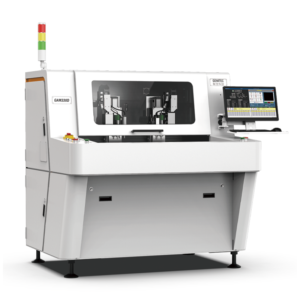
Routing-Based Depaneling: The Dominant Technology for Mixed-Product Environments
CNC routing remains the most widely deployed depaneling method in contract manufacturing facilities processing high-mix, low-to-medium volume runs, precisely because its tool path is programmable and the process window tolerates panel bow up to 0.3% of the longest dimension — a tolerance envelope that covers the vast majority of FR-4 and polyimide constructions after multiple reflow cycles. A standard carbide spiral router bit with a 1.2mm to 2.0mm cutting diameter, spinning at 40,000–60,000 RPM and advancing at 150–300 mm/min along a programmed vector path, removes material by shear along the kerf. The critical performance parameter here is not spindle speed alone but the combination of chip load per tooth (typically 0.02–0.05 mm for FR-4) and the heat dissipation rate at the board surface, which must keep the localized temperature rise below 60°C above ambient to prevent resin softening in the HDI microvia layer adjacent to the routing channel. Facilities processing boards with ≥8-layer stackups and laser-drilled microvias must validate that the routing operation does not introduce delamination at the resin-glass interface within 0.5mm of the kerf edge — a failure mode confirmed by IPC-A-600H acceptance criteria for surface disturbanc and one that is routinely discovered only during ICT or AOI downstream, creating rework costs that negate any rental-cost savings from selecting inadequate equipment.
Laser Depaneling: Precision for Fine-Pitch and Sensitive Assemblies
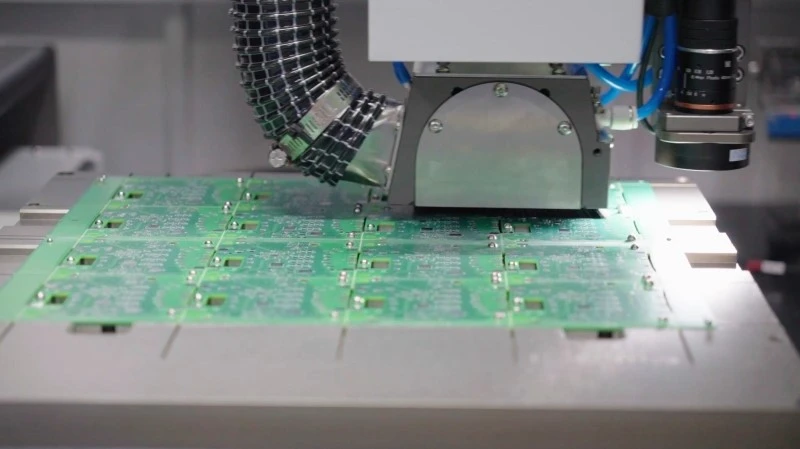
Laser ablation depaneling uses a focused CO₂ or UV laser to vaporize substrate material along a kerf width of 50–100 µm without mechanical contact, which eliminates the principal failure mode of routing-based methods: tool-wear-induced kerf widening and resultant board-edge heat damage. UV lasers operating at 355nm wavelength achieve a heat-affected zone (HAZ) of less than 20 µm adjacent to the kerf in standard FR-4, and the non-contact nature means no mechanical stress is transmitted to adjacent components, which is the decisive advantage when depaneling assemblies with chip components on 0201 metrics or below, placed within 0.8mm of the scoring or routing line. The process feed rate for a 10W UV laser depaneling a 1.6mm-thick FR-4 board is typically 20–60 mm/s along a vector path, producing a kerf depth of 1.6mm ± 0.05mm. For emergency rental scenarios, the critical assessment criterion is whether the available laser system can achieve this kerf depth uniformity across the full panel dimension — panel thermal bow during laser operation can cause focal plane deviations of ±150 µm in unconstrained panels, which directly translates to incomplete penetration or overcutting if the machine lacks real-time autofocus compensation.
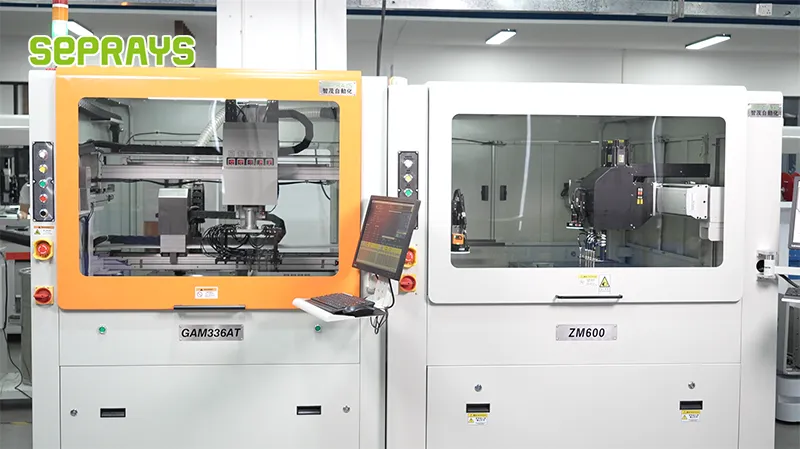
Punching and die-cutting systems occupy a niche but strategically important role in high-volume production environments
Progressive die depaneling using custom-shaped steel rule dies achieves cycle times of 1–3 seconds per strip, with positional accuracy of ±0.05mm at the cutting edge, making it viable only for boards with stable, long-run production volumes exceeding 5,000 panels per SKU. For emergency rental triggered by a rush order with a total quantity under 500 boards, die-cutting is almost never the correct rental decision: the tooling lead time alone (5–10 business days for custom steel rule fabrication) exceeds the typical rush-order window, and the per-board cost amortization fails to recover the tooling investment. However, if the facility has pre-approved flexible dies available in inventory — or can source a universal grid-vane die within 24 hours — the die-cutting route eliminates the overhead of tool path programming and yields the lowest per-board variable cost at volumes above 200 units per panel configuration.
Equipment Selection Criteria for Emergency Rental Assessment
The decision framework for selecting a depaneling method under emergency rental conditions must evaluate five independent technical parameters: board material composition and layer count (determines heat sensitivity and structural rigidity), minimum component-to-edge clearance at the depaneling boundary (determines permissible kerf width and method viability), panel size and post-reflow bow measurement (determines fixturing requirements), production volume and required throughput (determines whether per-cycle time or per-unit cost dominates), and the electrical test coverage plan for the finished assemblies (determines acceptable risk level for latent defects introduced during depaneling). A facility can perform a rapid bow measurement using a 3D laser profilometer in under 60 seconds per panel; the resulting bow magnitude and symmetry data directly inform whether a routing machine with vacuum fixturing can achieve the required positional accuracy or whether the process must migrate to a non-contact laser system that tolerates larger bow without requiring board re-lamination to a subfixture. This five-parameter assessment, completed in under 30 minutes with standard in-line metrology equipment, replaces the common but costly practice of renting the cheapest available machine and discovering during production that the process window does not close.
Rental Risk Mitigation: Validation Protocols Before Production Release
Before committing a rush-order production run to any rented depaneling equipment, the facility engineering team must execute a validation sequence comprising: a first-piece dimensional check at three points along each depaneled board edge using a calibrated profile projector (acceptance criterion: ±0.08mm from Gerber-defined board outline), a cross-sectional analysis of the depaneling kerf at 40× magnification to confirm absence of delamination, measling, or heat-induced resin recession within the 0.5mm exclusion zone defined by IPC-A-600H Section 2.3.7, and a minimum 10-board mechanical stress test using a 3-point bend fixture at 50% of the IPC/JEDEC-9702 board-level bending limit to confirm that depaneling operations have not initiated latent microcracks in via structures or high-density signal routing near the board edge. Failure to complete this validation sequence on a rush-order production run is the single most significant predictor of a field failure incident attributable to depaneling-induced damage, and the associated cost of a customer return with root cause traced to a depaneling defect typically exceeds the total rental cost of the equipment by a factor of 8–15× when warranty, logistics, and reputational exposure are fully accounted for.
Technical Summary
Effective depaneling equipment selection for emergency rental conditions is not primarily a commercial decision but a process capability matching exercise that must account for the residual stress state of post-reflow assemblies, the thermal and mechanical sensitivity of components near the depaneling boundary, and the dimensional accuracy envelope demanded by the board’s end-use application. Routing-based systems provide the broadest material and geometry flexibility but require validated tool condition monitoring and fixturing protocol; laser systems offer superior edge quality and minimal HAZ at the cost of lower throughput and higher per-minute rental rates; die-cutting delivers the fastest cycle times but is economically viable only at sustained volume. The five-parameter technical assessment framework — completed in under 30 minutes — is the minimum rigor required to ensure that an emergency rental decision does not trade a schedule risk for a quality risk of equal or greater magnitude.
Recommended Equipment
Looking for proven depaneling solutions? Seprays offers a full range of equipment backed by 30+ years of industry experience. Here are two options worth considering for your production line:
- GAM 340AT In-Line Automatic PCB Router Machine — Dual workbench with auto-focus vision camera — maximizes throughput for inline SMT integration
- PCB/FPC Stamping Type Board Separation Machine — Handles PCB, FPC flexible, and rigid-flex boards — versatile stamping depaneling solution
Frequently Asked Questions
I don’t see the article “Decision Process for Emergency Rental of Depanelers for Rush Orders” in our conversation. Could you please paste the article content or provide the file/path where it’s located? Once I have the article text, I’ll generate exactly 3 practical Q&A pairs in the HTML format you specified.
About Seprays
About Seprays Precision Machinery
Founded in 1993, Seprays has over 30 years of expertise in PCB depaneling solutions. With two manufacturing facilities totaling 26,000 m2, 9 service centers across China, and clients in 31 countries — including Foxconn, Flex, Luxshare, Bosch, and CRRC — Seprays delivers equipment that consistently meets the demanding tolerances of automotive, medical, aerospace, and consumer electronics production lines.
Certifications: ISO9001, ISO14001, ISO45001, CE | Patents: 100+
Need a customized depaneling solution or want to discuss your specific production requirements? Our technical team is ready to help.
Contact: jimmy@seprays.com