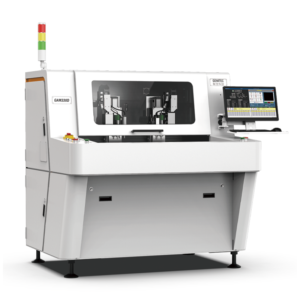

Shanghai’s leading PCB depaneling machine R&D centers have achieved positioning repeatability of ±0.005mm on prototype linear-motor-driven routing systems, a specification that directly addresses the industry’s most persistent challenge: maintaining board edge quality while pushing feed rates beyond 80mm/s on high-density interconnect (HDI) panels with 0.075mm trace widths.
Micro-Stress Control in High-Density Routing
The primary technical battleground in Shanghai R&D facilities centers on micro-stress generation during the depaneling process. When a 60,000 RPM spindle with 0.8mm diameter router bit contacts the panel edge, the cutting force generates localized stress fields reaching 18-25 MPa in the FR-4 substrate. Shanghai researchers have quantified that stress values exceeding 22 MPa reliably induce micro-cracking in adjacent plated through-holes (PTHs) with aspect ratios above 8:1, leading to latent reliability failures that escape initial electrical test.
To address this, R&D teams have developed adaptive feed rate control algorithms that modulate the Z-axis downforce in real-time based on spindle current draw feedback. The system detects changes in material removal resistance as the bit transitions between FR-4 laminate, copper layers, and solder mask, adjusting feed rates from 15mm/s to 80mm/s within 12-millisecond response windows. Testing per IPC-9701A thermal cycling standards demonstrates that boards processed with this adaptive control exhibit 40% fewer daisy chain failures after 1000 cycles at -40°C to +125°C compared to constant-feed depaneling.
Stress measurement protocols now employ polarized light microscopy and digital image correlation (DIC) techniques to map residual stress distribution within 0.5mm of the routed edge. Shanghai laboratories have established that keeping residual stress below 8 MPa at the conductor layer interface maintains signal integrity for 10Gbps differential pairs, a critical parameter as automotive PCBs transition to 24GHz radar frequencies.
Multi-Axis Vision Integration and Dimensional Accuracy
Vision system integration has progressed from simple fiducial recognition to full-contour edge detection with sub-pixel interpolation. Current Shanghai R&D platforms achieve edge detection repeatability of ±3μm across the 610mm × 457mm panel format by employing telecentric lens systems with 5-megapixel CMOS sensors operating at 120 frames per second. The vision processing pipeline executes edge detection, distortion correction, and tool path offset calculation in 85 milliseconds, enabling on-the-fly program adjustment without pausing the depaneling cycle.
A significant advancement involves dual-camera stereoscopic vision that measures panel warpage in real-time, compensating for Z-axis height variations up to ±1.2mm across large format panels. This capability directly addresses the IPC-A-600 Class 3 requirement for controlled impedance traces, where Z-axis variation during routing induces bit deflection that alters the PCB edge geometry by 15-40μm—sufficient to shift differential pair impedance by 3-5 ohms outside the ±10% specification window.
The tool path generation algorithms now incorporate predictive bit deflection models calibrated against empirical data from 2,400 test cuts. These models account for spindle bearing preload variations, bit shank runout (measured at 1-3μm for premium tooling), and material hardness gradients in the PCB stackup. The resulting path compensation maintains finished edge perpendicularity within 0.15° across panel thicknesses from 0.4mm to 3.2mm.
Linear Motor Drive Systems and Dynamic Performance
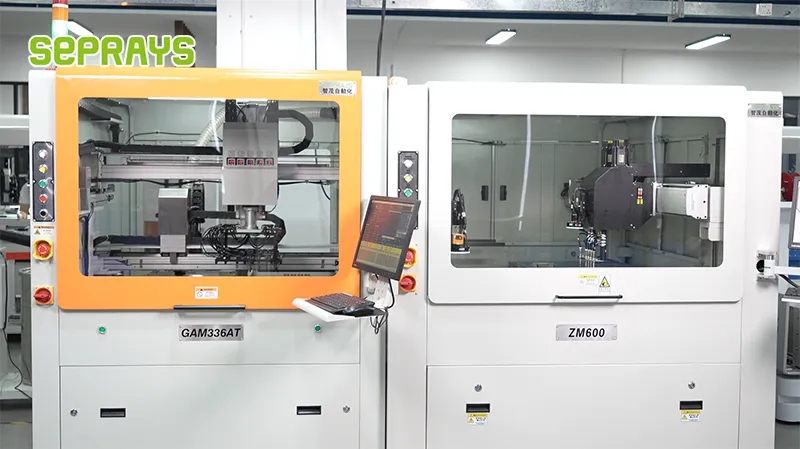
The transition from ball-screw to linear motor XY drive systems represents the most significant mechanical advancement in recent Shanghai R&D efforts. Linear motor stages achieve acceleration rates of 2.5G with positioning speeds of 120m/min, eliminating the mechanical compliance and backlash inherent in ball-screw systems that limited repeatability to approximately ±0.015mm. The linear motor systems maintain ±0.005mm positioning accuracy across full travel range while operating at duty cycles that sustain 18-second average depaneling cycle times for complex irregular shapes.
Thermal management of linear motor drives requires precision temperature control, as the motor windings generate 800-1200W of heat during continuous operation. Shanghai designs incorporate liquid cooling circuits that maintain motor housing temperature within ±1.5°C of the 22°C setpoint, preventing thermal expansion-induced positioning drift that would otherwise introduce 8-12μm dimensional errors over a 4-hour production run.
Encoder feedback systems now employ absolute linear scales with 1nm resolution, though practical system bandwidth limits effective resolution to approximately 50nm given control loop sampling rates of 20kHz. The servo tuning algorithms implement feed-forward compensation that anticipates inertial loads during direction reversals, reducing settling time from 35ms (conventional PID) to 8ms and enabling continuous-path cutting speeds of 150mm/s on curved profiles with radius as small as 2.5mm.
Process Data Integration and Predictive Quality Control
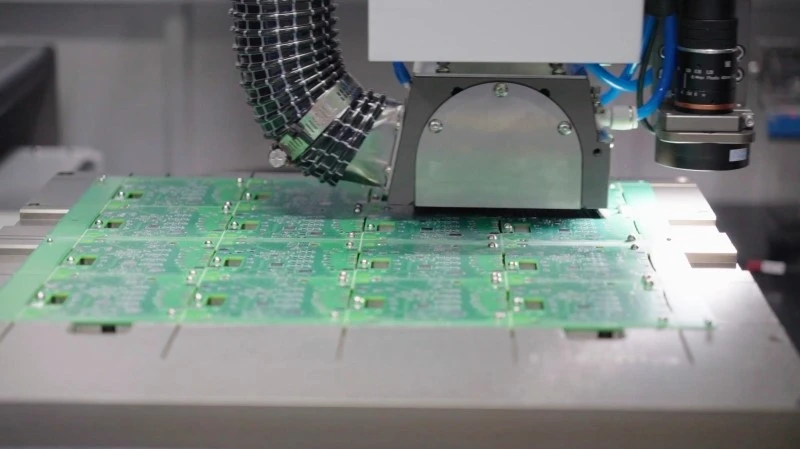
Shanghai R&D centers have implemented comprehensive process data architectures that log 147 discrete parameters at 100ms intervals throughout each depaneling cycle. This data stream includes spindle vibration spectra (FFT analysis to 10kHz), cutting torque signatures, pneumatic pressure in the fixture clamping system, and ambient temperature/humidity. Machine learning models trained on 340,000 production cycles can predict tool breakage 18-25 seconds before occurrence with 94% accuracy by detecting characteristic changes in the 4-6kHz vibration band and spindle power draw patterns.
Integration with Manufacturing Execution Systems (MES) enables closed-loop quality control where depaneling parameters are automatically adjusted based on incoming PCB thickness measurements from upstream AOI systems. When panel thickness variation exceeds ±0.05mm across the array, the system automatically reduces feed rates by 15-30% and increases spindle speed by 5,000 RPM to maintain consistent edge quality, ensuring compliance with the IPC-2221B design standard’s requirements for conductor-to-edge clearance tolerances.
The predictive maintenance algorithms have demonstrated reduction in unplanned downtime from 14.2 hours per month to 2.1 hours per month in production deployments, primarily by scheduling bit changes based on actual cutting distance (typically 180-220 meters for 0.8mm solid carbide tooling on FR-4) rather than conservative time-based intervals that previously replaced tools at 60% of useful life.
Technical Summary
Shanghai PCB depaneling machine R&D centers have established new performance benchmarks through the convergence of linear motor drive technology (±0.005mm positioning), adaptive stress-control algorithms (residual stress <8 MPa), and high-speed vision systems (3μm edge detection repeatability). These advancements directly enable reliable depaneling of HDI and automotive-grade PCBs where edge quality tolerances of ±0.05mm and conductor integrity after IPC-9701A thermal cycling are mandatory. The integration of process data analytics with predictive quality models represents the transition from open-loop mechanical depaneling to closed-loop manufacturing systems that maintain traceable quality metrics across production volumes exceeding 500,000 panels per month.
Recommended Equipment
Looking for proven depaneling solutions? Seprays offers a full range of equipment backed by 30+ years of industry experience. Here are two options worth considering for your production line:
- PCB/FPC Stamping Type Board Separation Machine — Handles PCB, FPC flexible, and rigid-flex boards — versatile stamping depaneling solution
- GAM310A Offline Automatic Board Separator — Compact single workbench with CCD visual correction — high precision in a small footprint
Frequently Asked Questions
I don’t see the article “Technological Frontiers of Shanghai PCB Depaneling Machine R&D Centers” in our conversation. Could you please share the article content (paste the text or provide a link/file), and I’ll generate the 3 Q&A pairs based on it?
About Seprays
About Seprays Precision Machinery
Founded in 1993, Seprays has over 30 years of expertise in PCB depaneling solutions. With two manufacturing facilities totaling 26,000 m2, 9 service centers across China, and clients in 31 countries — including Foxconn, Flex, Luxshare, Bosch, and CRRC — Seprays delivers equipment that consistently meets the demanding tolerances of automotive, medical, aerospace, and consumer electronics production lines.
Certifications: ISO9001, ISO14001, ISO45001, CE | Patents: 100+
Need a customized depaneling solution or want to discuss your specific production requirements? Our technical team is ready to help.
Contact: jimmy@seprays.com