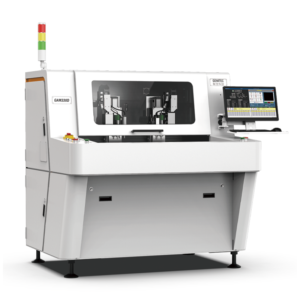

When emergency rework boards require depaneling with component placement densities exceeding 85% and board edge clearances below 3.0mm, automated routing induces pad cratering failures exceeding 1500με microstrain, necessitating manual depaneling intervention. In typical SMT line emergency scenarios, production stops occur at rates of 2-5 incidents per 1000 boards, with manual depaneling serving as the primary recovery method when automated equipment cannot accommodate boards with non-standard tooling holes, missing fiducials, or damaged lead-in/lead-out routing paths.
Stress Distribution and Mechanical Relief in Manual Depaneling
Manual depaneling operations for emergency rework boards must maintain cutting forces below 15N to prevent solder joint fractures at the component-to-PCB interface. V-score depaneling using manual V-cut separators applies a controlled bending moment across the score line, typically achieving stress levels of 400-800με in adjacent components when the operator maintains a feed rate between 50-100mm/second. The critical parameter is the V-score residual thickness, which must be controlled to 0.3-0.5mm (±0.05mm tolerance) to ensure clean separation without excessive force. For FR-4 boards with thickness of 1.0-1.6mm, manual depaneling with pneumatic assist reduces operator-applied force by 60-70% compared to purely manual lever systems, with pneumatic pressure regulated to 0.4-0.6MPa to prevent board warp exceeding 2.0mm/m.
Stress wave propagation during manual snap-off depaneling reaches peak amplitudes of 12-18MPa within 0.5-1.0ms of fracture initiation. IPC-9701 Class 2 and Class 3 assemblies require verification that depaneling-induced stress remains below the 1000με threshold for BGAs and 1500με for chip components (0402 and larger). Manual depaneling with properly maintained blade sharpness (surface roughness Ra < 0.8μm) reduces stress concentration factors by 30-40% compared to dull blades, which create micro-cracks at the V-score tip that propagate under thermal cycling stress in field operation.
Dimensional Accuracy and Tooling Considerations for Irregular Boards
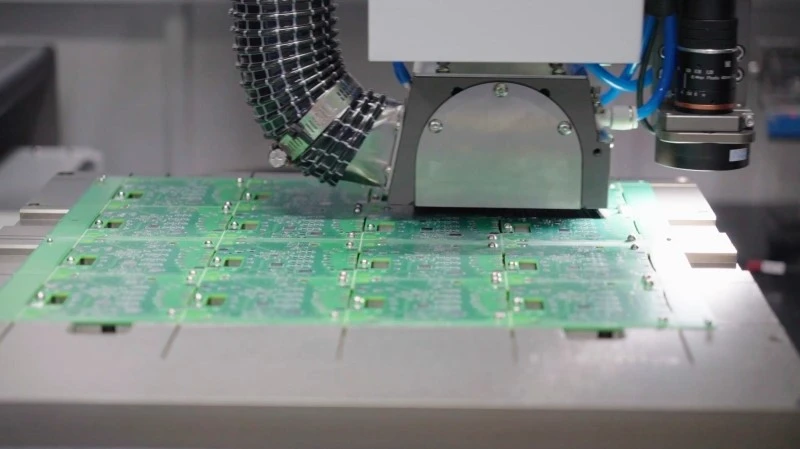
Emergency rework boards frequently deviate from standard panelization geometries, with missing break-away rails, damaged mouse bites, or incomplete routing passes creating non-standard edge conditions. Manual depaneling routers operating at 40,000-60,000 RPM with 0.8-1.5mm diameter carbide end mills achieve cut tolerances of ±0.10mm when operators use optical positioning aids with 10× magnification. Feed rates must be reduced to 5-15mm/second for manual routing of boards containing components within 5.0mm of the depaneling path, as higher feed rates generate cutting temperatures exceeding 180°C that damage adjacent solder mask and delaminate the PCB substrate.
For boards with component heights exceeding 25mm on the underside, manual depaneling requires custom fixture cutouts with positioning tolerances of ±0.15mm to prevent component collision during the depaneling stroke. Fixture wear allowances must be monitored, as clearance increases beyond 0.20mm result in board movement during cutting that degrades edge quality to surface roughness values exceeding Ra 6.3μm. IPC-A-600 Class 2 acceptance criteria require edge finish roughness below Ra 3.2μm for plated-through-hole applications and below Ra 6.3μm for non-critical edge profiles.
Process Control and Quality Assurance for Emergency Rework
Manual depaneling of emergency rework boards requires 100% visual inspection under 5× magnification to detect delamination, fiber exposure, or copper exposure at the cut edge. Destructive cross-section analysis per IPC-TM-650 Method 2.1.1 must be performed on the first article and at minimum every 25 boards for emergency rework batches, measuring resin smear thickness (must be <5μm after desmear), glass fiber exposure length (must be <0.10mm), and edge straightness (deviation <0.15mm over 100mm length). Manual depaneling generates considerably more edge raggedness than automated systems, with typical edge deviation of ±0.20mm compared to ±0.05mm for CNC routing.
Cut quality correlates directly with tool wear. Carbide router bits in manual depaneling machines require replacement after 150-200 linear meters of FR-4 cutting, or when edge burnishing exceeds 0.3mm width. For aluminum-backed PCBs commonly used in LED emergency rework, manual depaneling with diamond-coated blades operating at 20,000-30,000 RPM achieves acceptable edge quality with burr heights below 0.10mm. Aluminum substrates require flooded coolant delivery at 2-4 L/min to prevent chip recutting and edge galling that degrades insulation resistance below the 10^8 ohm-cm threshold specified in IPC-4101.
Operator Technique and Repeatability Limitations
Manual depaneling repeatability depends heavily on operator skill and ergonomic conditions. Trained operators achieve positional repeatability of ±0.25mm for router bit positioning, degrading to ±0.50mm after 4 hours of continuous operation due to muscle fatigue. Proper technique requires maintaining perpendicular tool approach within ±2 degrees to prevent angled cuts that reduce PCB effective width below minimum electrical clearance requirements. Feed force must be maintained constant within ±20% variation; force spikes exceeding 25N cause immediate micro-cracking audible as high-frequency acoustic emission signals above 40kHz.
Boards requiring manual depaneling often exhibit warpage from previous reflow exposure exceeding 3.0mm over 100mm span. Clamping force for such boards must be increased to 40-60N to prevent vibration-induced cutting chatter, but must not exceed 80N to avoid component damage from board flexure. IPC-9641 provides guidelines for depaneling stress evaluation, recommending strain gauge validation for any manual depaneling process introduction, with acceptance criteria of zero solder joint failures after 500 temperature cycles from -40°C to +125°C.
Technical Summary
Manual depaneling for emergency rework boards provides essential process flexibility when automated systems cannot accommodate non-standard panel geometries, damaged tooling features, or urgent turnaround requirements below 30 minutes. Successful implementation requires strict control of cutting forces below 15N, spindle speeds matched to material thickness and composition, and validated tooling with positional tolerances maintained within ±0.15mm. Stress induction must be verified to remain below 1000με for BGA components and 1500με for discrete passives through strain gauge testing per IPC-9701. Cut edge quality must satisfy IPC-A-600 Class 2 or Class 3 requirements with surface roughness below Ra 3.2μm and delamination-free edges verified by 5× magnification inspection and periodic cross-section validation. Process capability depends on operator training, tool maintenance intervals of 150-200 linear meters for carbide tooling, and environmental controls that minimize board warpage and moisture absorption prior to depaneling operations.
Recommended Equipment
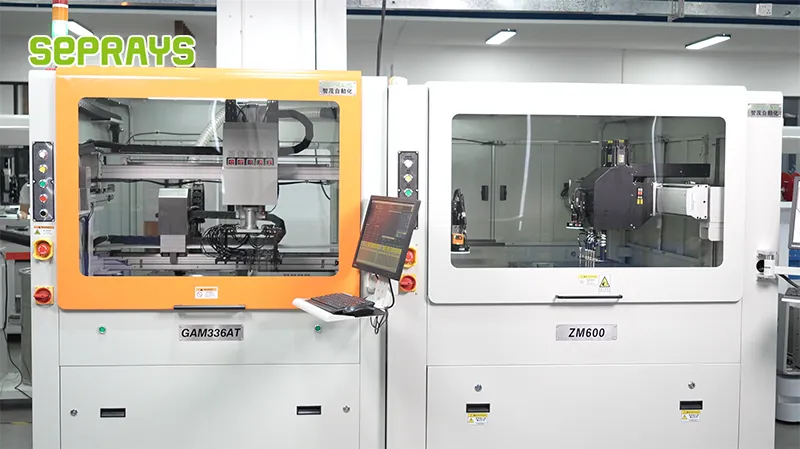
Looking for proven depaneling solutions? Seprays offers a full range of equipment backed by 30+ years of industry experience. Here are two options worth considering for your production line:
- GAM310A Offline Automatic Board Separator — Compact single workbench with CCD visual correction — high precision in a small footprint
- GAM330AT Fully Automatic PCB Depaneling Machine — Self-feeding operation with automatic sorting — ideal for high-volume automated production lines
Frequently Asked Questions
I don’t see the article content in our conversation. Could you please provide the article about “Manual Depaneler Usage Scenarios for Emergency Rework Boards” so I can generate the Q&A pairs based on its content?
About Seprays
About Seprays Precision Machinery
Founded in 1993, Seprays has over 30 years of expertise in PCB depaneling solutions. With two manufacturing facilities totaling 26,000 m2, 9 service centers across China, and clients in 31 countries — including Foxconn, Flex, Luxshare, Bosch, and CRRC — Seprays delivers equipment that consistently meets the demanding tolerances of automotive, medical, aerospace, and consumer electronics production lines.
Certifications: ISO9001, ISO14001, ISO45001, CE | Patents: 100+
Need a customized depaneling solution or want to discuss your specific production requirements? Our technical team is ready to help.
Contact: jimmy@seprays.com