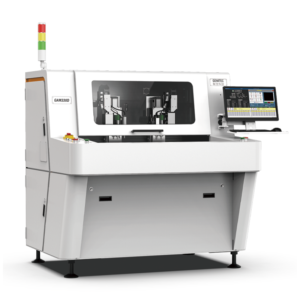

A standard V-cut groove depth of 1/3 the board thickness on a 1.6mm FR-4 panel leaves only 0.53mm of material at the web — a margin that demands sub-0.05mm positioning accuracy from any depaneling system to avoid tearing copper layers near the score line. This geometric constraint alone explains why V-scored panels and non-V-scored (routing-tab or tab-routed) panels require fundamentally different depaneling strategies, tooling approaches, and process windows.
V-Cut Geometry and Its Impact on Stress Distribution
V-scoring creates a predefined fracture plane by removing material from both sides of the board in a V-shaped profile, typically at a 30-degree to 45-degree included angle. The remaining web thickness is the critical parameter — for a 1.6mm panel with symmetrical scoring at 1/3 depth per side, the web is approximately 0.53mm; for 0.8mm panels, this drops to roughly 0.27mm. The primary advantage is that the score line acts as a stress concentrator, directing the separation force along a predictable path with minimal lateral stress propagation. However, the thin web also means that mechanical stress from the depaneling blade — typically a rotary circular blade operating at 30,000 to 45,000 RPM — concentrates at the apex of the V, creating bending moments that can delaminate inner copper layers if the blade alignment deviates by more than ±0.05mm from the score centerline. IPC-6012 Class 2 and Class 3 specifications require that depaneling-induced damage to copper or laminate remain within defined acceptability limits, which effectively sets the process window for V-score depaneling at a blade-to-score alignment tolerance of ±0.05mm or tighter.
Non-V-Scored Panels: Tab-Routed Separation Mechanics
Panels without V-cut grooves — commonly referred to as tab-routed or mouse-bite panels — rely on narrow bridges or tabs of remaining material, typically 2.0mm to 5.0mm wide, connecting individual boards within the array. These tabs must be cut entirely through using either a milling spindle or a punching mechanism. Routing-based depaneling employs end mills of 1.0mm to 2.0mm diameter rotating at 40,000 to 80,000 RPM, with feed rates between 10mm/s and 50mm/s depending on material stack-up and tool wear state. The key challenge with tab-routed panels is that the cutting tool must fully sever the remaining FR-4 and internal copper layers without generating excessive heat or mechanical vibration that propagates into the board area. Because there is no pre-defined fracture plane like a V-score, the cutting path must be precisely programmed to follow the tab outline, and any deviation introduces the risk of cutting into the board edge or leaving burrs on the routed edge. Typical edge quality requirements call for burr heights below 0.1mm and delamination not exceeding 0.5mm from the cut edge per IPC-A-600 criteria.
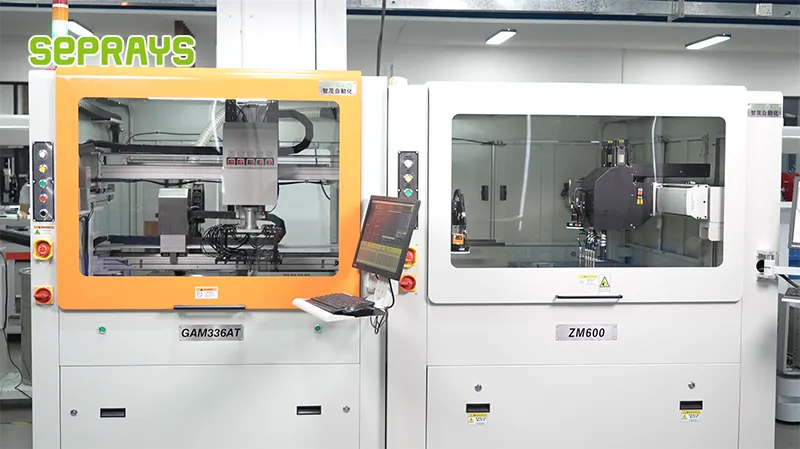
Mechanical Stress Comparison and Failure Modes
The two panel geometries generate markedly different stress profiles during separation. V-score depaneling produces a predominantly bending stress concentrated along the score line, with peak stresses reaching 80-120 MPa at the web apex during blade contact. This bending mode can cause micro-cracking in brittle ceramic components placed within 3mm of the score line, and it may induce warpage exceeding 0.5mm across a 100mm board dimension if the panels are not adequately supported during separation. Non-V-scored tab routing, by contrast, introduces localized shear and compressive stresses at the cutting zone, with peak values of 150-250 MPa at the tool-workpiece interface. These higher localized stresses create a different failure profile: they tend to cause fiber pull-out on the routed edge, copper peel-back at internal layer transitions, and component cracking through direct vibration transmission rather than bending. Vibration amplitude during routing typically measures 2-5 G at the board surface near the cutting zone, compared to 0.5-1.5 G during V-score blade pass-through.
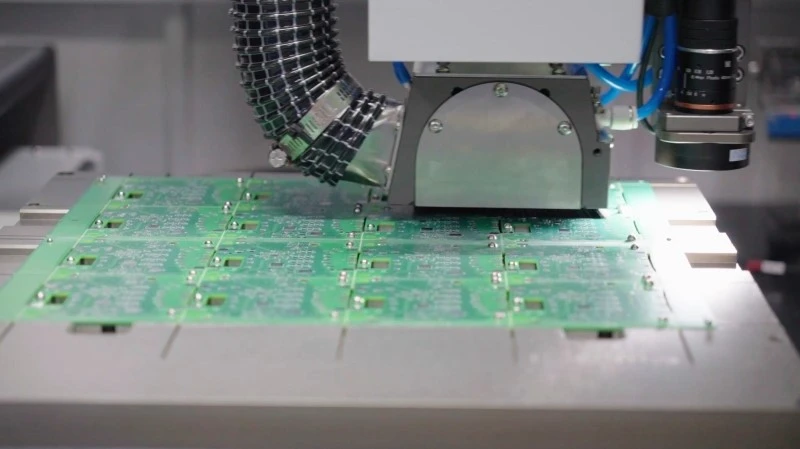
Process Control and Equipment Selection Considerations
Selecting the appropriate depaneling method requires matching equipment capabilities to panel geometry. V-score panels are well-suited to linear blade systems — either manual pull-through units for low-mix/high-volume production or automated inline blade systems for volume manufacturing. These systems achieve throughput of 300 to 600 boards per hour with cycle times under 2 seconds per panel, making them the preferred choice when the V-score geometry is consistent across the product line. For non-V-scored panels, routing-based systems are mandatory, and the equipment must provide closed-loop positioning accuracy of ±0.025mm or better to maintain cut-path fidelity across the tab. Vision alignment systems using fiducial recognition are standard, with typical registration accuracy of ±0.02mm. Dust extraction is a critical secondary consideration for routing: FR-4 dust particles generated at 40,000+ RPM can re-deposit on exposed contacts and create electrical insulation failures, so vacuum flow rates of 2.0-3.5 m³/min at the cutting head are standard requirements. V-score depaneling generates significantly less airborne particulate since the material is fractured rather than milled, typically reducing dust generation by 80-90% compared to routing operations.
Summary
V-scored panels offer faster separation speeds, lower dust generation, and a self-guiding fracture plane — but they impose strict constraints on component placement proximity and web-thickness uniformity, with alignment tolerances tighter than ±0.05mm required to prevent copper delamination. Non-V-scored tab-routed panels demand full-thickness cutting with high-speed spindles at 40,000-80,000 RPM, producing higher localized stresses of 150-250 MPa and significantly more airborne particulate, but they accommodate irregular board shapes and permit components closer to the panel boundary. The choice between these approaches is not merely a tooling decision — it is a structural and mechanical trade-off that directly affects yield, board-level reliability, and downstream inspection costs.
Recommended Equipment
Looking for proven depaneling solutions? Seprays offers a full range of equipment backed by 30+ years of industry experience. Here are two options worth considering for your production line:
- GAM 340AT In-Line Automatic PCB Router Machine — Dual workbench with auto-focus vision camera — maximizes throughput for inline SMT integration
- ZM30-D Multi-Tool Multi-Group PCB Depaneling Machine — One-time full LED board cutting — daily output exceeding 100,000 pieces with custom configurations
Frequently Asked Questions
## Depaneling Scenario Differences Between V-Scored and Non-V-Scored Panels
### Introduction to Panel Types
In modern electronics manufacturing, PCB panels arrive at the depaneling stage in two primary configurations: V-scored panels and non-V-scored panels (commonly using tab-routing or邮票孔/breakaway mouse bite connections). The depaneling method selection fundamentally impacts throughput, edge quality, and final assembly yield. Understanding the scenario-based differences between these panel types enables process engineers to optimize equipment parameters and reduce rework rates.
### V-Scored Panel Characteristics
V-scoring involves cutting a partial-depth groove (typically one-third to one-third of board thickness) along all panel separation paths during the routing stage. This creates predetermined fracture lines where boards separate cleanly upon mechanical or thermal activation.
The primary depaneling scenario for V-scored panels involves push-pull or_router separation mechanisms. Equipment must deliver consistent force application at the score line, typically maintaining a separation speed between 15mm/s and 40mm/s depending on material thickness and glass transition temperature. The allowable displacement tolerance at the separation point is ±0.05mm to prevent pad damage on fine-pitch components located within 3mm of the panel edge. IPC-A-610 specifies that post-depanel inspection shall verify no cracks extending beyond 0.5mm from the score edge.
### Non-V-Scored Panel Characteristics
Non-V-scored panels rely on either tab-routed connections (partially cut tabs left as breakaway points) or mouse bite tabs (small perforation patterns). These panels require the depaneling equipment to physically cut through connection material while controlling burring and delamination.
The critical parameter difference here involves the cutting stress distribution. Tab-routed connections experience concentrated shear stress during separation; router speed must decrease to 8,000 to 15,000 RPM with a feed rate of 150mm/s to 300mm/s to minimize burring height below 0.1mm. For mouse bite configurations, the breakaway tabs provide stress concentration points, allowing slightly higher feed rates but requiring precise force calibration to avoid tab remnants exceeding 0.15mm in height.
### Scenario-Specific Considerations
When evaluating depaneling scenarios, engineers must consider component proximity to separation lines. V-scored panels permit closer component placement (2mm minimum from score line per IPC-7525 stencil guidelines) because the fracture propagates predictably along the groove. Non-V-scored panels require larger keep-out zones (3mm minimum) due to vibration and mechanical transfer during tab separation.
Thermal considerations differ significantly between methods. V-score separation generates minimal heat (under 2°C rise at the separation interface), while router-through depaneling of tab connections produces localized thermal spikes of 15°C to 30°C, potentially affecting adjacent temperature-sensitive components such as electrolytic capacitors or certain LED configurations.
—
Q1: What critical equipment parameter must be adjusted when switching from V-scored to tab-routed panel depaneling, and why?
A1: Spindle RPM must decrease significantly when processing tab-routed panels—typically from 20,000-30,000 RPM (suitable for V-score separation) down to 8,000-15,000 RPM—because tab connections require the router to actually cut through material rather than follow a pre-scored fracture line. The lower RPM reduces cutting stress and controls burring height below 0.1mm; exceeding this causes tab remnants that violate IPC-A-610 acceptability standards for product cosmesis and functionality.
Q2: How does component keep-out zone distance differ between V-scored and non-V-scored panels, and what IPC standard supports these requirements?
A2: V-scored panels permit minimum 2mm keep-out from the score line (per IPC-7525 stencil guidelines), whereas non-V-scored panels require 3mm minimum clearance from separation points. The additional 1mm for tab-routed or mouse bite configurations accounts for mechanical vibration and stress transfer during breakaway separation, which can propagate micro-cracks in components positioned too close to connection points.
Q3: What thermal impact difference should engineers expect between V-score separation and router-through depaneling of tab connections?
A3: V-score separation generates minimal thermal rise (under 2°C at the fracture interface), making it suitable for thermally sensitive components near panel edges. Router-through depaneling of tab connections produces localized thermal spikes of 15°C to 30°C, which can degrade adjacent electrolytic capacitors, certain LED configurations, or adhesive-bonded components if adequate clearance or cooling measures are not implemented.
About Seprays
About Seprays Precision Machinery
Founded in 1993, Seprays has over 30 years of expertise in PCB depaneling solutions. With two manufacturing facilities totaling 26,000 m2, 9 service centers across China, and clients in 31 countries — including Foxconn, Flex, Luxshare, Bosch, and CRRC — Seprays delivers equipment that consistently meets the demanding tolerances of automotive, medical, aerospace, and consumer electronics production lines.
Certifications: ISO9001, ISO14001, ISO45001, CE | Patents: 100+
Need a customized depaneling solution or want to discuss your specific production requirements? Our technical team is ready to help.
Contact: jimmy@seprays.com