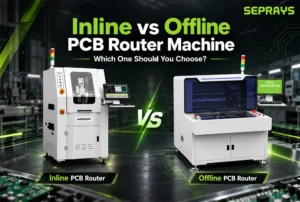

Choosing between an inline and offline PCB router mainly depends on your production flow, output requirements, and level of automation.
Choose an inline PCB router for continuous automated production; choose an offline PCB router when flexibility and frequent product changes are more important.
The comparison below will help you decide which one fits your production line better.
The Main Difference Is Production Flow
Both machines use routing to separate PCBs, but they fit into production differently.
An offline PCB router works as an independent station and usually requires manual loading and unloading, while an inline PCB router connects directly with upstream and downstream equipment so boards can move through the line automatically.
This is why the choice should be based on the whole manufacturing process, not just the cutting function.
IPC’s
IPC-2591 Connected Factory Exchange (CFX)
standard also reflects this trend toward connected manufacturing equipment and standardized factory communication.
When Is an Offline PCB Router Better?
Offline routers are usually a better fit for factories that need flexibility.
They are especially suitable when PCB models change frequently, production is high-mix or batch-based, operators can load boards manually, and the router does not need direct SMT line integration.
The main advantage is easier product changeover and more flexible scheduling.
For EMS factories, sample production, or engineering projects, this can be more practical than full automation.
When Is an Inline PCB Router Better?
Inline routers are more suitable when depaneling needs to become part of a continuous production line.
They are commonly chosen when the factory wants automatic PCB transfer, lower operator involvement, more stable cycle time, connection with upstream and downstream machines, or future MES and traceability integration.
IPC-CFX is relevant here because it supports standardized communication between manufacturing equipment and factory systems.
Inline vs Offline PCB Router: Quick Comparison
| Factor | Inline PCB Router | Offline PCB Router |
|---|---|---|
| Production style | Continuous production | Flexible / batch production |
| Loading | Automatic | Usually manual |
| Operator involvement | Lower | Higher |
| Product change flexibility | Moderate | High |
| SMT line integration | Strong | Limited |
| High-volume production | Strong fit | Possible |
| High-mix production | Possible | Strong fit |
| System complexity | Higher | Lower |
Neither type is automatically better. The right choice depends on how your factory actually runs.
Cycle Time Matters More for Inline Production
For inline production, the router must keep up with the rest of the line.
The real cycle is not just routing time:
If the router is slower than the surrounding equipment, it can become a bottleneck.
That is why actual cycle time based on your PCB panel is more useful than the maximum cutting speed shown in a brochure.
Factory Integration Can Change the Decision
If your factory needs barcode scanning, traceability, MES communication, or production-data collection, inline systems usually provide more room for integration.
IPC-1782 covers manufacturing and supply-chain traceability requirements for electronics production and is especially relevant to industries such as automotive, medical, aerospace, and telecom.
You can review the official document here:
IPC-1782 – Manufacturing and Supply Chain Traceability
.
This does not mean every factory needs these functions today, but future automation plans should be considered before selecting the machine.
A Simple Way to Choose
Choose an offline PCB router if you care more about flexibility, frequent product changes, easier fixture replacement, and standalone operation.
Choose an inline PCB router if you care more about continuous production, automatic board transfer, lower labor involvement, stable takt time, and SMT or MES integration.
If both are important, the final decision should be based on your actual production flow rather than the machine name.
Before asking for a recommendation, it is useful to prepare your PCB panel size, board thickness, routing drawing, target cycle time, product change frequency, and future automation requirements.
Conclusion
The main difference between inline and offline PCB routers is how they fit into production.
Offline routers are better for flexible, high-mix manufacturing, while inline routers are better for continuous automated production.
Instead of comparing only machine specifications, focus on product change frequency, cycle time, labor involvement, and future automation plans.
That will usually lead to a more practical and cost-effective choice.