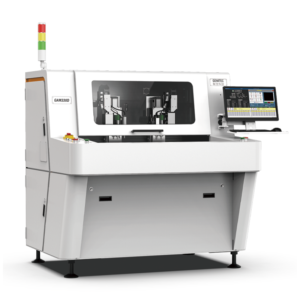

At 60,000 RPM spindle speed with a 2.0 mm solid carbide router bit, the typical tool life against standard 1.6 mm FR-4 ranges from 8,000 to 12,000 mm of cut length, translating to a consumable cost of $0.08–$0.15 per board depending on panel density—a line item rarely surfaced in initial capital equipment quotations.
Tooling Consumable Lifecycle and Replacement Frequency
Router bit wear directly impacts both cut quality and downstream rework costs. High-speed spindles operating at 40,000–80,000 RPM generate localized tip temperatures exceeding 180°C, accelerating tungsten carbide grain pullout when cutting halogen-free or high-Tg substrates. In production environments running 20+ panels per hour, router bit replacement every 3–5 shifts is common, with each bit costing $18–$35 depending on coating (DLC or diamond-like carbon extends life by 40–60% but carries a 2.5× price premium). Beyond the bits themselves, spindle bearing replacement is triggered by tool-change shock and imbalanced tooling; typical mean time between bearing service is 6,000–8,000 hours of spindle runtime, with a rebuild cost ranging from $1,200 to $2,800 per spindle. For a dual-spindle inline depaneling system, this represents an annualized hidden cost of $3,000–$6,000 that does not appear in the initial CAPEX line.
Stress-Induced Defect Costs Buried in Quality Budget
The most significant hidden cost in any depaneling process is stress-related component damage that escapes inline AOI but manifests as field failures. IPC-9701 defines the tolerance threshold for PCB strain: maximum principal strain must remain below 500 µε for SMT components and 1,000 µε for through-hole during depaneling. Poorly calibrated feed rates (exceeding 40 mm/s on wheel-cut systems) or excessive router bit deflection (>0.12 mm at the tool tip) generate localized stress concentrations at V-score corners that exceed 800 µε, creating micro-cracking in buried vias under BGAs. The cost of a single field return on a 12-layer PCBA with a BGA array can exceed $450 in failure analysis, logistics, and replacement—yet quotations for depaneling equipment rarely include strain-gauge validation testing (costing $800–$1,500 per panel type) to certify compliance with IPC-9701 limits. Without this validation, the equipment buyer inherits the risk of an unknown defect rate estimated between 50–200 DPPM for unvalidated cutting parameters.
Programming, Fiducial Teaching, and NPI Changeover Overhead
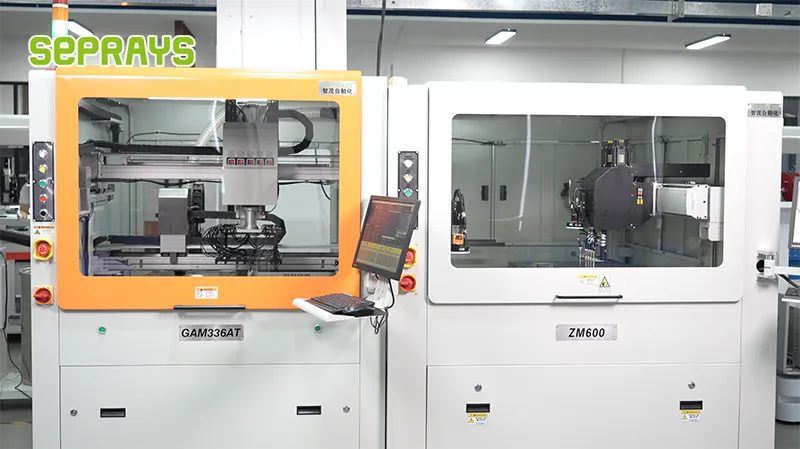
Each new PCB variant requires CAM processing of the depaneling program: importing Gerber data, defining tool paths, setting origin offsets, and teaching fiducial recognition. For systems without offline programming capability, this is done on the machine, blocking production for 45–90 minutes per new panel type. At an average loaded labor rate of $42/hour for SMT process engineers, the NPI cost per new SKU is $32–$63, and high-mix facilities introducing 15–25 new panels per month incur $6,000–$15,000 annually in changeover engineering time. Furthermore, fiducial mark recognition reliability varies with lighting and substrate color; misreads trigger manual intervention, adding 3–8 minutes of downtime per occurrence. Quotations focusing on cycle time (boards/hour) rarely account for this availability loss, which typically reduces effective OEE by 6–12 percentage points in high-mix environments.
Dust Extraction Infrastructure and ESD Compliance Requirements
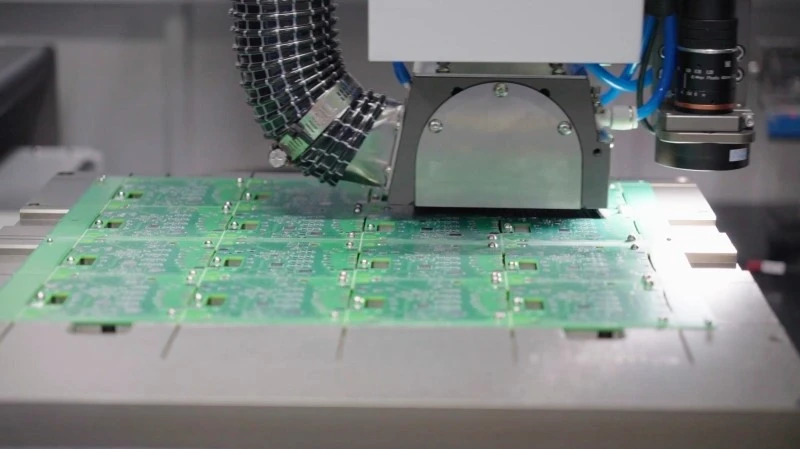
Depaneling generates particulate matter in the 0.5–10 µm range, requiring dust extraction systems capable of maintaining >200 CFM (cubic feet per minute) at the cutting head with a filtration efficiency of 99.97% at 0.3 µm (HEPA 14 equivalent). The hidden capital cost here includes the extraction unit itself ($2,800–$7,500 depending on zone coverage), ductwork installation, and recurring filter replacement ($180–$400 per filter, every 3–6 months under continuous operation). Additionally, IPC-1601 Class 3 assemblies mandate ESD-safe handling throughout depaneling; this requires ionized air knives at the inlet and outlet ($$800–$1,200 each), grounded conveyor surfaces with surface resistance <10^9 Ω/sq, and periodic verification testing. The combined infrastructure cost to bring a "bare" depaneling machine into compliance often reaches 18–25% of the base machine price—a figure systematically excluded from equipment quotations that focus on the machine alone.
Throughput Mismatch and Buffer-Induced Floor Space Costs
Quoted cycle times of “6 seconds per board” assume ideal conditions: no panel warpage, perfect feeder alignment, and continuous upstream supply. In practice, panel warpage exceeding 0.75% bow per IPC-A-600 causes jamming at the infeed, reducing effective throughput by 15–22%. To compensate, production planners add buffer conveyors ($$1,200–$2,800 each) and sometimes a manual inspection station post-depaneling, consuming 8–15 linear feet of SMT line space. At a typical facility cost of $185–$320 per square foot annually, the floor space penalty for accommodating a mismatched depaneling system adds $2,400–$5,800 per year in hidden facility carrying cost. Moreover, when the depaneling system becomes the line bottleneck (common when quoted tact time is <85% of the SMT line's placement rate), the opportunity cost of reduced line throughput can exceed $12,000–$28,000 per month on high-layer-count boards, a systemic cost that only becomes visible after the equipment is installed and the line is operational.
Technical Summary
A PCB depaneling machine quotation that lists only the base equipment price obscures 30–45% of the total cost of ownership over a 5-year lifecycle. The largest hidden exposures are tooling consumables ($3,000–$8,000/year), stress-induced defect risk (uncertified processes carry 50–200 DPPM field failure exposure), NPI changeover engineering ($6,000–$15,000/year in high-mix environments), dust extraction and ESD infrastructure (18–25% of base machine cost), and throughput mismatch penalties including floor space and line balancing losses. A rigorous TCO model should consolidate these into a per-board cost that accounts for spindle RPM-dependent tool life, IPC-9701 strain compliance validation, and real-world OEE rather than nameplate cycle time, enabling an apples-to-apples comparison across equipment options.
Recommended Equipment
Looking for proven depaneling solutions? Seprays offers a full range of equipment backed by 30+ years of industry experience. Here are two options worth considering for your production line:
- GAM330AT Fully Automatic PCB Depaneling Machine — Self-feeding operation with automatic sorting — ideal for high-volume automated production lines
- GAM310A Offline Automatic Board Separator — Compact single workbench with CCD visual correction — high precision in a small footprint
Frequently Asked Questions
Q1: What hidden costs should I look for in a PCB depaneler quotation that vendors typically exclude from the base price?
A1: Base quotations often exclude annual maintenance contracts (typically 8-12% of initial CAPEX), custom fixture tooling ($2,000-5,000 per unique board design), and software license renewals for offline programming suites. Additionally, spindle replacement costs (every 2,000-3,000 operating hours at $1,500-4,000 per spindle) and dust collection system integration are frequently omitted from initial quotes.
Q2: How do routing-based depanelers compare to laser depaneling systems in terms of hidden operational costs?
A2: Router systems incur ongoing bit replacement costs ($50-150 per carbide bit, replaced every 10,000-15,000 cuts) and generate mechanical stress that can increase scrap rates by 0.3-0.8% due to micro-cracking. Laser systems eliminate tooling wear and mechanical stress but require nitrogen assist gas (continuous OPEX of $200-500/month) and annual laser source re-calibration costing $3,000-8,000.
Q3: Are there facility-related hidden costs I should account for when installing a new PCB depaneler?
A3: Yes, HVAC upgrades are often required to manage heat from high-RPM spindles (18,000-60,000 RPM) and laser systems, adding $5,000-15,000 in electrical infrastructure. Vibration isolation foundations for precision router systems can cost $3,000-8,000 to prevent tool chatter affecting cut quality, and compliant dust collection with HEPA filtration adds $4,000-12,000 depending on IPC Class 2/3 cleanliness requirements.
About Seprays
About Seprays Precision Machinery
Founded in 1993, Seprays has over 30 years of expertise in PCB depaneling solutions. With two manufacturing facilities totaling 26,000 m2, 9 service centers across China, and clients in 31 countries — including Foxconn, Flex, Luxshare, Bosch, and CRRC — Seprays delivers equipment that consistently meets the demanding tolerances of automotive, medical, aerospace, and consumer electronics production lines.
Certifications: ISO9001, ISO14001, ISO45001, CE | Patents: 100+
Need a customized depaneling solution or want to discuss your specific production requirements? Our technical team is ready to help.
Contact: jimmy@seprays.com